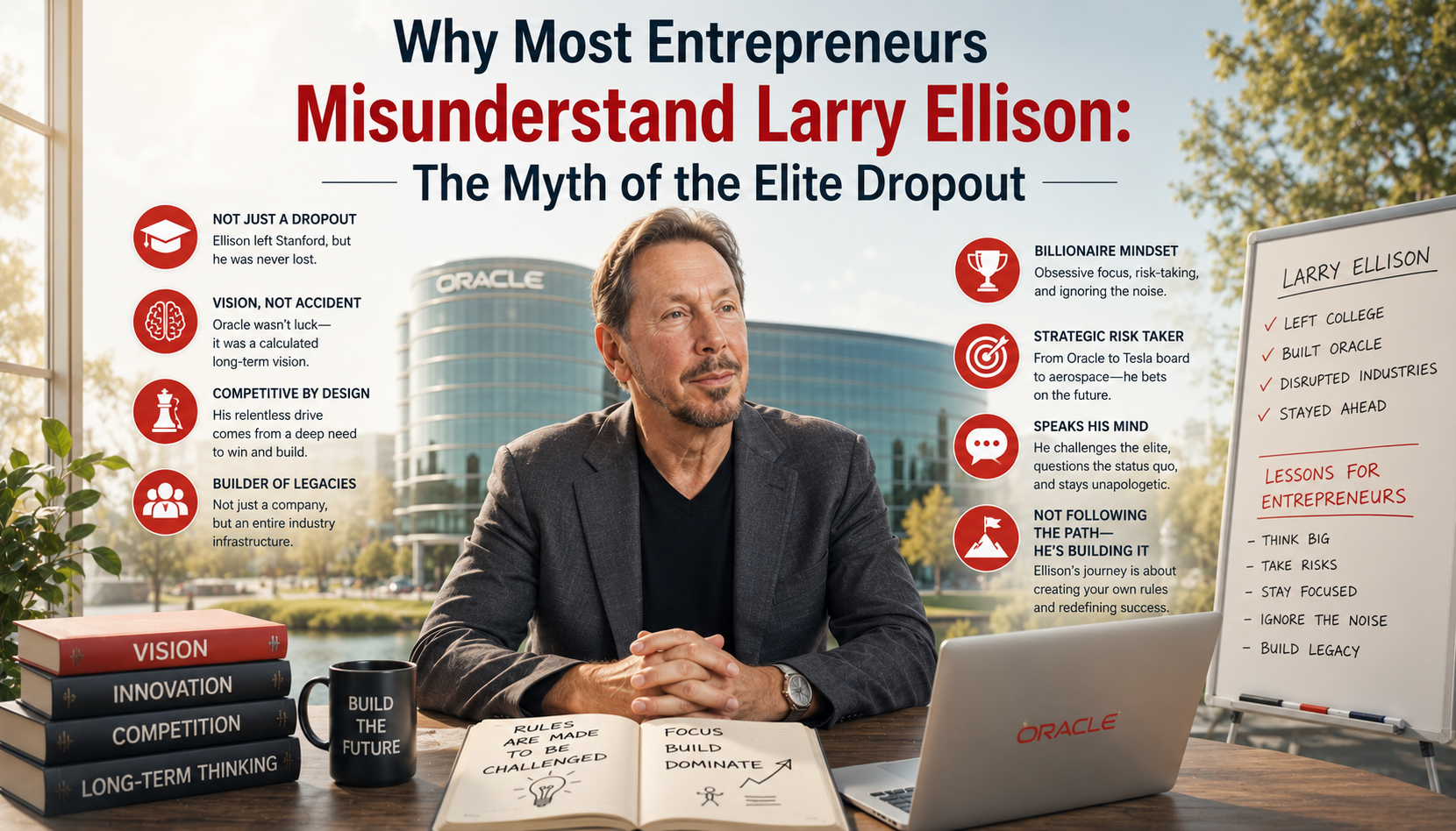
The Outlier Fallacy: Systemic Risk, Chaos, and the Myth of the Elite Dropout
There is a famous piece of digital folklore—an urban legend wrapped in the aggressive syntax of hyper-competitive corporate warfare—detailing a graduation speech allegedly delivered by Oracle founder Larry Ellison at Yale University. In this narrative, Ellison stands before the elite cohort of Ivy League graduates, looks them dead in the eye, and tells them they are destined for psychological and financial mediocrity simply because they committed the ultimate sin: they didn’t drop out.
While this specific speech is a well-documented internet myth (Yale campus security never dragged Larry Ellison off a stage), the aggressive ideology underlying the text points directly toward a profound psychological trap. It forces us to confront a vital question regarding human ambition:
Does institutional conditioning systematically crush the raw, chaotic genius required to build a global empire, or does the human mind look at exceptional outliers like Ellison, Gates, and Dell and completely misinterpret the true variables of extraordinary success?
Survivorship Bias and the Mathematics of the Outlier
When we isolate the trajectories of individuals who abandoned formal institutions to build multi-billion-dollar enterprise ecosystems, the human nervous system falls victim to a major cognitive error known as Survivorship Bias.
[Total Population of Dropouts]
│
├──► 99.9% Collapse Into Market Obscurity (Invisible Data)
│
└──► 0.1% Outlier Super-Performers (Visible Data) ──► Cult of the Dropout
Our brains are hardwired for narrative. We focus entirely on the visible “survivors” of a highly volatile market loop while remaining completely blind to the silent graveyard of the thousands who dropped out and collapsed into economic obscurity.
Dropping out of an elite university is not a magical variable that grants automated commercial brilliance. The dropout status of Ellison or Gates was not the cause of their success; it was a byproduct of an overwhelming, hyper-focused obsession with a specific technological shift. They did not leave institutional structures because they were lazy or unfocused—they left because their operational momentum was moving so rapidly that the institution had become an active drag on their cognitive bandwidth.
Institutional Domestication vs. The Chaos Framework
Despite the mathematical illusion of survivorship bias, the underlying text of the Ellison myth captures a genuine friction between institutional training and original venture building. Formal education is engineered to build reliable compliance, risk mitigation, and predictable cognitive patterns.
+-----------------------------------------------------------------+
|               THE OPERATIONAL PROCESSING SPECTRUM               |
+-----------------------------------------------------------------+
| INSTITUTIONAL BLUEPRINT: Optimization --> Risk Reduction --> Scale |
| CHAOS FRAMEWORK:         Disruption   --> Risk Embrace   --> Pivot |
+-----------------------------------------------------------------+
- The Institutional Blueprint: Teaches you to optimize within existing systems. It trains the prefrontal cortex to value safety, clear frameworks, and steady validation (the “annual performance review” or “salary check” loop).
- The Chaos Framework: Demands the capacity to operate in environments of absolute ambiguity, high allostatic load, and systemic instability. To disrupt a market, your nervous system must tolerate being misunderstood, rejected, and completely isolated for extended developmental windows.
This is the psychological grain of truth inside the myth: if you are conditioned to only move forward when a professor, an institution, or an established authority grants you permission, you will struggle to survive the profound isolation of early-stage entrepreneurship.
The Transition of Ambition: From External Toys to Internal Legacy
The evolution of the real Larry Ellison reveals a deeper psychological truth that completely contradicts the superficial corporate bravado of his internet myth.
Early in their developmental cycle, the high-performance entrepreneur is often driven by a defensive childhood blueprint—a profound need to prove their intrinsic value to an external world through high-visibility status markers: fighter jets, massive real estate holdings, and record-breaking mega-yachts. This is the nervous system seeking somatic safety through absolute material dominance.
[Status Acquisitional Phase] ---> Existential Mortality Shift ---> Legacy Architectural Phase
However, as the neuro-biological reality of mortality approaches, the currency of ambition undergoes a radical structural shift. Following the loss of primary attachment figures and close colleagues, the focus pivots away from competitive accumulation and toward existential impact.
Ellison’s massive financial pivot into molecular biology, life-extension technologies, and anti-aging research demonstrates this inevitable shift. The aging founder realizes that all the material toys of early-stage conquest cannot purchase a single micro-dose of extra time. The ultimate game shifts from beating your competitors in a market index to attempting to rewrite the biological constraints of human aging itself.
Interrogating Your Strategic Placement
Whether you possess a collection of advanced degrees or abandoned institutional paths entirely is ultimately irrelevant to your long-term creative trajectory. The only metric that matters is the structural design of your daily focus.
- Audit Your Permission Loop: Are you delaying the launch of your business, your book, or your project because you are waiting for a systemic stamp of approval? Recognize this delay as a defense mechanism designed to protect your ego from the vulnerability of real-world feedback.
- Build Localized Chaos Sanctuaries: If your daily career demands high institutional compliance, deliberately cultivate an aggressive, independent project outside of those working hours. Give your mind a playground where you make the rules, absorb the risks, and control the entire operational flow.
- Shift from Consumption to Architecture: Stop accumulating facts, certifications, and endless theoretical knowledge just to feel secure. The market does not reward what you know; it rewards the specific, unique value you build when you force your ideas past the sanctuary of your mind and into real, actionable execution.