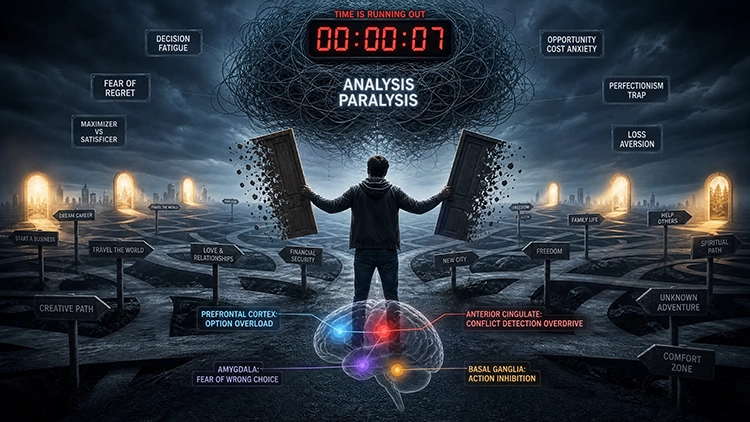
The Paradox of Choice: Why Indecision Is a Defense Mechanism (and How to Break Paralysis)
Almost everyone has found themselves completely paralyzed by a trivial decision—staring blankly at a streaming menu for forty minutes, endlessly comparing two nearly identical menu items, or delaying a minor purchase until the opportunity quietly slips away.
In psychology and behavioral economics, this experience is known as choice overload or decisional procrastination. While it feels like a simple flaw in time management, indecision is rarely about the options themselves. Instead, it is a protective strategy deployed by the executive brain to avoid a far more uncomfortable outcome: regret, responsibility, and the loss of potential.
To simplify your decision-making process, you do not need more willpower or endless pros-and-cons lists. You need to understand the underlying cognitive friction causing the paralysis and adopt structured behavioral constraints that reduce mental friction.
The Root Mechanics: Why the Brain Freezes
When presented with multiple paths forward, the human brain executes an implicit risk assessment. Indecision emerges when the perceived psychological cost of choosing outweighs the immediate discomfort of doing nothing.
                  [ CHOICE PRESENTED ]
│
▼
[ SUBCONSCIOUS THREAT APPRAISAL ]
"What if I choose wrong? What if I regret this?"
│
┌─────────────┴─────────────┐
▼                           ▼
[ PATH A: ACTION ]           [ PATH B: INACTION ]
• Commits resources          • Preserves all options
• Risks immediate regret     • Eliminates immediate risk
• Accepts responsibility     • Defers accountability
│                           │
▼                           ▼
[ High Short-Term ]          [ Low Short-Term ]
[ Cognitive Friction]        [ Relief (Avoidance) ]
│                           │
└─────────────┬─────────────┘
│
▼
[ DECISIONAL PROCRASTINATION ]
Six main psychological drivers typically create this friction:
┌─────────────────────────────────────────────────────────────────────────┐
│                       THE SIX ENGINES OF INDECISION                     │
├─────────────────────────┬───────────────────────────────────────────────┤
│ Paradox of Choice       │ More options lower confidence and increase    │
│                         │ post-choice regret.                           │
├─────────────────────────┼───────────────────────────────────────────────┤
│ Perfectionism           │ Framing decisions as absolute "right/wrong"   │
│                         │ binaries rather than spectrums of trade-offs. │
├─────────────────────────┼───────────────────────────────────────────────┤
│ Conflict Avoidance      │ Prioritizing others' expectations over        │
│                         │ personal internal signals ("People Pleasing").│
├─────────────────────────┼───────────────────────────────────────────────┤
│ Low Self-Efficacy       │ Distrusting your future self's capacity to     │
│                         │ handle a sub-optimal outcome.                 │
├─────────────────────────┼───────────────────────────────────────────────┤
│ Overthinking (Analysis) │ Endless loop searching for non-existent 100%  │
│                         │ certainty.                                    │
├─────────────────────────┼───────────────────────────────────────────────┤
│ Loss Aversion           │ Fear of forfeiting the unchosen options       │
│                         │ (Opportunity Cost).                           │
└─────────────────────────┴───────────────────────────────────────────────┘
Analysis Paralysis: The Cost of Maximizing
Behavioral economist Barry Schwartz famously categorized decision-makers into two primary archetypes: Maximizers and Satisficers.
                           [ DECISION APPROACH ]
│
┌──────────────────────────┴──────────────────────────┐
▼                                                     ▼
[ MAXIMIZER ]                                         [ SATISFICER ]
• Goal: The absolute best choice                      • Goal: A "good enough" choice
• Scans every single alternative                      • Sets explicit criteria upfront
• High regret, high anxiety                           • Accepts trade-offs quickly
• Paralyzed by choice overload                        • Reclaims cognitive bandwidth
- Maximizers strive to make the absolute optimal choice. They analyze every variable, read every review, and re-evaluate past decisions continuously. Consequently, even when they make an objectively great choice, they experience lower satisfaction and higher regret because they remain acutely aware of the unchosen alternatives.
- Satisficers establish clear, pragmatic baseline criteria upfront (“I need a laptop under $800 with 16GB RAM”). The first option that satisfies these pre-determined conditions is selected immediately. Once the criteria are met, search halts.
Satisficing: A decision-making strategy that entails searching through available alternatives until an acceptability threshold is met, prioritizing efficiency and peace of mind over an elusive “optimal” outcome.
Reducing Cognitive Friction: Structural Decision Rules
If you are currently feeling stuck or overwhelmed by choices, you can bypass overthinking using concrete structural heuristics rather than trying to force a decision through sheer effort.
1. Apply the “Maximizer-to-Satisficer” Threshold
Before evaluating options, explicitly define 2–3 non-negotiable criteria. As soon as an option satisfies those conditions, select it immediately and close the search. Remind yourself that a good decision made today is vastly superior to a “perfect” decision made three weeks too late.
2. Practice Asymmetric Bracket Elimination
When faced with numerous options, comparing them all simultaneously creates cognitive fatigue. Instead, pit two options against each other at a time in a single-elimination tournament style:
  Option A ──┐
├──► Winner 1 ──┐
Option B ──┘               │
├──► FINAL CHOICE
Option C ──┐               │
├──► Winner 2 ──┘
Option D ──┘
Discard the loser immediately from your mental space. Reducing the active comparison field to a maximum of two choices prevents working memory overload.
3. Deploy Time-Boxing and the 5-5-5 Frame
Indecision expands to fill the time allotted to it. Impose external constraints to accelerate processing:
- Time-Box Small Choices: Give yourself a strict 90-second timer for low-stakes decisions (coffee, meals, minor scheduling).
- The 5-5-5 Rule: Ask yourself: “Will the outcome of this decision matter in 5 minutes? 5 months? 5 years?” If it will not matter in 5 months, cap your deliberation time to less than five minutes.
Re-Framing Failure: Trusting Your Adaptability
Underneath chronic indecision lies a subtle mistrust of your future self. We delay choosing because we fear that a sub-optimal choice will permanently damage our well-being or self-esteem.
In reality, psychological research on cognitive dissonance reduction demonstrates that the human mind naturally rationalizes and adapts to committed choices far better than it tolerates prolonged ambiguity. Once a decision is made, the brain actively highlights its benefits and minimizes its downsides to restore internal harmony.
Indecision keeps you trapped in an artificial illusion of control. By setting firm constraints, accepting reasonable trade-offs, and choosing action over analysis, you reclaim your cognitive bandwidth and move forward with clarity.