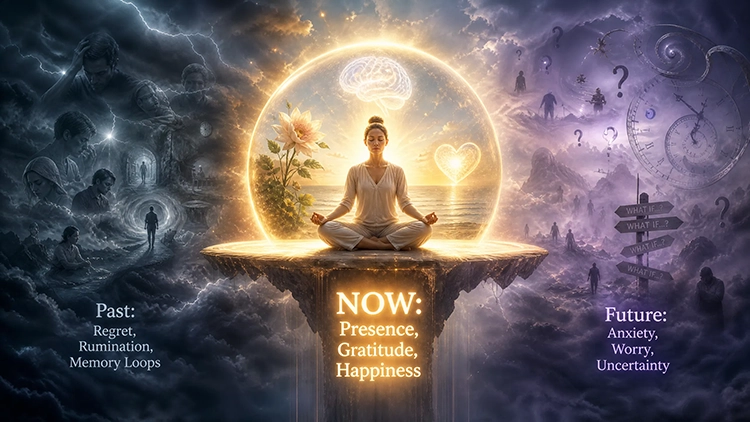
The Temporal Drift: Evolutionary Mismatch, Cognitive Wandering, and the Science of Psychological Flexibility
1. The Evolutionary Paradox of the Wandering Mind
Human consciousness achieved a monumental evolutionary breakthrough when it gained the ability to mentally simulate realities outside the immediate present.
Unlike other species, humans possess Uprun-Dependent Temporal Projection: the capacity of the Default Mode Network (DMN) to disengage from present sensory input to reconstruct past events, model hypothetical futures, and simulate complex social dynamics.
[ Immediate Present Sensory Input ] ──► (DMN Activation / Temporal Drift) ──► [ Mental Simulation (Past / Future) ]
│
▼
[ Unconscious Negativity Bias ]     ◄── (Threat Scanning / Anticipation) ◄── [ Evolutionary Survival Protocol ]
This capacity built human civilization, allowing us to plan, invent, learn from remote history, and calculate risk. However, this same evolutionary advantage carries a severe psychological surcharge.
When the mind wanders into non-present terrain, it does not explore neutrally. Governed by a deeply ingrained Negativity Bias—the ancestral survival code designed to mistake harmless tree bark for a lurking predator—a roaming mind naturally drifts toward threat scanning, catastrophic forecasting, and past regret.
2. Deconstructing the Empirical Benchmark: Killingsworth & Gilbert (2010)
In 2010, Harvard researchers Matthew A. Killingsworth and Daniel T. Gilbert published a landmark study in Science titled “A Wandering Mind Is an Unhappy Mind.” Utilizing real-time experience sampling via smartphone technology across a massive demographic, the empirical data revealed stark realities regarding human consciousness:
+-----------------------------------------------------------------------+
|                THE MECHANICS OF MENTAL DRIFT & AFFECT                 |
+-----------------------------------------------------------------------+
|  OCCURRENCE FREQUENCY                  AFFECTIVE CORRELATION          |
|  • Mind wanders ~46.9% of waking hours • Non-present states produce   |
|  • Active across almost all tasks      consistently lower happiness    |
|  • Independent of task pleasantness    • Wandering is CAUSE, not just  |
|                                          an EFFECT, of unhappiness    |
+-----------------------------------------------------------------------+
[ Present-Moment Engagement ] ──► Lower DMN Hyper-Activity ──► Higher Subjective Well-Being
│
▼
[ Wandering Mind (Past/Future) ] ──► Threat & Rumination Drift ──► Systemic Emotional Atrophy
Key Insights from the Empirical Data:
- The Ubiquity of Absence: The human mind operates on “autopilot” (wandering) nearly half of its waking life, regardless of whether a person is working, commuting, or resting.
- Directionality of Happiness: The study established that mental wandering is a causal driver of lower happiness, not merely a byproduct of feeling unhappy.
- The Primacy of Temporal Presence: What individuals were thinking about was a far stronger predictor of their happiness than what they were actually doing in the physical environment.
3. Epistemological Cross-Currents: From Sati to Secular Psychology
While modern neuroscience quantifies the cost of a drifting mind through brain imaging and sampling algorithms, this insight forms the core baseline of ancient contemplative traditions and Western therapeutic models alike.
       [ Ancient Eastern Foundations ]
• Buddhist "Sati" (Mindful Awareness)
• Observation of Anicca (Impermanence)
│
▼
( The Epistemological Convergence )
│
▼
[ Modern Western Frameworks ]
• Acceptance & Commitment Therapy (ACT)
• Mindfulness-Based Cognitive Therapy (MBCT)
I. The Concept of Sati (Mindfulness)
In the Theravada Buddhist tradition, mindfulness originates from the Pali word Sati, denoting lucidity, mental retention, and present-moment awareness. It is not an esoteric state or a religious ritual; it is a foundational human faculty—the capacity to observe internal phenomena without immediate reaction or identification.
II. Western Secular Integration
When secularized into modern clinical psychology (e.g., Jon Kabat-Zinn’s MBSR, and Steven C. Hayes’ Acceptance & Commitment Therapy), mindfulness shifts from a cultural or spiritual practice into a Secular Metacognitive Tool. It provides a structured methodology to decouple identity from transient mental events.
4. Operational Modes of Consciousness: Doing vs. Being
To navigate psychological distress, cognitive therapies distinguish between two primary functional states of the self:
+-----------------------------------------------------------------------+
|                    DOING MODE vs. BEING MODE                          |
+-----------------------------------------------------------------------+
|  THE DOING MODE (Conceptual Self)     THE BEING MODE (Observing Self) |
|  • Driven by discrepancy-reduction    • Driven by open awareness      |
|  • Evaluates "What is" vs. "Should be"• Witnesses experiences as data |
|  • High rumination & planning load    • High psychological flexibility|
|  • Stuck in thought content           • Aware of thinking process     |
+-----------------------------------------------------------------------+
[ Challenging Emotion / Thought ]
│
├────────────────────────────────────────┐
▼                                        ▼
[ DOING MODE Interventions ]             [ BEING MODE Interventions ]
• Analyze cause                          • Observe somatic presence
• Attempt emotional erasure              • Allow thought to pass
• Prolongs narrative loop                • Dissolves threat charge
When an individual operates exclusively in the Doing Mode, every uncomfortable emotion or intrusive thought is treated as a problem that must be immediately analyzed, fixed, or suppressed. This paradoxically fuels rumination.
Transitioning to the Being Mode allows one to step back into the Observing Self—the immutable baseline of awareness that witnesses changing thoughts, bodily sensations, and environmental events without being consumed by them.
5. Subjective Well-Being vs. Hedonic Happiness
Philosopher John Stuart Mill noted in the 19th century that happiness cannot be attained by pursuing it directly as a primary goal. When treated as an absolute target, “hedonic happiness” breaks down because it depends heavily on volatile external conditions.
               [ Hedonic Pursuit ] ──► Condition-Dependent ──► Fragile & Volatile
│
▼
[ Subjective Well-Being (Eudaimonia) ] ◄── Psychological Flexibility ◄── [ Internal Equanimity ]
Mindfulness targets Subjective Well-Being (Eudaimonia)—a state of baseline equanimity and psychological flexibility.
Unlike transient emotional happiness, subjective well-being is not broken when facing external hardship, grief, or uncertainty. It stems from an cultivated capacity to remain grounded, aligned with core personal values, and non-reactively present regardless of whether circumstances are pleasant or painful.
6. Protocols for Cultivating Metacognitive Equanimity
Transforming an untrained, wandering mind—which operates like a reactive, dysregulated companion—requires deliberate, daily structural practice.
[ Intrusive Threat / Rumination ] ──► [ Cognitive Defusion Intercept ] ──► [ Somatic Anchor (Breath/Body) ]
│
▼
[ Restoration of Psychological Flexibility ] ◄─────────────────────────────────────┘
Protocol I: Cognitive Defusion (Disarming the Narrative)
Instead of arguing with an anxious thought or attempting to force positive thinking, apply Cognitive Defusion:
- The Linguistic Pivot: Transform “Everything is falling apart” into “I notice my mind is generating the thought that everything is falling apart.”
- The Neuro-Logic: This subtle shift moves the brain out of the Conceptual Self (Doing Mode) and activates the prefrontal networks of the Observing Self (Being Mode), instantly lowering physiological arousal.
Protocol II: The Somatic Anchoring Reset
When the Default Mode Network drags focus into catastrophic future projections or past regret, use a physical anchor to disrupt the temporal drift:
- Interrupt the Loop: Immediately pause mental narrative processing.
- Ground in Raw Data: Direct 100% of conscious attentional bandwidth to a physical sensation—the pressure of your feet on the floor, the tactile rhythm of breathing, or ambient sounds.
- Verify Reality: Ask: “Is the threat my mind is constructing currently occurring in this physical room, in this exact second?”
Protocol III: Values-Aligned Action Matrix
Use present-moment awareness not as an escape from reality, but as a launching pad for meaningful execution:
┌────────────────────────────────────────────────────────────────────────┐
│                     VALUES-ALIGNED PRESENT CHECK                       │
├────────────────────────────────────────────────────────────────────────┤
│ 1. What unverified narrative is my mind currently fixating on?          │
│ 2. Can I allow this internal sensation to exist without fighting it?   │
│ 3. What is the single most valuable action I can take right now?       │
└────────────────────────────────────────────────────────────────────────┘
7. The Ultimate Synthesis
The mind’s tendency to wander into yesterday’s mistakes and tomorrow’s uncertainties is an ancient, evolutionary habit—not a personal flaw.
Yet, true psychological freedom begins the moment you realize that you are not your thoughts; you are the context in which your thoughts occur.
By shifting from the restless urgency of the Doing Mode into the quiet clarity of the Being Mode, you stop treating every passing mental simulation as an absolute reality. You clear the accumulated noise of temporal drift, reclaim your attentional sovereignty, and anchor your life firmly where it actually takes place: here and now.