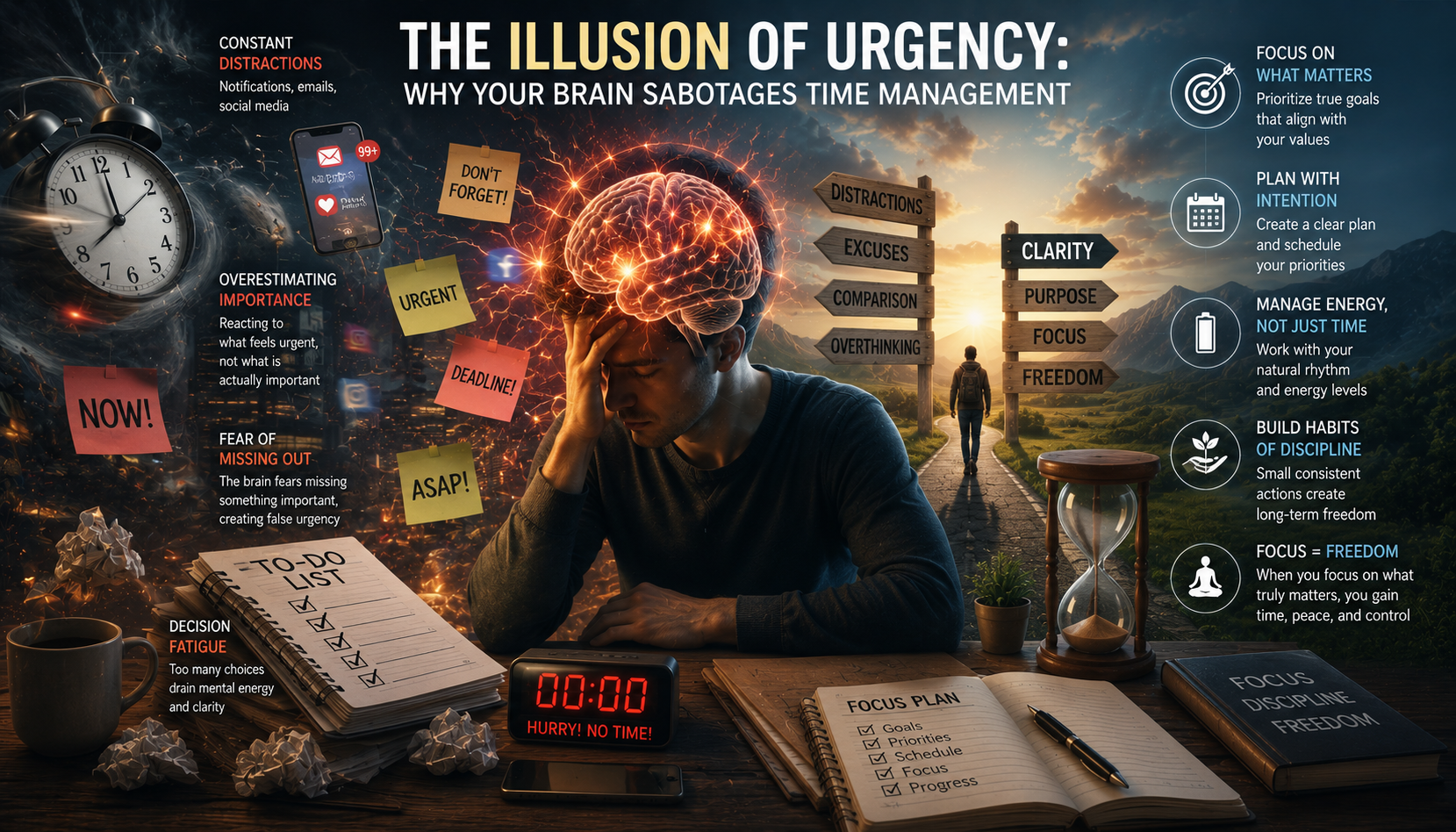
Why does a single hour spent in a cold waiting room feel like an eternity, while an entire weekend of deep, creative flow vanishes in what feels like a heartbeat?
Most of us live with a quiet, persistent anxiety. We buy planners, download productivity apps, and color-code our calendars. Yet, at the end of the day, we often lie awake with an unshakeable sense of exhaustion, feeling as though we have run a marathon without moving an inch forward. We feel busy, but deeply unproductive. We treat time as an external enemy to be conquered, yet the real battle is happening entirely within our own nervous system.
If you have ever promised yourself a fresh start on Monday, only to find yourself frozen on Sunday night, you are not suffering from a lack of willpower. You are experiencing a mismatch between objective clock time and your brain’s internal survival mechanisms.
Why Do We Perceive Time Differently?
Physically, time is exceptionally democratic. A day consists of precisely twenty-four hours, whether measured on the wristwatch of a Nobel laureate or a person sitting quietly in a park. This is objective time—chronos.
However, our brains do not live in chronos. We inhabit kairos: subjective, experiential time.
[Threat/Stress State]     --> Fast Internal Clock  --> "Time is slipping away" (Anxiety)
[Safety/Coherence State]  --> Slow Internal Clock  --> "Time is expanding"     (Flow)
The human brain estimates duration based on the number of neural coordinates it processes within a given window. When you are stressed, anxious, or hyper-focused on survival, your brain processes information at an accelerated rate. This fast-tracking is an evolutionary adaptation; it allows you to scan for threats.
The collateral damage of this state is that time feels incredibly scarce. When your nervous system is chronically dysregulated, an hour feels like ten minutes when trying to meet a deadline, but a few minutes of quiet stillness feel like an agonizing hour.
The Neurological Root of Procrastination and Perfectionism
We often blame modern distractions for our inability to focus, but the blueprint for how we handle time was drawn long before we ever held a smartphone. Between the ages of zero and seven, a child’s brain operates primarily in theta and alpha brainwave states—highly suggestible frequencies where we absorb parental dynamics, environmental safety, and definitions of worth.
If your early environment conditioned you to believe that your worth was directly tied to flawless performance, your adult brain will interpret any complex task as a threat to your safety.
- Perfectionism is not a pursuit of excellence. It is a neurological defense mechanism designed to prevent the perceived danger of criticism.
- Procrastination is not laziness. It is an emotional regulation problem where your brain temporarily paralyzes you to avoid the stress associated with a specific task.
When we try to force ourselves into rigid, hyper-optimized schedules without addressing this underlying conditioning, we trigger an internal alarm system. We attempt to solve a deep somatic safety issue with a superficial daily planner.
The Neuro-Somatic Reality of Saying “No”
Why is saying “no” to an unproductive meeting or an unreasonable demand so physically uncomfortable?
Clinical observations show that the prospect of setting a boundary triggers the anterior insular cortex—the exact region of the brain that processes physical pain. In our early evolutionary history, isolation from the tribe meant literal death. If your early childhood blueprint conditioned you to please others to secure love and safety, setting a boundary feels, at a cellular level, like an existential threat.
When we cannot say “no” to others, we are forced to say “no” to our own cognitive peace. We fill our calendars with secondary obligations, leaving our prefrontal cortex too exhausted to handle our primary goals.
Furthermore, when we do attempt to work, we often fall victim to Parkinson’s Law: work expands to fill the time allotted for its completion. Without clear boundaries, we spend five hours on a task that requires one, drowning in details to avoid the vulnerability of declaring a piece of work “finished.”
Reclaiming Your Temporal Autonomy
To become the master of your time, you must first transition your nervous system from a state of survival to one of safety.
+-------------------------------------------------------------+
|               TEMPORAL ALIGNMENT PROTOCOL                   |
+-------------------------------------------------------------+
|  1. SOMATIC SAFETY  --> Slow the internal pacemaker first.   |
|  2. MONOTASKING     --> Protect the prefrontal cortex.       |
|  3. EXTREME LIMITS  --> Give tasks aggressive constraints.  |
+-------------------------------------------------------------+
True time management is actually energy management. The human prefrontal cortex—the seat of executive function, planning, and decision-making—consumes massive amounts of glucose. Its capacity for high-density focus naturally decays after roughly twenty-five to thirty minutes of intense activity.
Instead of forcing your brain through long, unproductive marathons, work in short, highly concentrated intervals. More importantly, respect the transition periods. A Mediterranean siesta is not an act of laziness; it is a profound physiological reset that allows the brain to consolidate information and restore its chemical equilibrium.
To step off the treadmill of chronic urgency, we must stop asking how we can fit more tasks into our day, and start asking why we feel the somatic need to stay so perpetually busy.
Time cannot be saved, accumulated, or negotiated; it can only be inhabited.