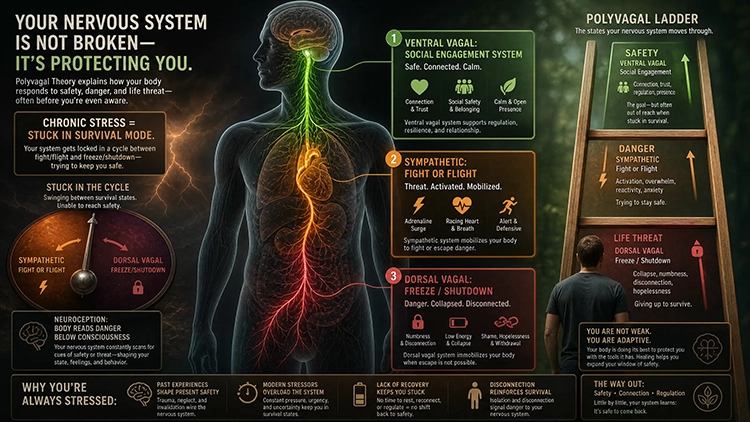
The Evolutionary Architecture of Stress: How Polyvagal Theory Explains Modern Burnout
Every afternoon in modern corporate spaces, an ancient survival script unfolds silently. A tight project deadline arrives, an unexpected email pops up from an executive, or a tense meeting begins. Physically, there is no predator in the room. There is no immediate threat to bodily integrity. Yet, your heart rate accelerates, your breathing shallows, your muscles tighten, and a subtle wave of irritability or dread settles in.
To understand why a simple workplace request or news notification can trigger the exact physiological reaction our ancestors experienced when facing life-or-death threats, we must look beyond basic stress management. We must examine the biological architecture of the autonomic nervous system—and specifically how its evolutionary timeline dictates our daily emotional and psychological capacity.
The Autonomic Hierarchy: An Evolutionary Timeline
For decades, standard medical textbooks framed the autonomic nervous system as a simple binary toggle: the Sympathetic (“fight-or-flight”) versus the Parasympathetic (“rest-and-digest”). While functional, this two-part model failed to explain complex human responses like behavioral freezing, dissociation, or why supportive social connection can instantly lower heart rate.
In the mid-1990s, neuroscientist Dr. Stephen Porges introduced Polyvagal Theory, demonstrating that the parasympathetic system is actually divided into two distinct evolutionary pathways via the vagus nerve (the 10th cranial nerve). This reclassified our autonomic response system into a three-tiered evolutionary hierarchy:
                       [ EVOLUTIONARY TIMELINE ]
Oldest (500M+ Years)       Intermediate (400M+ Years)       Newest (Mammalian)
┌───────────────────┐      ┌───────────────────┐      ┌───────────────────┐
│  Unmyelinated     │      │    Sympathetic    │      │   Myelinated      │
│  Dorsal Vagus     │ ───► │  Nervous System   │ ───► │   Ventral Vagus   │
└───────────────────┘      └───────────────────┘      └───────────────────┘
[ Immobilization ]          [ Mobilization ]           [ Social Engagement ]
• Freeze / Shutdown         • Fight / Flight           • Safety / Connection
• Dissociation              • Hypervigilance           • Co-regulation
1. The Dorsal Vagal Complex (Immobilization)
- Evolutionary Age: ~500+ Million Years (Primitive Vertebrates)
- Anatomical Structure: Unmyelinated vagal fibers originating in the dorsal motor nucleus.
- Physiological Response: When a threat is perceived as completely inescapable, this system initiates an energy-conservation protocol: dramatic drops in heart rate and blood pressure, metabolic slowdown, behavioral freezing, visceral numbness, and psychological dissociation.
2. The Sympathetic Nervous System (Mobilization)
- Evolutionary Age: ~400+ Million Years (Early Fish and Amphibians)
- Anatomical Structure: Sympathetic chain ganglia running parallel to the spinal cord.
- Physiological Response: Designed for active threat response. It triggers the release of adrenaline and cortisol, redirects blood flow from digestive organs to skeletal muscles, dilates pupils, and accelerates respiration to prepare the organism to fight or flee.
3. The Ventral Vagal Complex (Social Engagement)
- Evolutionary Age: Mammalian Evolution (Unique to mammals)
- Anatomical Structure: Myelinated (fast-conducting) vagal fibers originating in the nucleus ambiguus, neuro-anatomically linked to the cranial nerves controlling facial expression, vocal tone, and middle-ear hearing.
- Physiological Response: Acts as a biological “brake” on the sympathetic system. When active, it promotes feelings of safety, social reciprocity, somatic calm, and visceral restoration.
Neuroception: The Subconscious Threat Scanner
The brain does not evaluate safety solely through conscious logic. Long before your prefrontal cortex consciously registers a situation, your autonomic nervous system executes a process Porges termed neuroception.
Neuroception: The subconscious neural process through which the nervous system continuously scans environmental, interpersonal, and internal visceral cues for signs of safety, danger, or life threat without involving conscious cognitive awareness.
                  [ Environmental / Interpersonal Cues ]
│
▼
[ SUBCONSCIOUS NEUROCEPTION ]
│
┌──────────────────────────┼──────────────────────────┐
▼                          ▼                          ▼
[ Cues of Safety ]       [ Cues of Danger ]      [ Cues of Life Threat ]
│                          │                          │
▼                          ▼                          ▼
Ventral Vagal Active     Sympathetic Mobilized     Dorsal Vagal Shutdown
(Social Engagement)        (Fight / Flight)          (Freeze / Numbness)
Neuroception evaluates three distinct layers of inputs:
- Outer Space (Environment): Background noise levels, lighting, movement, physical constraints.
- Interpersonal Space (Relational Cues): Vocal prosody (warmth vs. monotone), facial expressions, eye contact, micro-tensions in body language.
- Inner Space (Interoception): Heart rhythm, gastrointestinal contractions, muscle tension, respiratory depth.
When neuroception detects subtle cues of danger—even non-physical ones like social rejection, harsh vocal tones, or unpredictable workloads—it automatically down-regulates the Ventral Vagal Complex and shifts autonomic control down the evolutionary ladder to the Sympathetic System.
The Modern Mismatch: Chronic Sympathetic Activation
In ancestral environments, sympathetic activation was acute, intense, and brief. A physical predator appeared; the organism fought or fled; the threat resolved; and the Ventral Vagal “brake” re-engaged to restore homeostasis.
In contemporary life, however, threats are rarely physical and almost never brief. They manifest as continuous cognitive demands: persistent notifications, ambiguous emails, financial anxiety, and relentless task management. Because the brain’s primitive survival structures cannot distinguish between a physical predator and a symbolic work deadline, the body remains trapped in a state of chronic low-grade mobilization.
  [ Acute Survival Loop (Ancestral) ]
Threat Detected ──► Sympathetic Activation ──► Physical Resolution ──► Ventral Vagal Recovery
[ Chronic Stress Loop (Modern) ]
Symbolic Threat ──► Sympathetic Activation ──► No Physical Discharge ──► Systemic Exhaustion
When the nervous system spends extended periods in sympathetic mobilization without sufficient recovery, two major physiological breakdowns occur:
1. Allostatic Overload
The cumulative wear and tear on tissues and organs caused by prolonged exposure to elevated stress hormones (cortisol, adrenaline). This manifests as elevated systemic inflammation, impaired glucose metabolism, hypertension, and disrupted sleep architecture.
2. Functional Vagal Deconditioning
Like a muscle that atrophies without use, the Ventral Vagal Complex loses its capacity to rapidly buffer sympathetic arousal. The nervous system’s baseline shifts from calm alertness to chronic hypervigilance, making small daily disruptions feel disproportionately overwhelming.
The Biological Fallback: Dorsal Vagal Shutdown and Burnout
When the sympathetic system remains activated for too long without relief, or when a person encounters an ongoing emotional situation perceived as entirely unmanageable, the nervous system deploys its final defense mechanism: Dorsal Vagal Immobilization.
  [ Autonomic Cascade Under Unresolved Stress ]
Ventral Vagal (Safety)
│
▼  [Perceived Danger]
Sympathetic (Mobility / Anxiety / Restlessness)
│
▼  [Chronic Overwhelm / Overload]
Dorsal Vagal (Immobilization / Burnout / Numbness)
In modern clinical psychology, this state is commonly recognized as clinical burnout or functional depression. It is not a cognitive failure or a lack of willpower; it is a primal biological conservation protocol.
- Emotional Signatures: Apathy, profound brain fog, emotional flatness, social withdrawal, feeling disconnected from one’s body (depersonalization).
- Physical Signatures: Chronic fatigue, gastrointestinal distress (sluggish digestion), low heart rate variability (HRV), and muscle weakness.
Recalibrating the System: Physiological Levers for Vagal Toning
Because autonomic state is governed below the level of conscious thought, trying to “think your way out” of a stress response is inherently inefficient. Effective autonomic regulation requires using bottom-up physiological interventions—signaling safety directly to the brainstem through physical channels.
┌─────────────────────────────────────────────────────────────────────────┐
│                     BOTTOM-UP REGULATION LEVERS                         │
├─────────────────────────┬───────────────────────────────────────────────┤
│ Vagal Respiratory Brake │ Exhalation > Inhalation (e.g., 4s in, 6s out) │
├─────────────────────────┼───────────────────────────────────────────────┤
│ Co-Regulation Cues      │ Warm vocal tones, eye contact, shared calm    │
├─────────────────────────┼───────────────────────────────────────────────┤
│ Visceral Decompression  │ Unstructured rest, low-sensory environments   │
└─────────────────────────┴───────────────────────────────────────────────┘
1. Activating the Respiratory Vagal Brake
The vagus nerve directly innervates the sinoatrial node of the heart. Inhalation subtly suppresses vagal influence (accelerating heart rate), while exhalation enhances vagal tone (slowing heart rate). Extending the exhalation phase relative to the inhalation phase (for example, a 4-second inhale paired with a 6-to-8-second exhale) directly engages the Ventral Vagal circuit, lowering systemic arousal within minutes.
2. Utilizing Social Co-Regulation
Because the Ventral Vagal system evolved alongside mammalian social bonding, the human nervous system is biologically wired to regulate in proximity to other calm nervous systems. Engaging in face-to-face conversations characterized by warm vocal prosody, genuine eye contact, and relaxed posture signals profound safety to the neuroception system—a process known as co-regulation.
3. Acoustic and Environmental Reset
The middle ear muscles (stapedius and tensor tympani) are innervated by the same cranial nerves that form the Ventral Vagal complex. High-frequency acoustic chaos (urban noise, overlapping digital alerts) triggers defensive sympathetic scanning. Conversely, low-demand natural acoustics (wind, water, soft natural tones) allow the middle ear muscles to relax, signaling safety back to the brainstem.
From Resistance to Regulation
Stress is not an enemy to be eradicated; it is an evolutionary survival engine operating in an environment vastly different from the one for which it was designed. When you experience anxiety, physical tension, or cognitive overwhelm, your nervous system is not failing—it is executing its evolutionary programming to protect you.
By shifting your perspective from forcing cognitive control to actively providing your body with concrete physiological signals of safety, you move out of chronic survival states and restore the natural balance of your autonomic architecture.