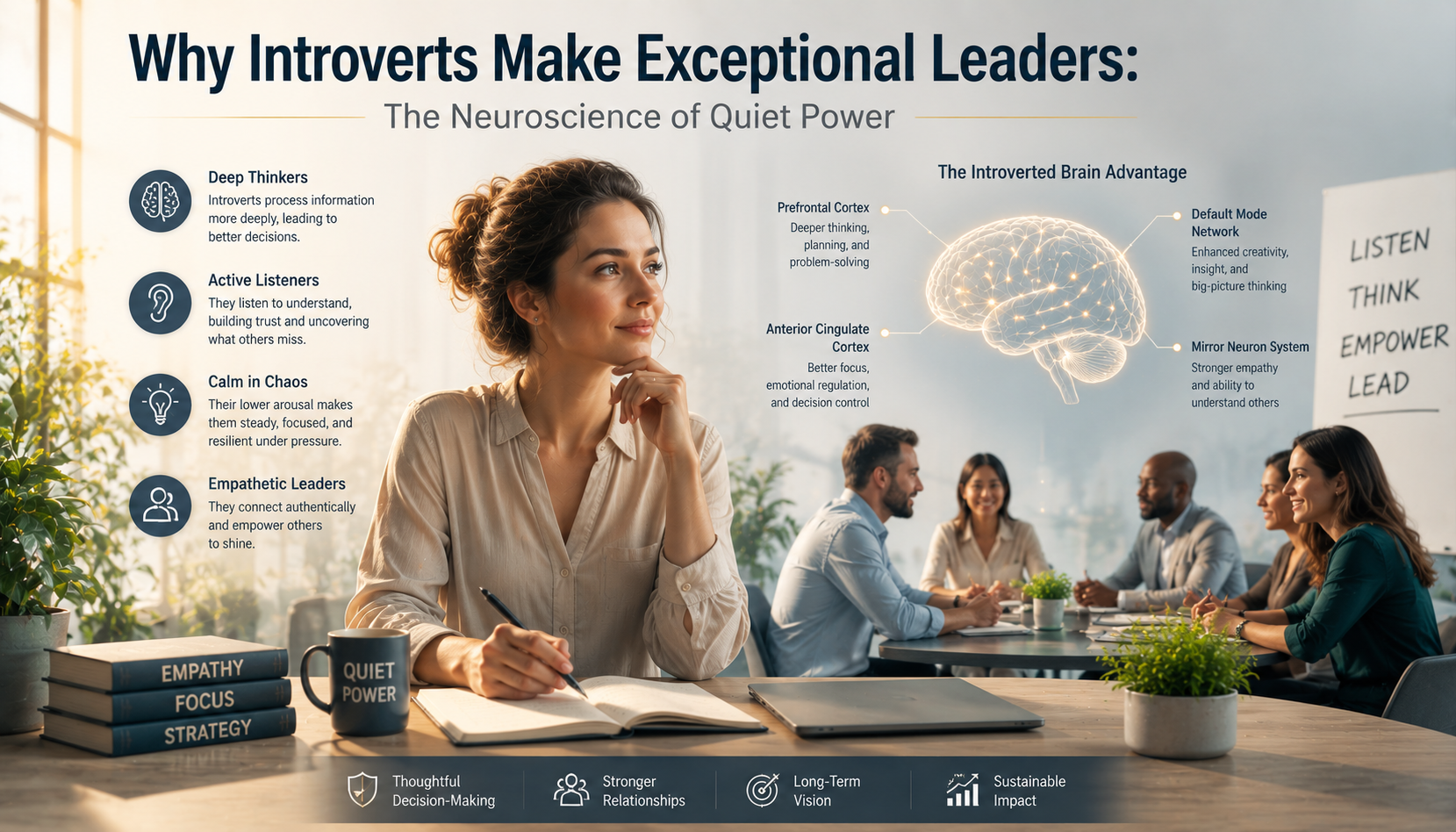
The Quiet Vanguard: The Neuro-Somatic Power of Introversion
We live in a hyper-stimulated culture that pathologizes silence. We treat charisma as a mandatory operational baseline and interpret quiet contemplation as a structural defect. From our modern school systems, which prioritize collaborative group-think, to open-plan corporate environments, the world is engineered to reward the extraverted nervous system.
If you are a quiet, deeply analytical individual who prefers solitude over shallow social networking, society often labels you as aloof, passive, or socially anxious. You may feel a persistent external pressure to force yourself into a high-energy, performative state just to be heard.
This social conditioning misses a fundamental biological reality: quietness is not weakness; it is a highly concentrated form of neurological power. The assumption that effective leadership, creative breakthrough, and personal resilience require an explosive, outward-facing presence is a cultural illusion. Some of the most disruptive movements, technological revolutions, and strategic masterpieces in human history have been quietly engineered by introverted minds who understood how to harness the immense power of an isolated focus.
The Neurobiological Divergence: Stimulation Thresholds
To understand the immense capacity of the introverted mind, we must look past superficial behavior and examine the underlying neurobiology. The primary distinction between introverts and extraverts lies in their baseline sensitivity to environmental stimulation.
[Extraverted Nervous System] --> Low Dopamine Sensitivity --> Craves High-Stimulus Environments
[Introverted Nervous System]  --> High Dopamine Sensitivity --> Thrives in Low-Stimulus Sanctuaries
As detailed in groundbreaking behavioral research—including the seminal work by researcher Susan Cain—the introverted brain operates on a highly sensitive dopamine loop. Introverts possess a lower threshold for chemical stimulation; their neural pathways require far less environmental input to feel awake and engaged.
When an introvert is placed in a loud, chaotic, high-allostatic-load setting, their nervous system is rapidly flooded with sensory data, leading to cognitive fatigue. Conversely, the extraverted nervous system is less sensitive to dopamine, requiring a continuous influx of external noise, social interaction, and environmental novelty to maintain basic alertness.
Forcing an introverted individual to operate in a high-stimulus environment is not “encouraging growth”—it is a form of sensory overload that actively degrades their capacity for deep focus and executive function.
Deconstructing the Illusion: Shyness vs. Introversion
One of the most persistent errors made by educators, corporate leaders, and parents is the absolute conflation of introversion with shyness.
+-----------------------------------------------------------------+
|               THE SOCIAL PROCESSING SPECTRUM                    |
+-----------------------------------------------------------------+
| SHYNESS:     Fear of Negative Evaluation --> Hyper-Vigilance     |
| INTROVERSION: Preference for Quiet Space   --> Energy Preservation|
+-----------------------------------------------------------------+
- Shyness is a psychological defense mechanism: It is rooted in a fear of social disapproval, negative evaluation, and interpersonal vulnerability. A shy individual may desperately crave high-volume social interaction but is paralyzed by fear.
- Introversion is a structural preference: It is an innate preference for low-stimulus environments. An introvert does not avoid a crowded room out of fear; they choose to exit because the environment lacks the quiet required for efficient cognitive processing.
When you leave an introvert alone in a quiet space, they do not experience loneliness or anxiety; they experience a return to somatic safety. Their energy reserves recharge, allowing their minds to engage in deep pattern recognition, creative writing, and complex problem-solving.
The Strategic Architecture of Quiet Leadership
The widespread cultural myth that effective leaders must be dominant, vocal performers is thoroughly debunked by historical data. When we examine iconic figures who permanently altered human history—such as Mahatma Gandhi, Mother Teresa, or tech pioneer Bill Gates—we see the architecture of the quiet leader.
[Deep Listening Protocol] ---> Collaborative Freedom ---> Measured Executive Action
Introverted leaders possess distinct operational advantages that extraverts frequently struggle to replicate:
- Advanced Listening Capacity: Because they naturally prefer listening over talking, introverted leaders process information with high semantic precision. They hear what is left unsaid, analyze subtle undertones, and make decisions based on comprehensive data rather than emotional impulse.
- Autonomy and Deep Collaboration: Extraverted leaders often dominate conversations, unintentionally suppressing the ideas of their team. Introverted leaders, conversely, create a quiet, non-threatening operational space that allows talented individuals to voice original insights without being spoken over.
- Immunity to Groupthink: Because their creative processing thrives in solitude, introverts are uniquely insulated from the dangers of consensus-driven mediocrity. They do not need the immediate validation of a crowd to sustain their conviction; they rely on the objective structural integrity of their plan.
The Blueprint of Introverted Integration
If your natural disposition leans toward quiet reflection, stop trying to force your nervous system into a performative, extraverted mold. True personal power is achieved through strategic self-alignment, not imitation.
- Protect Your Cognitive Capital: Schedule regular, non-negotiable windows of complete solitude throughout your week. Treat these blocks not as passive downtime, but as essential periods of neural consolidation and white matter recovery.
- Leverage Written Expression: If your brain prefers processing ideas through written language rather than verbal banter, tilt your professional communication toward high-density writing. A precisely crafted document or strategic outline is often far more impactful than a chaotic boardroom presentation.
- Master the Power of the Pause: In a culture that values rapid, unexamined speech, your natural inclination to pause, process, and speak with deliberate intent is an elite asset. Let others exhaust their energy in empty volume; when you choose to speak, make sure your words carry the weight of clear, undivided focus.