The Crowded Mind: Why We Absorb Other People’s Anxiety (and the Real Science of Grounding)
Have you ever stepped into a crowded room, a busy shopping center, or turned on the evening news, only to feel an abrupt, inexplicable sense of heaviness settling into your chest?
It is a remarkably common human experience: you enter a space feeling perfectly calm, yet within minutes, your shoulders tense, your breath shallowly sits in your upper chest, and an unsettling wave of irritability or dread washes over you. You might wonder if you are simply picking up on invisible signals around you, or if your nervous system is somehow absorbing the unseen distress of total strangers.
When faced with this overwhelming sensory and emotional burden, standard advice often suggests either complete isolation or mystical quick-fixes—promising that tuning into external “frequencies” or purchasing energetic devices will instantly shield your mind. However, these explanations confuse a deeply real, biological reality with ungrounded theories. The reason you feel exhausted in tense environments is not because of electromagnetic waves or external energetic shifts; it is due to a far more profound, ancient biological mechanism hardwired directly into the human brain.
To understand why other people’s distress feels so physically palpable—and how to truly regain your internal equilibrium—we must look beneath the surface of sensory overload into the architecture of social neuroscience.
The Architecture of Resonance: How Emotion Spreads Like Wildfire
Human beings are fundamentally social organisms whose survival once depended entirely on instant, non-verbal group communication. Long before language existed, an individual’s ability to detect fear, anger, or distress in another member of the tribe meant the difference between life and death.
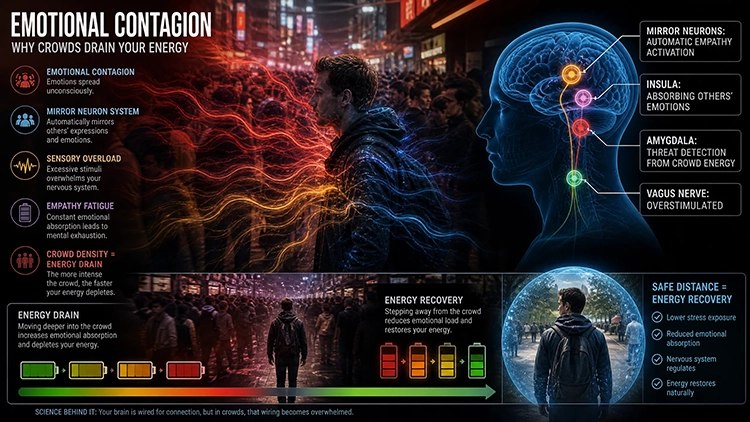
When you walk into a crowded room, your brain does not remain a passive observer. Instead, it continually executes a subterranean process known as emotional contagion.
    [ External Environment: Crowds / High-Stress Media ]
│
▼
[ Subconscious Micro-Cue Detection ]
(Posture, pitch, facial muscle micro-tension)
│
▼
[ Mirror Neuron System Activation ]
│
▼
[ Visceral Somatic Mirroring ]
(Elevated heart rate, cortisol release)
│
▼
[ Executive Reinterpretation: "I am anxious" ]
Through a sophisticated network of mirror neuron systems and subconscious perceptual channels, your brain rapidly scans the people around you. It registers high-pitched vocal tones, subtle facial muscle constriction, hurried walking cadences, and rigid body postures.
Emotional Contagion: The automatic, subconscious process through which an individual mimics and synchronizes their facial expressions, vocalizations, postures, and nervous system arousal with those of another person, leading to a shared emotional state.
Within milliseconds, your autonomic nervous system attempts to co-regulate with the surrounding environment. If the collective environment is fraught with friction, hypervigilance, or hostility, your body mirrors that arousal. Your adrenals release stress hormones like cortisol and adrenaline, elevating your heart rate and placing your body into a low-grade “fight-or-flight” posture.
You are not absorbing an external invisible field; you are experiencing your own body’s evolutionary threat-detection system firing in response to human distress signals.
The Misconception of External Tuning vs. Internal Regulation
It is tempting to look for external explanations—such as planetary frequencies or bio-energetic tools—to resolve this visceral discomfort. These concepts offer a comforting narrative: the idea that our distress is merely an external frequency mismatch that can be fixed by an outside device or passive alignment.
However, relying on external devices to correct internal nervous system states misses the fundamental physiological reality. The human nervous system does not operate like a radio receiver tuned to an external broadcast; it operates as a self-regulating, adaptive network shaped by sensory inputs, cognitive appraisals, and somatic feedback.
┌─────────────────────────────────────────────────────────────┐
│                   THE TWO PATHWAYS                          │
├──────────────────────────────┬──────────────────────────────┤
│ Passive External Dependency  │ Active Biological Grounding  │
├──────────────────────────────┼──────────────────────────────┤
│ • Relies on external tools   │ • Leverages intrinsic biology│
│ • Assumes passive tuning     │ • Activates vagal nerve tone │
│ • Fosters subtle helplessness│ • Restores autonomy & agency │
└──────────────────────────────┴──────────────────────────────┘
When we attribute our internal state entirely to external waves, we inadvertently surrender our psychological agency. True resilience comes from understanding that while we cannot control the emotional climate of a crowd, we possess direct physiological levers to recalibrate our own autonomic state.
The Vicarious Hypervigilance Loop
For individuals with high sensory sensitivity, exposure to tense environments often initiates what can be termed The Vicarious Hypervigilance Loop.
[ Unconscious Somatic Mirroring ] ──► [ Elevated Physical Tension ]
▲                                      │
│                                      ▼
[ Increased Environmental Scanning ] ◄── [ Cognitive Alarm / Threat Assessment ]
- Somatic Mirroring: The body unconsciously mirrors ambient tension from micro-expressions and body language around it.
- Physical Awareness: The individual notices physical symptoms—tightness in the stomach, shallow breathing, a racing pulse.
- Cognitive Attribution: The mind seeks a reason for this sudden change, interpreting the body’s physical discomfort as a sign of immediate personal danger or extreme mental fatigue.
- Amplified Vigilance: This cognitive alarm triggers even greater sensitivity to environmental cues, compounding the feeling of overwhelm.
Breaking this loop requires redirecting focus from trying to fix or shield against the environment to actively signaling safety back to your own brain.
The Real Science of “Grounding”: Why Nature Resets the Mind
Why does spending time in a forest, by the ocean, or in a quiet park feel so profoundly restorative?
While popular myths attribute this restoration to unmeasurable planetary hums, environmental psychology and evolutionary biology offer a clear, empirical explanation: The Biophilia Hypothesis and Attention Restoration Theory.
                   [ Urban / Crowded Setting ]
│
┌─────────────────────┴─────────────────────┐
▼                                           ▼
[ High Sensory Complexity ]               [ Constant Social Cues ]
│                                           │
▼                                           ▼
[ Directed Attention Fatigue ]             [ Autonomic Arousal ]
│                                           │
└─────────────────────┬─────────────────────┘
│
▼
[ Psychological Exhaustion ]
│
▼
[ Transition to Nature ]
│
┌─────────────────────┴─────────────────────┐
▼                                           ▼
[ Fractal Geometry / Soft Fascination ]    [ Non-Threatening Environment ]
│                                           │
▼                                           ▼
[ Parasympathetic Activation ]             [ Vagal Tone Restoration ]
│                                           │
└─────────────────────┬─────────────────────┘
│
▼
[ Restoration of Psychological Agency ]
When you are in a city or a crowded room, your executive brain must constantly deploy directed attention—filtering out background noise, assessing social dynamics, avoiding collisions, and suppressing distractions. This creates severe cognitive fatigue.
Nature, by contrast, presents the brain with what psychologists call soft fascination. The visual geometry of natural environments—such as the fractal patterns in trees, clouds, or water ripples—requires zero effort for the brain to process.
- Reduced Cognitive Load: Natural environments feature low-demand sensory inputs, allowing the prefrontal cortex to rest.
- Autonomic Balance: The absence of perceived social threats allows the vagus nerve to engage the parasympathetic (“rest-and-digest”) branch of the autonomic nervous system.
- Biochemical Signals: Plants emit airborne organic compounds (such as phytontoncides) that have been shown in physiological studies to reduce circulating cortisol levels and lower blood pressure.
Going into nature does not disconnect you from reality; it disconnects you from artificial, high-density social threat signals, allowing your body’s baseline regulatory mechanisms to recover naturally.
Reclaiming Internal Stability: Practical Somatic Shifts
When sensory or emotional overload strikes in daily life, you do not need special equipment to restore balance. You can directly influence your nervous system using biological levers already at your disposal:
1. Extended Exhalations (Vagal Brake Activation)
Your breath cadence directly regulates your heart rate variability. When you lengthen your exhale relative to your inhale (for instance, inhaling for 4 seconds and exhaling for 7 seconds), you stimulate the vagus nerve. This acts as a biological “brake” on your sympathetic nervous system, signaling to your brain that you are safe regardless of your surroundings.
2. Peripheral Vision Widening
Under stress, our visual field narrows into “tunnel vision” to focus on perceived threats. By intentionally relaxing your gaze and expanding your visual awareness to notice your far peripheral surroundings, you signal to your brainstem that there is no immediate predator or danger requiring tight focus, causing muscular tension to release.
3. Sensory Anchoring (5-4-3-2-1 Technique)
To interrupt The Vicarious Hypervigilance Loop, shift your focus away from internal alarm signals and re-anchor your awareness in neutral, physical facts. Name five concrete objects you can see, four textures you can touch, three sounds you can hear, two scents you can smell, and one physical sensation in your feet. This shifts cognitive processing away from threat-appraisal centers and back toward grounded sensory processing.
The next time you feel overwhelmed by a tense crowd or a distressing news cycle, recognize that your body is not broken, nor is it subject to mysterious external forces beyond your control. It is simply doing what human bodies have evolved to do: reading the room. By understanding the true biological mechanisms of emotional contagion and practicing intentional somatic regulation, you move from passive vulnerability to active self-mastery.