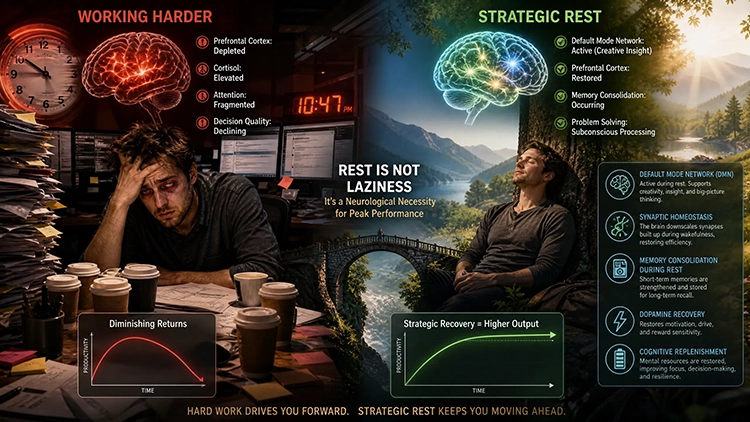
The Productivity Fallacy: Strategic Cessation, Cognitive Recalibration, and the Mechanics of the Sharpened Edge
At the conclusion of a period of sustained exertion, a subtle discomfort often surfaces. It is not physical fatigue, but an existential restlessness: the impulse to resume output. When presented with unstructured time, the modern mind experiences a subtle cognitive friction. We label rest as a luxury, a reward for past accomplishments, or a passive delay in our forward momentum.
In a culture that equates continuous activity with personal worth, pausing is rarely viewed as a neutral state. It is instinctively registered as a surrender—a tactical regression that allows competitors to pull ahead.
Yet, this dynamic reveals a fundamental misunderstanding of performative endurance. The belief that relentless effort yields superior results is a structural fallacy. Continuous exertion without systematic interruption does not maximize cumulative output; it compounds cognitive fatigue, degrades decision-making accuracy, and narrows observational perspective.
To understand why stillness is essential for long-term capability, we must look beyond superficial self-care rhetoric and analyze the neuro-architecture of rest, the mechanics of cognitive recalibration, and the strategic value of purposeful pause.
The Neurobiology of the Unfocused Brain
The dominant cultural model of productivity relies on an industrial metaphor: the human mind as a engine designed for continuous production. When output declines, the prescribed remedy is usually increased effort—forcing the prefrontal cortex to maintain focus through sheer willpower.
However, neurobiological research demonstrates that the brain does not function like an assembly line. It operates via an intricate balance between two primary, mutually exclusive large-scale brain networks:
- The Executive Control Network (ECN): Engaged during goal-directed, highly focused, analytical tasks. It suppresses extraneous sensory information and consumes high levels of metabolic energy.
- The Default Mode Network (DMN): Activates precisely when the individual steps away from explicit tasks, engages in unstructured contemplation, or allows the mind to wander without immediate deadlines.
[ Active Task Execution ] ──► ECN Active / DMN Suppressed ──► High Metabolic Drain (Local Optimization)
│
▼
[ Strategic Cessation ]   ──► ECN Inactive / DMN Active   ──► Subconscious Synthesis (Global Recalibration)
When an individual refuses to pause—continuously working without interruption—the Executive Control Network experiences sustained depletion. The result is not merely physical tiredness, but Cognitive Tunneling: a state in which the brain loses its capacity for abstract reasoning, pattern recognition, and long-range strategic assessment.
Cognitive Tunneling: A neurological state induced by prolonged executive strain where working memory contracts, forcing the mind to focus exclusively on immediate, tactical tasks while missing broad structural solutions.
The Default Mode Network is not an idle system; it is the primary engine of background integration. When you deliberately disengage from an immediate problem, the DMN synthesizes disparate memories, identifies hidden structural patterns, and consolidates complex learning. The sudden breakthrough that occurs while taking a walk or pausing mid-task is not accidental; it is the direct neurochemical output of background processing.
The Identity Engine: Production as Self-Preservation
If the performance benefits of strategic rest are demonstrably clear, why does the human mind fight so hard against stopping?
The answer lies in how modern identity is constructed. For many high-performing individuals, continuous activity is not merely an operational choice; it serves as a Psychological Defense Mechanism.
  Traditional Assumption:    Lack of Rest  ──►  Poor Time Management
Structural Reality:       Continuous Output ──► Identity Anchoring ──► Avoidance of Existential Uncertainty
When self-worth is unconsciously anchored to quantitative output, stepping away from the arena triggers deep-seated threat responses. Unstructured time forces an encounter with underlying questions that busyness conveniently conceals:
- Who am I when I am not actively producing?
- Is my value intrinsic, or is it contingent upon my utility to others?
- What quiet anxieties emerge when the ambient noise of labor stops?
To evade these uncomfortable inquiries, the ego constructs a compelling narrative: I cannot afford to pause right now; too much depends on my continued presence.
This is the origin of The Productivity Fallacy. We convert chronic overwork into a badge of moral superiority, mistaking exhaustion for competence and motion for progress. We stay active not because it is effective, but because stopping threatens the structural integrity of the professional ego.
The Economics of Effort: The Sharpened Blade Protocol
The classic allegory of two woodcutters illustrates this principle with precision. One cuts trees continuously without pause, sweating profusely, driven by the fear of losing time. The second stops for fifteen minutes every hour. At the end of the day, the second woodcutter has harvested significantly more timber.
When asked how this was possible, the answer is simple: “During those fifteen minutes, I was not simply resting; I was sharpening my axe.”
                       [ CONTINUOUS EXERTION ]
Effort Curve:   ─────────────────────────────────► High Energy Spent
Output Curve:   ───────────┐
└─────────────────────► Diminishing Returns
[ STRATEGIC CESSATION ]
Effort Curve:   ───┐   ┌───┐   ┌───┐   ┌───┐   ┌───► Controlled Energy
└───┘   └───┘   └───┘   └───┘
Output Curve:   ─────────────────────────────────► Sustained Peak Yield
This simple narrative contains a profound principle in behavioral economics: The Law of Diminishing Marginal Returns on Uncalibrated Effort.
| Metric | Continuous Uncalibrated Effort | Strategic Cessation Protocol |
|---|---|---|
| Primary Tool | Dull Edge (Depleted Prefrontal Cortex) | Sharpened Edge (Restored Executive Function) |
| Focus Profile | Reactive, Fragmented, Short-Term | Intentional, Systemic, Long-Range |
| Energy Consumption | High Expenditure / Low Efficiency | Regulated Expenditure / Maximum Efficiency |
| Long-Term Trajectory | Accelerated Burnout & Structural Error | Sustained High Output & Adaptive Capacity |
When you operate with a dull tool, every subsequent action requires exponentially more physical and mental force to achieve baseline results. The woodcutter who does not stop works harder, burns more calories, and generates more heat, but cuts less wood.
In knowledge work, the “blade” is your executive capacity—your judgment, attention span, emotional stability, and creative synthesis. Continuing to work with a depleted mind is the operational equivalent of swinging a blunt iron bar against an oak tree: immense noise, maximum strain, and negligible progress.
Strategic Cessation: Reframing Rest as Tactical Recalibration
To break free from the productivity trap, we must redefine rest. Rest is not a reward you earn after work is completed; it is an active, strategic component of the work itself.
Old Model:   Work ──► Exhaustion ──► Passive Recovery (Guilt-Laden Rest)
New Model:   Strategic Work ──► Intentional Pause ──► System Recalibration ──► Peak Execution
Transitioning from passive exhaustion to Strategic Cessation requires three fundamental mental shifts:
1. Shift from Temporal Evaluation to Impact Yield
Stop measuring your day by the number of hours you remained seated at a desk or the quantity of minor tasks you cleared. Measure your performance by the clarity of your strategic decisions and the quality of your deep execution. A single sharp decision made with full cognitive capacity often outweighs ten hours of reactive, low-energy labor.
2. Implement Unstructured Deliberate Pauses
Incorporate structured, non-negotiable pauses into your routine before exhaustion forces them upon you. A strategic pause should contain zero cognitive inputs—no emails, no instructional podcasts, no algorithmic newsfeeds. Allow the Default Mode Network to process, organize, and synthesize your existing internal knowledge without competing for bandwidth.
3. Decouple Worth from Immediate Utility
Acknowledge that your fundamental value as a human being is not an accounting equation calculated by daily output. When you liberate your identity from continuous performance, rest ceases to feel like a guilty concession and becomes what it was always meant to be: a quiet, essential recalibration of human agency.
The Sovereign Perspective
The urge to run continuously without stopping is not a mark of extraordinary dedication; it is often a sign of underlying friction. True mastery is demonstrated not by the ability to endure endless wear and tear, but by the intelligence to maintain the structural integrity of your tools.
The next time you feel the urge to press forward despite profound cognitive fatigue, step back and examine the blade you are swinging.
In a world obsessed with continuous speed, the most decisive move you can make is not to swing harder—it is to take the time to sharpen the edge.
The Audit of Operational Capacity
To assess whether your current routine is building or eroding your capability, ask yourself these three structural questions:
- Am I working continuously because my presence is genuinely producing high-value outcomes, or because stopping exposes me to an uncomfortable internal silence?
- Is my current level of effort yielding maximum output, or am I applying force through a depleted, unsharpened mind?
- If I viewed strategic rest not as downtime, but as an essential element of long-term capability, what non-essential task would I immediately drop from my schedule?