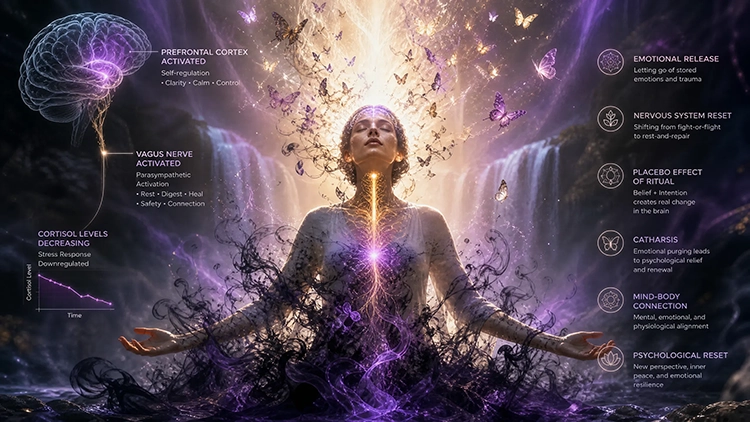
The Architecture of Energetic Entropy: A Neuro-Psychological Analysis of Ritual Cleanse
Human beings exist as complex open systems, constantly exchanging information, emotion, and neuro-chemical signals with their environment. In modern discourse, when an individual speaks of feeling “spiritually heavy,” “energetically drained,” or in need of “spiritual purification” (ruhsal arınma), they are rarely describing a supernatural anomaly. Instead, they are articulating a tangible phenomenon: energetic entropy.
[External Stressors / Hyper-Connectivity]
│
▼
[Autonomic Nervous System Overload]
│
▼
[Allostatic Load & Cognitive Entropy] ──► "Energetic Heavy/Stagnant State"
│
▼
[Deliberate Somatic & Attentional Rituals]
│
▼
[Homeostatic Reset & Parasympathetic Shift]
When our attentional channels are perpetually saturated by chronic stressors, micro-traumas, social friction, and digital noise, the human nervous system loses its homeostatic balance. The subjective experience of this loss is a sense of emotional stagnation, chronic fatigue, and cognitive fragmentation.
What is the true mechanism behind spiritual cleansing rituals? What esoteric traditions describe as “clearing negative energy” is neurobiologically understood as the deliberate down-regulation of the sympathetic nervous system and the clearing of cognitive residue. Through somatic grounding, intentional focus, and environmental resetting, purification practices disrupt emotional contagion loops and restore parasympathetic dominance, shifting the brain from high-beta stress reactivity into coherent alpha and theta states.
Understanding spiritual purification requires moving beyond supernatural assumptions and reductionist dismissal. By examining the structural intersection of psychology, neuroscience, and human ritual, we discover how these practices systematically recalibrate the mind-body apparatus.
The Neurobiology of Stagnation: Allostatic Load and Emotional Contagion
To clear “negative energy,” one must first define what this energy actually is within human physiology.
When the brain perceives continuous environmental threats—whether an inbox flooded with urgent requests, hostile social dynamics, or global instability—it maintains a perpetual state of hyper-vigilance. This produces a elevated allostatic load: the cumulative physiological wear and tear on the body resulting from ongoing stress responses.
+-------------------------------------------------------------------------+
|                  THE SPECTRUM OF PHYSIOLOGICAL STATES                   |
+-------------------------------------------------------------------------+
|  SYMPATHETIC DOMINANCE (Stagnation)   │  PARASYMPATHETIC RESET (Purified) |
|  • High-Beta brainwaves (20–30 Hz)    │  • Alpha/Theta waves (4–12 Hz)    |
|  • Elevated cortisol & systemic inflammation │  • Lowered heart rate & vagal tone  |
|  • Fragmented attention & reactivity  │  • Integrated cognitive capacity  |
+-------------------------------------------------------------------------+
Simultaneously, human beings are bound by emotional contagion—a process mediated by mirror neuron networks that involuntarily absorb the physiological stress states of those around us. Without deliberate interventions to reset this emotional baseline, the brain accumulates cognitive residue, manifesting as the feeling of being “energetically blocked.”
(How, then, do classic ritual practices disrupt this neurological accumulation?)
Somatic and Olfactory Anchors: Overriding the Threat Response
For thousands of years, cultures across the globe have utilized specific physical elements—smoke, thermal shifts, and acoustic resonance—for energetic clearing. Far from being arbitrary superstitions, these practices directly target human neurobiology.
1. Thermal Shock and Autonomic Modulation
Practices involving extreme heat—such as traditional saunas or sweat lodges (temazcal)—act as powerful physiological resets. Thermal stress triggers heat-shock proteins, induces systemic vasodilation, and promotes the excretion of metabolic byproducts through perspiration. More importantly, the intense sensation forces the brain out of abstract rumination and into absolute present-moment somatic awareness, effectively breaking severe cognitive loops.
2. The Olfactory Express Way
The olfactory nerve provides the only direct neurological pathway from the external environment to the amygdala and limbic system, bypassing the rational prefrontal cortex entirely.
When one burns sacred resins, sage, or uses essential oils like sandalwood and lavender, the aromatic compounds register instantly within the emotional brain. This rapid chemical signaling can immediately alter emotional states, lowering heart rate and signaling safety to a hyper-reactive nervous system.
[Aromatic Volatiles] ──► [Olfactory Bulb] ──► [Limbic System / Amygdala] ──► [Immediate Parasympathetic Down-Regulation]
3. Auditory Entrainment and Neural Coherence
Acoustic modalities—such as singing bowls, gongs, or structured mantras—rely on the principle of neural entrainment. The human brain naturally synchronizes its internal wave frequencies to external rhythmic stimuli. Exposure to sustained, low-frequency soundscapes shifts brainwave activity from chaotic, high-beta waves (associated with anxiety and hyper-vigilance) down to coherent alpha and theta waves (associated with deep meditation, restorative sleep, and cellular repair).
The Cognitive Mechanisms of Purification
Physical interventions address the somatic container, but true psychological reset requires re-architecting how attention is allocated.
The Attentional Entrapment Principle: Energy follows attention. When an individual continually directs cognitive resources toward past grievances, hypothetical catastrophes, or social comparisons, the brain reinforces those precise neural pathways, making distress the default operating system.
To reverse this entropy, four psychological anchors must be deployed:
1. Linguistic Reframing through Mantras
A mantra or positive affirmation is not a magical incantation; it is a cognitive anchor. By deliberately repeating a specific linguistic sequence (e.g., “I release all structures that no longer serve my functional health”), you interrupt the automatic default mode network (DMN)—the brain region responsible for self-referential judgment and anxiety—replacing intrusive thoughts with intentional cognitive direction.
┌─────────────────────────────────┐
│     Default Mode Network        │ (Active: Rumination, Self-Doubt, Anxiety)
└────────────────┬────────────────┘
│
[Mantra / Intentional Focus]
│
▼
┌─────────────────────────────────┐
│  Task-Positive Network (TPN)    │ (Active: Presence, Clarity, Executive Control)
└─────────────────────────────────┘
2. Expressive Externalization (Journaling)
The act of writing down internal distress engages the left hemisphere of the brain, transforming vague, overwhelming emotional distress into tangible, bounded linguistic structures. This process—known in affect labeling research—reduces amygdala activation. Once an emotion is converted into words on paper, the brain no longer needs to store it as a high-priority threat in working memory.
3. Biophilic Grounding
Spending time in natural environments (Shinrin-yoku or forest bathing) strips away the unnatural, highly artificial stimuli of urban life. Nature presents patterns of “soft fascination”—fractals in trees, wave motions, organic sounds—that engage attention effortlessly without taxing the prefrontal cortex, allowing cognitive reserves to regenerate.
4. Somatic Energy Discharge (Movement and Asana)
Traumatic micro-events and chronic stress register as chronic muscular bracing, particularly in the hips, shoulders, and diaphragm. Structured somatic movement, such as yoga, pairs controlled respiration with targeted muscular stretch, releasing physically held tension and sending retroactive feedback to the brain that the physical body is no longer in danger.
Diagnostic Criteria: Identifying Energetic Entropy
Because the need for energetic resetting is a physiological reality rather than a abstract preference, it manifests through distinct clinical markers. Recognize these four key indicators that your system requires a deliberate reset:
- Somatic Fatigue Independent of Rest: Experiencing profound exhaustion despite adequate hours of sleep, indicating chronic sympathetic nervous system activation during rest cycles.
- Emotional Volatility or Anhedonia: Oscillating rapidly between hyper-reactivity (irritability, anxiety) and complete emotional numbness or detachment.
- Default Negativity Bias: Automatically filtering neutral inputs as inherently hostile or deficient, actively seeking out confirmation of personal or situational failure.
- Attention Fragmentation: An inability to maintain deep focus on a single task, accompanied by a compulsion to continuously engage with hyper-stimulating external inputs.
The Synthesis of Autonomy and Ritual
Human beings do not outgrow ritual; we merely replace intentional rituals with unintentional ones. Scrolling endlessly through social media feeds in the dark is as much a ritual as a structured cleansing bath—it is simply a ritual that induces entropy rather than coherence.
Purification is not an act of escaping reality or appealing to external forces for rescue. It is the disciplined, highly conscious reclamation of your physical and psychological environment. By systematically clearing physical space, down-regulating the nervous system, and asserting control over where your attention resides, you transition from a passive recipient of environmental noise into the active architect of your internal state.