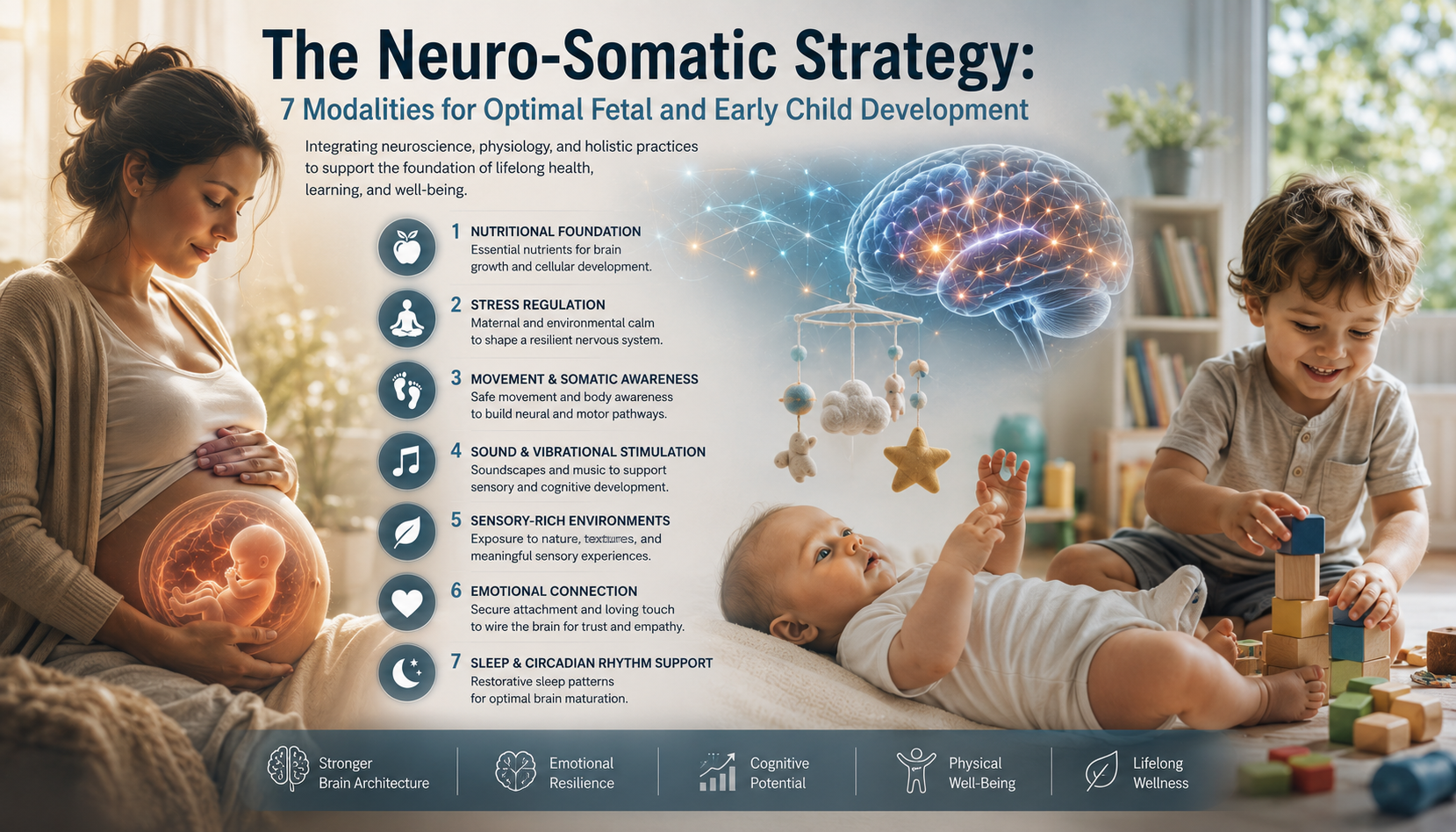
Why do we often treat early childhood education as the true beginning of cognitive development, while ignoring the complex neurological architecture being built entirely in the dark, months before birth?
We live in a culture that treats the womb as a passive waiting room and the newborn mind as a blank slate. We assume that structural optimization begins only when a child starts to speak or read. In reality, the foundational blueprint of the human nervous system is structurally established, myelinated, and deeply conditioned long before the first breath is taken.
If a child experiences learning difficulties or emotional dysregulation later in life, it is rarely due to a sudden lack of willpower. It is often the result of subtle, early developmental adjustments made by the brain in response to its earliest environments. Protecting and nurturing this developmental window requires far more than basic parenting advice; it demands a precise management of the biological and environmental variables that shape early neural structures.
The Gestational and Environmental Epigenetic Matrix
According to clinical guidelines established by leading public health institutions, optimizing early brain development requires a proactive, multi-phase strategy that bridges prenatal biology and early environmental design.
[Prenatal Nutrients & Safety] --> [Somatic Stress Reduction] --> [Enriched Environment]
|                                 |                          |
Synaptic Sprouting               Myelin Protection           Network Expansion
1. Micronutrient Calibration and Neural Tube Integrity
The structural baseline of the central nervous system requires specific chemical resources long before development can be observed. Maintaining a precise nutritional protocol prior to and during gestation—specifically optimizing levels of folik acid (folic acid) and iron—is a mandatory biological prerequisite. Folic acid serves as the primary catalyst for neural tube closure, preventing severe congenital anomalies, while iron drives cellular oxygenation and early dendritic expansion.
2. The Absolute Exclusion of Teratogenic Compounds
The developing fetal brain lacks the metabolic filtration systems required to detoxify environmental toxins. Even minor exposure to alcohol can pass through the placental barrier, permanently altering the delicate migration of neurons during cerebral cortex formation. Similarly, nicotine exposure acts as a potent vasoconstrictor, restricting fetal oxygen supply. Clinical observations consistently link prenatal smoking to significantly reduced total brain volume, presenting as diminished density in both gray and white matter networks.
3. Immunological Defenses and Neurological Protection
Systemic maternal infections can trigger severe inflammatory cascades that disrupt fetal neurodevelopment. Adhering to targeted immunization schedules during gestation—specifically securing the Tdap vaccine between weeks 27 and 36—provides critical protection against pertussis (whooping cough). Without this protection, the resulting bacterial toxins can cause severe neonatal hypoxia and irreversible brain damage.
4. Barrier Protocols Against Neurotropic Pathogens
Certain sexually transmitted infections (STIs)—including syphilis, genital herpes, and HIV—possess neurotropic properties, meaning they actively target and destroy nerve tissue. If transmitted to the fetus, these pathogens can cause severe structural damage, presentations of microcephaly, and cognitive deficits. Implementing strict safer-sex protocols, including consistent barrier methods and regular diagnostic screening, directly shields the developing fetal nervous system from pathogen-induced degradation.
Somatic Regulation and Architectural Enclosure
The blueprint of early brain development is shaped not only by physical pathogens, but also by the chemical signals generated by the maternal nervous system.
+-----------------------------------------------------------------+
|               THE CORTISOL-MYELIN COMPROMISE                    |
+-----------------------------------------------------------------+
| CHRONIC MATERNAL STRESS --> High Cortisol Crosses Placenta      |
|                                     |                           |
|                                     v                           |
| DETRIMENTAL IMPACTS     --> Reduced Cerebral Volume             |
|                         --> Damaged White Matter Connections     |
+-----------------------------------------------------------------+
5. Cortisol Mitigation and White Matter Protection
When the maternal system experiences chronic psychological stress, the prefrontal cortex is continuously flooded with cortisol. This hormone easily crosses the placental barrier. Prolonged fetal exposure to elevated cortisol levels alters the structural architecture of the developing brain, decreasing total cerebral volume and weakening the white matter tracts responsible for cross-hemispheric communication.
To protect this developing structure, the maternal nervous system must regularly return to a state of somatic safety. Utilizing dedicated mind-body practices —such as regulated sleep cycles, restorative movement, and deliberate mindfulness techniques—actively lowers systemic cortisol, preserving the delicate process of early myelination.
6. The Stability of the Postnatal Sanctuary
Following birth, the infant brain remains highly suggestible, operating predominantly in lower-frequency brainwave states. A chaotic, high-allostatic-load home environment functions as a chronic low-level threat to the infant’s nervous system. Conversely, a quiet, predictable, and emotionally responsive domestic environment acts as a structural sanctuary. When early interactions are anchored in safety and emotional attunement, the infant’s brain drops its defensive threat-scanning reflexes, freeing up vital metabolic energy for deep cortical development.
7. Cognitive Enrichment and Synaptic Sculpting
The long-term processing capacity of the human mind is determined by the density and efficiency of its neural circuits. Exposing infants and young children to novel, creatively stimulating environments acts as a potent catalyst for synaptic sprouting.
By encouraging exploratory play, sensory variety, and rich linguistic interaction, you actively prompt the child’s brain to construct complex, highly integrated neural pathways. This early structural enrichment provides the cognitive foundation that supports emotional intelligence, problem-solving capacity, and social adaptability for the rest of the child’s life.
Ultimately, the human brain does not automatically fulfill its highest potential in a vacuum; it requires a carefully curated ecosystem of biological security, somatic safety, and deliberate intellectual enrichment to transform its raw genetic blueprint into a highly optimized instrument of thought.