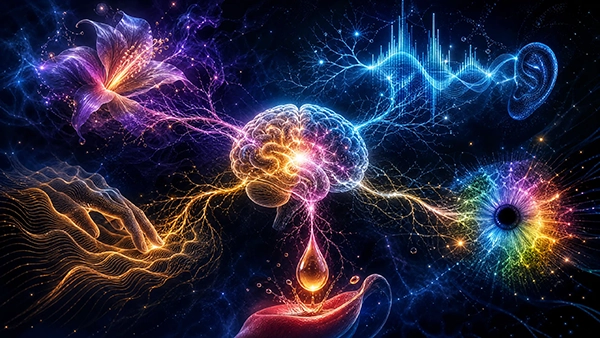
The Electric Silence Inside Your Head
Have you ever stopped on a quiet evening, absolute stillness wrapping around the room, and wondered what is actually going on behind your eyes right now?
We go through our lives entirely taking this biological vehicle for granted. We eat, we argue, we fall in love, we scroll through our phones, rarely pausing to consider that we are walking around inside a living, breathing miracle. You are essentially a ghost wearing a coat of bone and muscle, steered by a three-pound mass of wet tissue sitting in total darkness.
And that is perhaps the most surreal thing about the brain: it lives in complete, absolute pitch blackness. It has never seen a sunset, never heard a note of music, never touched a cold glass of water. Yet, out of tiny electrical pulses zip-lining through cellular fibers, it constructs your entire reality. It creates the color blue, the sting of a cold wind, the bittersweet ache of nostalgia.
It is the ultimate storyteller, working continuously on a power draw that wouldn’t even keep a faint bedside nightlight burning.
The Night Shift and the Ten-Watt Miracle
Think about that ten-watt figure for a moment. Right now, as your mind processes these words, weighs the ideas, and perhaps remembers an old friend, it is running on roughly the same amount of energy it takes to power a low-voltage refrigerator bulb. Supercomputers consume megawatts of electricity and require massive liquid-cooling towers just to play a decent game of chess. Your brain handles language, keeps your heart beating, balances your posture, filters millions of sensory inputs, and ponders the meaning of existence—all on a slice of toast and a cup of coffee.
What’s even wilder is what happens when you finally call it a night and close your eyes. You might think your brain powers down alongside your tired legs, but it actually does the exact opposite.
When the sun goes down, the brain goes out to play.
While you are fast asleep, your neural highways light up with furious activity. Neurons fire in complex rhythms, filing away memories, washing out metabolic debris with cerebrospinal fluid, and weaving dreams. If you’ve ever noticed that you dream with intense, vivid imagery, some cognitive scientists suspect that higher analytical processing might actually fuel more complex dreamscapes. It’s as if the moment the world goes quiet, your mind opens a private theater and runs its own surreal film festival.
The Hidden Superpowers of Your Senses
We tend to look at our senses as passive receivers, like tiny cameras and microphones collecting data from the outside world. But they are far more active—and far more bizarre—than we give them credit for.
Consider your sense of smell. Aside from identical twins, every single human being on this planet carries an entirely unique olfactory signature. A newborn baby, still blind to the details of the room, can pick their mother out of a crowd simply by the chemical whisper of her skin. Your nose doesn’t just smell the world; it archives it, holding the memory of over fifty thousand distinct scents. One whiff of an old pine floorboard or a specific brand of cheap perfume can instantly catapult you back to a summer afternoon when you were seven years old.
Or take the way we navigate space. We usually associate echolocation with bats darting through caves or whales singing in the deep ocean. But humans do it too. Without realizing it, your brain listens to the subtle bounce of sound off walls and furniture to map the room around you. If you walk into a large, empty cathedral with your eyes closed, you feel the vastness of the space before you even open your mouth to speak.
And then there’s the strange, elastic nature of time itself. Time isn’t a ticking clock on a wall; it’s an internal construction. When adrenaline surges through your bloodstream—giving you that legendary, near-superhuman strength to react in an emergency—your brain suddenly cranks up its sampling rate. It packs far more sensory detail into every fraction of a second. In moments of intense stress or awe, time literally dilates. The world slows down because your brain is suddenly living at a much higher frame rate.
A Question to Sit With
Tonight, as you lay your head on the pillow and feel the heavy blanket pull over your shoulders, take ten seconds to just listen to your own breathing, and ask yourself: What amazing, invisible story is my mind preparing to tell me while I sleep?