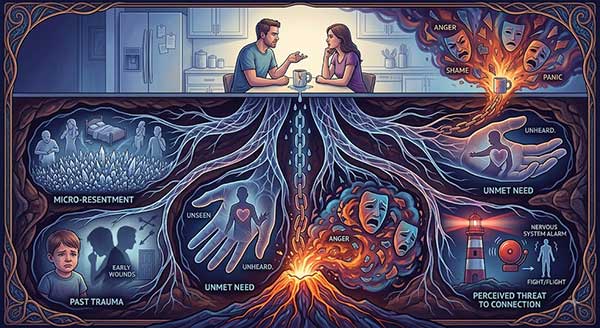
THE ANATOMY OF AN ECHO: DECODING THE MATRIX OF ATTACHMENT AND THE SOMATIC TRIGGER
“Please don’t leave me, I cannot survive without you!” “Look at everything I sacrificed for this bond…”
We toss these desperate phrases around under the banner of romance, rarely noticing that our nervous systems are not communicating affection—they are sounding an ancient alarm of abandonment. Whether it manifests in friendships, workplaces, or partnerships, every relational friction is less about the person standing in front of us and more about an old ghost rattling its chains.
THE CARTOGRAPHY OF THE SOMATIC TRIGGER
When a partner’s unread text, a sudden tone shift, or an unexpected silence sends a wave of heat or tightening terror into your chest, you are not reacting to the present moment. You are experiencing a somatic echo.
In clinical terms, a trigger is an implicit memory loop where the amygdala hijacks the prefrontal cortex, interpreting a minor social ambiguity as a life-or-death survival threat.
- The Physical Signatures: Shallow breathing, a racing pulse, a sudden constriction in the throat—your body is literally acting as though physical exile is underway.
- The Automatic Loop: In that pressurized microsecond, we drop into default defensive strategies: lashing out, weaponizing guilt, or shrinking into desperate compliance.
As developmental psychologist John Bowlby demonstrated through attachment theory, the blueprint for these panic responses is forged long before adulthood, rooted entirely in the early relational ecosystem we shared with our primary caregivers.
THE ARCHAEOLOGY OF FIRST CODE
We love to cast our current partners or colleagues as the villains of our emotional dramas. Yet, beneath the surface of every explosive argument lies unmined soil.
[ EARLY PRIMARY BOND ] ──> [ IMPLICIT ATTACHMENT WOUNDS ] ──> [ ADULT RELATIONAL PROJECTION ] ──> [ REPEATED RELATIONAL LOOPS ]
The home of our childhood lays down the foundational codebook for how we believe love is earned, preserved, or lost. If safety was conditional, our adult nervous systems learn to equate partnership with hyper-vigilance. When a trigger flares up, it is not a breakdown—it is an invitation. The shadow self is simply stepping out of the dark, holding out its hands, asking to be seen rather than weaponized.
THE SHIFT FROM CAPTIVITY TO SOVEREIGNTY
To break the loop of the desperate martyr—the one who whispers “I did everything for you”—requires a radical pivot in self-awareness.
- The Pause: The hardest, most transformative work is refusing to act on the first wave of adrenaline. It is sitting quietly in the uncomfortable crossfire of your own inner panic.
- The Detective’s Stance: Instead of asking, “Why are they hurting me?” turn the lens inward and ask, “What ancient script is my body trying to rewrite right now?”
- The Reframing of Love: True affection does not demand that another person anchor your ungrounded soul.
When we finally stop using other people as emotional tourniquets, we unlock a completely different paradigm of connection. Looking inward with profound tenderness allows us to rewrite our internal script. Only when we can stand in our own quiet sovereignty—breathing into our own completeness—can we look someone in the eyes and say “I love you” from a place of abundance rather than starvation.
EMPIRICAL REFERENCES
- Bowlby, J. (1982). Attachment and Loss: Vol. 1. Attachment (2nd ed.). Basic Books. (Foundational framework mapping how early parental bonding patterns dictate adult emotional regulation and abandonment triggers).
- Porges, S. W. (2011). The Polyvagal Theory: Neurophysiological Foundations of Emotions, Attachment, Communication, and Self-Regulation. W. W. Norton & Company. (Explains the somatic mechanics of how perceived social rejection triggers primitive fight-flight-freeze responses in the autonomic nervous system).