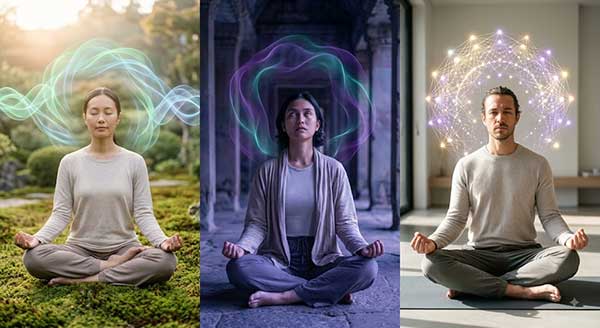
The Architecture of Stillness: Navigating the Three Pillars of Meditation
For centuries, humanity has returned to a simple, radical act: sitting down and training the mind. We live in an era where our attention is carved up by a thousand daily distractions, making the quiet discipline of meditation feel less like a luxury and more like an act of reclamation. Meditation is not about forcing the mind into a rigid vacuum; rather, it is a vast landscape with distinct pathways.
The Discipline of the Beam: Focus Meditation
At the core of nearly every contemplative tradition lies the art of concentration. Focus meditation is the rigorous training of the mind’s beam—gently pulling our wandering attention away from the mental chatter and tethering it to a single anchor, like the breath. If you have ever tried to sit in silence, you already know the humbling truth: even seasoned teachers find their minds drifting off. The golden rule is simply starting over, again and again.
When we look at the neurobiology of this practice, pioneering EEG research led by Dr. Richard Davidson at the University of Wisconsin-Madison revealed something remarkable: during intensive concentration and loving-kindness meditation, expert practitioners generate extraordinarily high-amplitude gamma-band oscillations, neural signatures associated with active, heightened consciousness and sharp cognitive binding. Disciplines like Zen, Qigong, and Yoga use this laser focus to actively steer our neural machinery.
The Art of Witnessing: Mindfulness Meditation
While focus is about holding the beam steady, mindfulness is about widening the horizon. Sometimes called insight meditation, its core aim is to cultivate a radical, unblinking awareness of our bodily sensations and the passing weather of our thoughts. In practices like Vipassana, the goal isn’t to wrestle your thoughts into submission—an exhausting habit we carry into daily life without realizing it. Instead, you learn to watch thoughts arise without immediately trying to fix them.
Neuroimaging studies, such as the landmark structural analyses conducted by Harvard neuroscientist Dr. Sara Lazar, demonstrate that mindfulness practice correlates with physical changes in brain regions associated with memory, empathy, and stress regulation, often accompanied by subtle theta wave activity linked to deep introspection and emotional processing.
Beyond Effort: Transcendental Meditation
Then there is a third path, brought to global prominence by Maharishi Mahesh Yogi. Transcendental Meditation (TM) occupies a unique space because it does not ask you to steer or actively witness the mind. Instead, it invites consciousness to settle effortlessly beyond thought into a state of quiet, self-referential peace through the silent repetition of a specific mantra for twenty minutes twice a day.
Neurologically, TM bathes the brain in alpha waves—the signature rhythm of relaxed wakefulness. Unlike purely subjective wellness fads, TM is backed by extensive clinical data. Notably, in a comprehensive scientific statement published by the American Heart Association (2013), researchers evaluated multiple clinical trials and officially reported that Transcendental Meditation is clinically effective for lowering blood pressure and supporting overall cardiovascular health.
Whether you prefer the disciplined laser of focus, the compassionate witnessing of mindfulness, or the effortless surrender of transcendence, the destination is always the same: a more spacious, resilient relationship with yourself.