Befriending the Quiet Room
We spend our days sprinting through an invisible obstacle course of obligations, frantically checking off boxes just to prove we exist. When an unscripted evening finally opens up before us, our immediate reaction is often a quiet panic. We grab our phones, scroll through endless digital feeds, or say yes to superficial gatherings—anything to avoid staring down the empty room.
Yet, the irony is stark. We sit in crowded restaurants, attend bustling social mixers, and maintain digital lifelines with hundreds of people online, only to feel a hollow, echoing isolation settling deep in our chests. We have confused proximity with connection, running away from physical solitude under the false assumption that being by ourselves is the ultimate proof of being unloved.
The Great Misunderstanding: Solitude vs. Loneliness
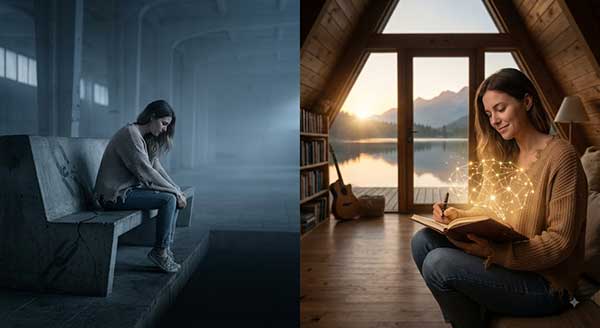
There is a profound, life-altering difference between emotional loneliness—the aching sensation of feeling unseen even in a crowd—and voluntary solitude, which is the chosen sanctuary of the self.
When we constantly flee from quiet moments, we starve our inner ecosystem. As MIT researcher and psychologist Dr. Sherry Turkle points out in her extensive explorations of human connection and technology, our flight from solitude has eroded our capacity for deep self-reflection. We have become so accustomed to outsourcing our emotional regulation to external validation that sitting alone with our thoughts feels like an unfamiliar, hostile climate.
However, psychological research paints a radically different picture. Studies examining the restorative nature of aloneness—such as the empirical reviews compiled by psychologist Dr. Virginia Thomas—highlight that intentional, self-chosen solitude is a vital catalyst for human thriving. Far from being a punishment, brief and welcomed periods of aloneness offer distinct psychological dividends:
- Cognitive Decompression: It quiets the brain’s default mode network, lowering cortisol and clearing the mental static accumulated through the day.
- Creative Incubation: True innovation and deep problem-solving require uninterrupted interior space, free from the subtle performance pressures of other people.
- Relational Calibration: As the old wisdom suggests, you cannot truly show up as a deep, grounded partner to others if you are a total stranger to yourself.
Cultivating the Art of Self-Appreciation
If we want to enjoy our own company, we have to unlearn the belief that affection and validation are commodities that must always be imported from the outside world. We wait for a partner, a boss, or a friend to hand us our worth, forgetting that the most enduring sanctuary is the one we build within.
Bringing warmth back into your solo hours doesn’t require a radical lifestyle overhaul; it begins in the quiet, overlooked micro-moments of ordinary days:
- The Unplugged Drift: Take yourself out for a quiet evening walk without your phone acting as a digital shield. Let your senses actually register the pavement, the air, and the city lights.
- The Mirror Glance: The next time you wash your face or brush your teeth, pause. Meet your own eyes in the mirror with the same gentle, uncritical warmth you would offer a child or a beloved pet.
- Internal Validation: When you finish a grueling project or tidy your space, stop and say thank you to yourself. Ask a simple, honest question: If someone else had done this for me, would I express gratitude? If the answer is yes, hand that appreciation inward.
- Dressing for the Audience of One: Put on that nice shirt or make that special tea just because your own presence deserves the effort.
Solitude is not a waiting room for someone else to arrive; it is the room where you finally meet yourself.
References
- Turkle, S. (2015). Reclaiming Conversation: The Power of Talk in a Digital Age. Penguin Press.
- Thomas, V. N., & Azmitia, M. (2019). Motivation matters: Development and validation of the Motivation for Solitude Scale (MSS). Journal of Adolescence, 70, 33-42.