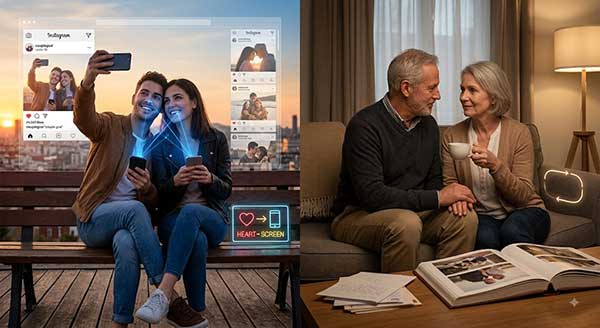
The Swipe Culture Trap: How Social Media is Rewriting Modern Love
Patience, unwavering will, and emotional stability used to be the foundational architecture of any enduring relationship. It took a quiet, deliberate kind of strength to weather the inevitable storms of a shared life—holding space for a partner’s rough edges, committing to steady communication when things broke down, and cultivating an everyday resilience rooted in mutual respect. Yet, if you look around at the modern romantic landscape today, you are struck by a very different, pervasive feeling: a profound, collective exhaustion.
Humanity has always prided itself on its capacity for adaptation. From the dawn of civilization, survival has depended entirely on our ability to bend, stretch, and re-engineer our habits when the environment shifts beneath our feet. But the digital revolution arrived with such dizzying, unyielding speed that our ancient emotional wiring has struggled to keep pace. Today, our relational flexibility has turned brittle. Instead of deep roots, we have cultivated a culture of disposable convenience. We live in an era of fleeting hookups, nameless encounters, perpetually impatient partners, and a vast, lonely army oscillating restlessly between anxious attachment and cold, defensive avoidance.
When an era is flooded with abundance, human nature has a peculiar habit of turning destructive—consuming everything in sight with a reckless, hollow hunger. With the advent of social media, that ravenous appetite turned inward, slowly beginning to devour our own capacity for genuine human connection. What, precisely, did social media do to the delicate art of loving one another?
The Weight of Absolute Accessibility
Consider how drastically the mechanics of basic human contact have changed. If you want to reach someone today, you no longer need to know their home address, memorize their landline number, or wait anxiously for a scheduled meeting. If Application A fails to deliver an instant response, Applications B, C, D, and E are waiting eagerly in your pocket, humming with notifications.
While this hyper-connectivity feels liberating on the surface, it has quietly corroded the bedrock of relational responsibility. When a person is reachable at any second of the day, with zero friction or physical distance standing in the way, a dangerous psychological script begins to play out in the back of the mind: “If you are this easily accessible to me, you must be just as easily accessible to everyone else. And if maintaining this connection requires actual effort, why bother? Someone else is only a tap away.”
We have mistaken physical convenience for emotional intimacy. By stripping away the natural buffers of time, distance, and anticipation, social media has transformed accessibility from a tool of connection into a built-in excuse for emotional cowardice.
The Open Buffet Syndrome and the Paradox of Choice
Beyond mere accessibility lies an even more disorienting illusion: infinite variety. We now inhabit a digital marketplace where it feels as though a better, shinier, more compatible option is always just a scroll away. Yet, everyone is simultaneously broadcasting their own hyper-curated version of “uniqueness.”
This dynamic turns the modern social landscape into a digital all-you-can-eat buffet. When you step up to an endless banquet of human faces, profiles, and personalities, the natural impulse is to load your plate until it collapses—sampling a little bit of everyone, chasing novelty, and refusing to commit to a single dish because the next table over looks just a bit more enticing.
This mirrors what psychologist Barry Schwartz famously diagnosed as the paradox of choice. When human beings are confronted with an overwhelming array of alternatives, satisfaction plummets, anxiety skyrockets, and we become entirely paralyzed when it comes to making meaningful commitments. We keep one eye perpetually fixed on the exit doors, terrified that choosing one path means missing out on a dozen others. The result? A collective case of emotional indigestion—we gorge ourselves on endless superficial validation while starving our souls of actual nourishment.
The Highlight Reel and the Perfection Trap
Perhaps the most insidious trick social media plays on our intimate lives is the manufacturing of a relentless perfection illusion.
When you open your feeds, you are not looking at real life; you are looking at everyone else’s meticulously edited highlight reel. Everyone online is deliriously happy, impeccably styled, perpetually adventurous, and madly in love. Then you look up from your screen and gaze across your living room. Your partner is tired, dealing with a messy Tuesday evening, or quietly stressed about work. Your relationship doesn’t feature cinematic sunset walks or perfectly framed vacation backdrops; it features laundry, budget spreadsheets, and quiet compromises.
This comparison trap breeds a toxic, low-grade discontent. Research into digital media consumption and relationship friction—such as studies exploring how technoference and social comparison bleed into romantic partnerships—consistently highlights how constant exposure to idealized online lifestyles erodes relationship quality. We start judging our messy, beautiful, backstage reality against everyone else’s glossy front stage. We begin wondering: Why isn’t my partner as breathtaking as the ones filling my feed? Why doesn’t our relationship look like a movie?
Before we even realize what we are doing, we start evaluating our lives not through the quiet truth of our own hearts, but through the artificial, algorithmic gaze of strangers.
Reclaiming the Reality of Connection
Facing these hard truths is rarely comfortable. It requires stepping off the algorithmic treadmill and asking ourselves a deeply unglamorous question: Is the life and the relationship we are curating genuinely serving our souls, or are we simply performing for an invisible audience?
True healing—and the restoration of depth in our relationships—always starts with that uncomfortable pause. It begins the moment you put the phone down, look at the messy, imperfect human sitting across from you, and remember that real love was never meant to be a curated aesthetic. It is a quiet, deliberate sanctuary built by two people brave enough to choose reality over illusion, every single day.
Why does social media make us feel so chronically dissatisfied in our relationships? Social media exposes us to an endless stream of idealized, highlight-reel lives and artificial perfection. When we constantly compare our real, unedited, and sometimes messy relationships to these impossible digital standards, it triggers unrealistic expectations and erodes our baseline contentment.
What is the “paradox of choice” in modern dating and friendships? Popularized by psychologist Barry Schwartz, the paradox of choice describes how having an overwhelming number of options actually paralyzes us. Instead of making us happier, endless digital alternatives make us fearful of commitment, chronically second-guessing our choices, and unable to invest deeply in the people right in front of us.
How can we protect our relationships from digital interference? It starts with intentional boundary-setting—such as establishing tech-free zones or moments during the day where phones are put away entirely. Cultivating digital mindfulness means recognizing when you are seeking external algorithmic validation rather than investing real energy into the tangible, imperfect human connection happening in your actual life.