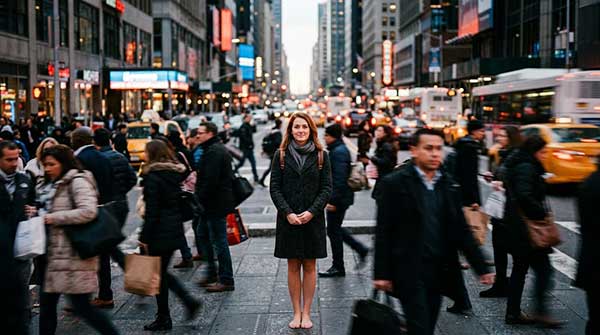
Why the world may never become quiet enough for you to begin
I suspect many people are currently waiting for life to become simpler before they begin the work that matters to them. We treat our goals like ships waiting for the sea to go perfectly flat before leaving the harbor, convinced that a “calm period” is just over the horizon. I was sitting on my living room floor yesterday, surrounded by the skeletal remains of a flat-pack bookshelf and a sense of profound, irrational failure, thinking about this exact delusion. The instructions were a wordless, Swedish fever dream, and despite my best efforts, the particle board kept splitting under the pressure of the screws. I found myself getting genuinely, red-faced angry at a piece of compressed wood. It wasn’t about the furniture, of course. It was about the fact that I had spent the previous three hours scrolling through news cycles that felt like a slow-motion collapse of global stability. My brain had been trying to process the geopolitical tensions of three different continents, and by the time I sat down to do something as simple as turn a screwdriver, my cognitive reserves were completely spent. I wasn’t just tired; I was vibrating with a kind of static that made even the smallest task feel like a confrontation.
This is the state of the modern human. We are being asked to navigate an environment where a century’s worth of history seems to happen every Tuesday. We often tell ourselves that we just need to get through this week, this election, or this economic dip before we can finally focus. But as I sat there on my carpet, surrounded by sawdust, I realized something uncomfortable: the sea is never going flat again. The chaos isn’t a temporary interruption of our lives; it has become the medium in which we live. If we wait for the world to become quiet enough for us to begin, we will spend our entire lives standing on the shore, watching the horizon for a peace that isn’t coming.
We are biological organisms designed for relatively steady, local environments, yet we are now forced to inhabit a digital space where the crises of eight billion people are delivered to our pockets in real-time. This creates a strange, heavy feeling that distant crises are happening in our own backyard. We are constantly reacting, constantly adjusting our routines, yet we rarely move forward because we are too busy trying to keep the compass from spinning. I’ve often wondered—and I’ll admit the research is frustratingly inconclusive here—if the human brain is even capable of this level of global synchronization. We might be reaching the limits of our emotional bandwidth.
The biology of a noisy brain
There is a popular narrative in self-help circles that stress is a toggle switch—that you can move from a state of survival to a state of thriving just by changing your mindset. In reality, the biology is far more stubborn. I should mention the work of the late Bruce McEwen on the concept of allostatic load. It’s not just that we are stressed; it’s that the wear and tear on the body accumulates over time. When we are bombarded with global chaos, our attention narrows. Stress does not literally switch the brain from one room to another, as popular neuroscience sometimes suggests. But chronic stress can narrow attention toward immediate threats and make deliberate planning much harder. We lose the ability to plan for next year because we are terrified of the next hour.
I’m not sure this distinction will land cleanly at first, but there is a massive difference between being informed and being occupied. Most of us are currently occupied by the world. We carry the world’s noise into our morning coffee, our work meetings, and our attempts to build a bookshelf. I remember a time—this is a brief digression, but I think it fits—when I tried to learn the flute during a particularly chaotic period of my life. I thought it would be a “peaceful escape.” Instead, I just blew frustrated, sharp notes into a quiet room because my mind was still arguing with a stranger on the internet. We don’t leave the world at the door; we bring the storm inside with us.
The research into information overload—what Herbert Simon famously called the attention economy—suggests that a wealth of information creates a poverty of attention. When the world is screaming, our internal compass gets demagnetized by the sheer volume of external interference. We find ourselves waiting for a perfect, quiet clearing in the woods where we can finally work on our potential. But that clearing is a hallucination. The work of being human has always been about finding your north while the storm is still howling. I suspect we are currently suffering from what I call the Horizon Fallacy—the belief that the next “big event” will be the one that finally resolves the tension and lets us rest.
Why the sea will never go flat
There is a persistent hope that we are living through a temporary spike in history that will eventually plateau. I’ve lived long enough to be skeptical of that hope. If you look at the patterns of human behavior, we don’t tend to settle into stasis; we tend to find new things to be anxious about. There is a Turkish word I have always liked for this: tekamül—the slow, grueling process of becoming. It suggests that growth isn’t a straight line upward; it’s a circular path toward maturity that requires you to keep moving even when the map is torn.
In the current global climate, we tend to view our lack of progress as a personal failure, but we rarely account for the invisible weight of the world we are carrying. I want to be careful here, because I don’t want to sound like I’m advocating for a cold, disconnected productivity. We are humans; we are affected by each other. But there is a point where empathy turns into a paralyzing form of noise. There is a Turkish phrase for this: sen sadece boğuluyorsun—you are simply drowning. If you are so tuned into the global static that you can no longer hear your own voice, you aren’t being aware; you are just being consumed.
The local sailors I met once in a small coastal town didn’t wait for the sun to come out to go to work; they relied on their instruments and their knowledge of the coastline. I suspect we are in a permanent fog now. Our goals, our routines, and our inner focus are the instruments we have to trust, even when the horizon is invisible. We have to stop looking for a smooth path. The smoothness is a sign that the world has stopped changing, and a world that stops changing is a world that has died. Perhaps the task of being alive right now is not to escape the chaos, but to build something meaningful within it.
Learning to trust the compass
Every time we check a headline, we are essentially asking the world if it’s safe to start living yet. And every time, the world says “not quite.” This is a trap. I suspect that the most successful people in the coming decades won’t be the smartest or the most talented, but the ones who have the best noise filters. The ability to maintain a signal in a world of high-decibel distraction is becoming the most valuable skill on the planet.
If you find yourself paralyzed by the state of things, try to look at your life not as a project that requires a quiet environment, but as a navigation exercise. You are a sailor, and the sea is currently rough. That doesn’t mean you can’t sail; it just means you have to be more disciplined about where you point the boat. I’m not entirely sure if history repeats or just rhymes—as the saying goes—but I do know that every generation thinks they are the ones living through the end of the world. And yet, people kept writing books during wars. People kept building houses during depressions. They didn’t do it because they were indifferent; they did it because they realized that life doesn’t wait for permission from history.
The normal we are waiting for is a ghost. It is a memory of a world that was actually just as chaotic, but perhaps less loud. We have to learn to work with the noise. We have to learn to turn the screws on the bookshelf even when the news is bad. This isn’t about being a hero; it’s about being a conscious part of your own life. Which is, when I think about it, a strange thing to have to say. The sun will set, and it will rise again, but the person you become in the dark is the only thing you get to take with you into the light.
One thing before you go
Today, pick one small, concrete goal that has absolutely nothing to do with the state of the world. It could be finishing that bookshelf, writing a letter to a friend, or finally organizing that one drawer in the kitchen. These tasks feel trivial when compared to global upheavals, but they are actually acts of rebellion. They are assertions that your life still belongs to you. I eventually got my bookshelf together. It’s slightly crooked, and there’s a scratch on the side that will always remind me of my irrationally angry afternoon, but it’s standing. It holds books. It’s a small, physical proof that I can still create something in a world that feels increasingly like it’s only interested in deconstruction.
Sources for further reflection:
- The End of Stress as We Know It, Bruce McEwen. (A grounded look at how stress actually impacts the brain’s architecture and allostatic load).
- The Sciences of the Artificial, Herbert A. Simon. (The foundational text on how information consumes the attention of its recipients).
- Man’s Search for Meaning, Viktor Frankl. (The classic editorial on finding a “why” that can survive any “how” during times of extreme crisis).
Honest answers to hard questions
How do I stop feeling guilty for focusing on myself when the world is in pain?
Most people carry the weight of the world because they think it’s a form of solidarity. It isn’t. If you let the global noise destroy your ability to function, you become another person in need of help rather than someone capable of offering it. Maintenance of your own life is what allows you to be a stable presence for others when they truly need you.
What if I honestly don’t have a goal or a target right now?
It depends on whether you are truly lost or just over-stimulated. Most people don’t lack potential; they lack the quiet space required to hear what that potential is asking for. If you don’t have a big goal, make your goal the protection of your attention for thirty minutes a day. Spend that time away from every screen and see what thoughts actually belong to you.
Is it really just an information problem, or are things actually getting worse?
The research is mixed, but the trend is clear: we are safer by almost every historical metric, yet our subjective experience of stress is at an all-time high. This suggests that while the physical world has improved, our information environment has become toxic. We are forced to hear every single thunderclap in every corner of the globe simultaneously, which makes the storm feel much larger than it actually is.