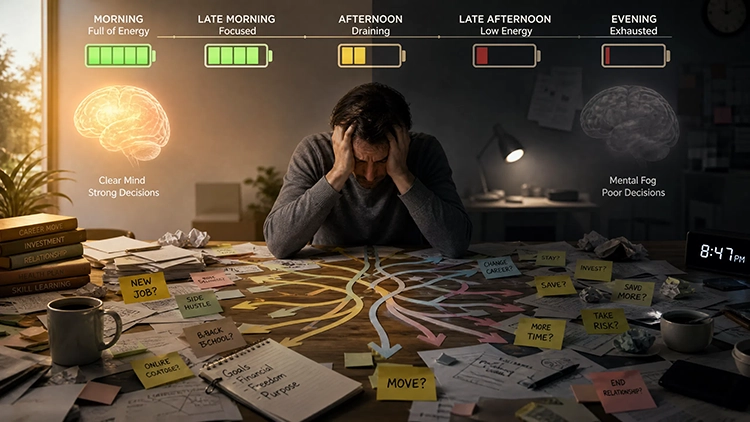
The Cognitive Cost of Choice: Navigating the Mental Burden of Decision Fatigue
Red or white? Flats or heels? Rare or well-done? Take a cab or walk? The average adult makes roughly 35,000 decisions every single day. If the mere sight of another choice triggers stress, you are not alone. Decision fatigue has escalated into a widespread mental health challenge, driven by evolving lifestyle demands and shifting daily environments. Also recognized as ego depletion, this condition manifests as difficulty making new choices after a period of intense micro-decisions, eventually degrading your ability to make healthy, rational choices altogether.
In a world saturated with options—where ordering a simple coffee turns into a complex matrix of choices—it is entirely logical that deciding becomes exhausting. When shifting routines force us to constantly plan what to wear, which tasks to prioritize, who to meet, or where to travel, the sudden inflation of choices leaves us feeling deeply overwhelmed. Let’s look closer at how decision fatigue paralyzes our execution and explore concrete strategies to regain control of your cognitive battery.
Defining Decision Fatigue and Its Mechanics
Decision fatigue occurs when the sheer volume of choices depletes your mental energy. While exercising free will typically feels empowering, forcing your brain to process too many continuous choices rapidly degrades your quality of judgment.
Imagine scanning a grocery aisle for a quick dinner. Would a few highly curated options make your choice easier, or would a wall of choices serve you better? While we instinctively believe that more variety yields more happiness, behavioral research proves that limited options streamline the decision process and yield more accurate outcomes. Why then does choosing deplete us?
[Continuous Low-Value Choices] ──► Prefrontal Energy Depletion ──► Ego Depletion State
│
┌──────────────────────────────────────────────────────────────────────┘
▼
[Impaired Autonomy] ──► Chronic Procrastination / Impulsive Selection / Decision Paralysis
According to ego depletion theory, making choices consumes a finite metabolic budget. Because your willpower and cognitive stamina are restricted resources, burning them on minor daily logistics leaves you bankrupt for high-leverage tasks that follow.
A study published in the Journal of Personality and Social Psychology examined this dynamic by asking one group of students to actively select their course programs from multiple options, while another group was simply handed pre-made schedules. Later, both groups were placed in a room with distractions and given a complex math problem. The students who had actively spent energy making choice selections abandoned the problem significantly faster, opting to procrastinate rather than exert self-control.
The Strategic Framework to Reclaim Executive Function
Mitigating decision fatigue requires auditing your habits, eliminating low-value variables, and preserving your prefrontal cortex for the choices that matter.
1. Front-Load and Prioritize High-Stakes Decisions
When your day demands high responsibility, tracking every obligation in your head amplifies your mental load. Offload this stress by listing tasks in an external system like a journal or digital planner. Identify your most critical strategic choices and tackle them early in the morning when your mental battery is fully charged.
2. Standardize and Automate Minor Routines
“What should I eat for lunch? Should I work out now or later? What should I wear?” These minor queries quietly drain your daily energy reserves. When mixed with major tasks, they cause unnecessary friction and delay execution. Eliminate this drain by automating repetitive choices: establish a fixed meal plan, batch your wardrobe options ahead of time, and build rigid weekly schedules. Save your intelligence for high-leverage work.
3. Implement Strict Time Ceilings for Choices
Fear of making the wrong choice generates anxiety, which paralyzes progress. Setting an absolute time limit forces you to move past over-analysis. While a countdown creates temporary pressure, it successfully breaks loops of overthinking. A prompt, calculated choice executed immediately is far healthier for your momentum than remaining stuck in prolonged ambiguity.
4. Aggressively Reduce Your Option Pool
Facing dozens of nearly identical choices—whether products, tools, or assets—wastes massive time. Simplify your processing by filtering choices against a single primary metric (such as price, speed, or utility). Instantly discard everything that falls outside your core criteria, select from the top two or three remaining options, and close the loop.
5. Clear the Attention Environment of Non-Essential Noise
Deep focus is essential for clear choice-making. Creators who manage to insulate themselves from constant environmental inputs consistently make superior choices. Minimize micro-distractions by disabling non-essential app alerts, closing open email tabs, and processing incoming messages in dedicated, block-timed windows.
+-----------------------------------------------------------------+
|                    COGNITIVE ALLOCATION MODEL                   |
+-----------------------------------------------------------------+
| AM WINDOW: High-Stakes Strategy & Asset Generation (Deep Work)   |
| PM WINDOW: System Maintenance, Batching, & Routine Automation  |
+-----------------------------------------------------------------+
6. Protect Your Boundaries with Direct Refusals
Managing your own daily schedule is demanding enough; constantly factoring in the competing preferences of others guarantees burnout. This is especially true when balancing multiple family or team logistics. Learn to say “no” to non-urgent requests. Declining non-critical commitments insulates you from the secondary choice loops that follow them.
7. Delegate and Leverage Trusted Networks
You don’t have to carry the cognitive weight of every project alone. When a choice becomes paralyzing, bounce the variables off a trusted colleague, partner, or mentor. Explaining the scenario out loud often clarifies the path forward, and an outside perspective can easily spot critical details you might have missed while over-analyzing.
8. Eradicate External Comparisons
Every creator operates under distinct risk tolerances, timelines, and primary metrics. Evaluating your journey against someone else’s choices introduces unnecessary noise into your processing system. Focus exclusively on your own framework, and stop wasting bandwidth wondering what an outsider would choose in your position.
9. Accept the Reality of Imperfect Choices
Human judgment shifts based on changing internal and external conditions. A strategy that felt optimal during a high-energy morning might seem counterproductive during an afternoon slump. Accept that variance is normal. You made the best possible choice given the parameters available to you at that moment; drop the expectation of absolute, permanent consistency.
10. Default to the Safest Low-Friction Variable
When cognitive exhaustion sets in and a choice remains unclear, protect your energy by choosing the path of least resistance or lowest risk. Taking a conservative, guaranteed action eliminates the secondary emotional tax of guilt, regret, and anxiety. This protective approach clears the decision off your dashboard so you can rest and recover.
The Sovereign Takeaway
Choices are a hidden source of systemic stress. By structuring your environment, automating low-value variables, and moving decisively through ambiguity, you transform your daily workflow from a chaotic reaction loop into a streamlined, high-output system.