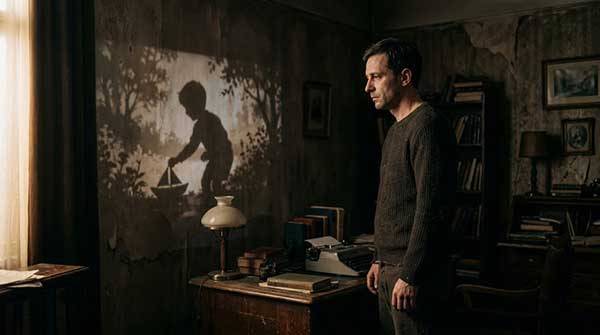
The excavation of the infant self
My daughter woke up last night gripped by a fear that felt far too large for her small frame. “I’m afraid of being lost,” she whispered, her voice cracking in the dark. As I held her, trying to anchor her back to the safety of her bedroom, a strange lump formed in my own throat. I realized that her fear wasn’t just a childhood phase; it was a mirror. I, too, feel a profound sense of being lost—not in space, but in time. I am an adult who has traveled decades away from my origin, and the further I go, the more the first few years of my life feel like a site that has been buried under layers of heavy, silent silt.
We are all walking around with a massive, unreadable gap at the very beginning of our stories. Most of us cannot remember being held, being bathed, or the specific way our parents looked at us when we were six months old. We have the “records”—the photos in dusty albums or the anecdotes told at dinner parties—but we lack the visceral, sensory data. We have the blueprints of the house, but we have forgotten the feeling of the floorboards under our feet. I’ve started to view the search for childhood compassion as an excavation project. We are archaeologists of our own souls, digging through the sediment of adulthood, trying to find the foundation of a kindness we are told was there, but can no longer feel.
The central dilemma is this: we are the sum of experiences we cannot consciously recall. The “Who are you?” question that echoes in the deeper chambers of our psyche is often answered by the ghosts of our first three years. We are looking for a compassion that we might have received, but because it didn’t leave a narrative mark, we treat it as if it never happened. We spend our lives hungry for a touch that we might have already had, wandering our internal landscapes like survivors looking for a home that was leveled by a storm we don’t remember.
The silent silt of infantile amnesia
There is a technical, almost clinical term for this black hole in our history: infantile amnesia. Most humans possess no autobiographical memories from before the age of three or four. The hippocampus, the brain’s primary librarian, isn’t fully “online” yet during those early years. It’s as if the library was open, but the librarian hadn’t learned how to file the books. But here is where the evidence gets complicated. While the narrative memory is absent, the body acts as a separate, more reliable ledger. This is often called somatic memory.
Research into early developmental psychology suggests that while you don’t “remember” your mother’s embrace in a way you can describe with words, your nervous system does. The way you were held—or not held—calibrated your internal thermostat for safety. If the excavation goes deep enough, we find that our current capacity for stress, our ability to trust, and our hunger for affection are all artifacts of those forgotten years. I’m still struggling to articulate why this feels so heavy, but there is a specific kind of grief in knowing that the most formative moments of your life are ones you will never actually “know.”
I recall a moment during a workshop recently where I was asked to imagine a “place of total safety.” My mind immediately went to a corner of a room filled with soft toys—a “hug corner.” I stayed there far longer than the exercise required, clinging to a pile of imaginary cushions as if they were life rafts. It was a visceral reminder that despite my graying hair and my professional titles, there is a five-year-old inside me who is still desperately looking for a place to hide. We don’t “grow out” of the need for compassion; we just learn how to hide the hunger under more sophisticated masks.
The curator’s archives: parents as external hard drives
Because our own internal servers are wiped clean of those early years, we rely on our parents to act as curators of our infancy. Last week, I sat down with my mother and father and asked them to describe the minutiae of my beginning. I wanted to hear about the midnight crying, the way they washed my hair, and the specific smell of the room where I slept. I needed them to read from the files that I no longer have access to.
Listening to them felt like watching a film of someone who looked like me but lived a completely different life. They spoke of a child who brought “healing and light” to the house, a version of me that was soft, fragile, and utterly dependent. I found myself envious of that child. He had a level of certainty in his own worth that I have spent my entire adult life trying to rebuild.
There is a natural digression here that I keep returning to: the smell of the soap they used. My mother mentioned a specific brand of baby wash, and for a split second, I felt a strange, cold shiver on the back of my neck. I didn’t “see” a memory, but my body reacted to a phantom sensation. It’s a strange thing to have to say, but our parents are the only witnesses to the “unpainted” version of ourselves. They saw the wood before the lacquer. When they tell these stories, they aren’t just sharing information; they are helping us re-integrate the pieces of ourselves that we dropped along the way.
I’m not entirely convinced that simply hearing these stories can replace the absence of a felt memory. There is a risk that we just build a “narrative identity” based on their words, rather than a genuine connection to our past. We are taking their word for it. But in the absence of our own records, these stories are the only tools we have to bridge the gap between the “me” I am now and the “me” I was then.
Excavating the womb: the limit of the search
Some therapeutic schools go even further, attempting to excavate the memories of the womb itself. They speak of a “primordial peace,” a state of total containment and warmth that we are all subconsciously trying to return to. I want to be cautious here, because the science of “prenatal memory” is highly speculative and debated. It’s easy to slip into a poetic kind of certainty that doesn’t actually have a biological basis. However, the idea of it—the intention to find a point of origin that is pure and unburdened—is a powerful psychological anchor.
When I closed my eyes and “gave permission” to revisit that state of ufacıklık—of being tiny and held—I didn’t find a memory. I found a silence. But it was a different kind of silence than the one I usually inhabit. It wasn’t the silence of an empty room; it was the silence of a deep, dark forest. It was a space where the “lost” daughter and the “searching” father could finally stop moving.
We are definitions of our scars, but we are also the products of the compassion we don’t remember. The search for our childhood self isn’t an act of nostalgia; it’s an act of reclamation. We are trying to find the part of us that hasn’t been hardened by the world, the part that still knows how to give and receive without a script. The excavation is never finished, and the gold we find is rarely a clear, shiny object. Usually, it’s just a bit of warmth in the dirt—a reminder that before we were “someone,” we were simply held.
A practical shift in focus
If the search for your own childhood feels like digging through frozen ground, try this tonight: Instead of looking for a specific memory, look for a specific sensation. Find a blanket or a piece of clothing that feels particularly soft. Wrap it around yourself and sit in a chair with your back as straight as possible. Close your eyes and don’t try to “think” about your past. Just feel the weight of the fabric on your shoulders. For five minutes, try to inhabit the body of that child who didn’t need to know his own name to know he was safe. You aren’t looking for a story; you are looking for the feeling of the floorboards.
Sources for further reflection:
- The Body Keeps the Score, Bessel van der Kolk. (The definitive guide to how the body stores what the mind forgets).
- Childhood and Society, Erik Erikson. (On the foundational stages of trust and identity).
- Infantile Amnesia and the Development of Self, Howe & Courage. (A technical look at why we lose the first three years).
Something to clear up before we part
Is it possible that I don’t remember being hugged because it didn’t actually happen?
This is the fear that stops many people from even starting the excavation. It is entirely possible that your early years lacked the compassion you crave. However, even in homes where touch was scarce, there are often moments of “somatic grace”—the feeling of sun on skin, the warmth of a meal, the rhythm of a voice. The goal isn’t to validate a perfect past, but to find whatever “scraps” of safety your body managed to save. You are looking for the foundation, even if it’s cracked.
Can I “re-parent” myself if my own parents aren’t around to tell me these stories?
I suspect that the “parent” we are looking for is actually a part of our own consciousness. When you sit in that silence and offer yourself compassion, you are using your adult mind to hold your infant self. You are the archaeologist and the artifact at the same time. You don’t need the external hard drive to start the dig; you just need the willingness to look at the dirt.
Why does looking back feel so much like “being lost” as my daughter described?
Because the past is a foreign country with no map. When you try to remember who you were before you were “you,” you are stepping off the edge of your own narrative. It feels like being lost because it is an act of losing the rigid, adult identity you’ve spent so long building. But being lost is sometimes the only way to find the origin of the echo.