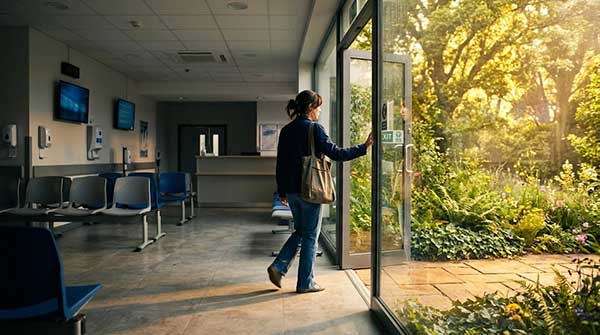
The cost of living in the waiting room of your own life
I saw a stack of cardboard boxes in a friend’s hallway last week, piled high and sealed with heavy-duty packing tape. They had been there for three years. When I asked about them, he laughed—a short, defensive sound—and told me he was waiting until he “really settled in” before he unpacked his good dishes and his favorite books. He has been living out of a suitcase in a house he owns, eating off paper plates while his real life sits in the dark behind layers of corrugated paper. We do this with our existence more often than we care to admit. We treat our current reality as a temporary staging area, a messy transit hub where we wait for the “actual” life to arrive. We are perpetually standing in the hallway, looking at brochures for a destination that doesn’t exist, while the rooms we currently inhabit remain cold and empty.
This is the psychological tax of living in the “not-yet.” We have been conditioned to believe that the life we have is a draft, a rough sketch that we will eventually erase and replace with a masterpiece. There is a common piece of advice in parenting circles that suggests we should raise the child we actually have, not the one we wish we had. It is a simple, almost banal statement, yet it contains a profound existential directive. If you spend your time trying to mold a quiet, bookish child into a star athlete, you miss the person standing in front of you. You become a stranger to your own offspring. The same logic applies to the self. If you are constantly trying to inhabit the life you want—the one with the perfect career, the ideal body, and the regulated emotions—you effectively become a squatter in your own biography. You are present in body, but your attention is elsewhere, mourning the absence of a phantom.
The act of owning your existence begins with a radical, often uncomfortable, acceptance of the raw material. It is the realization that the frustration you feel right now, the specific ache in your lower back, and the messy tangle of your current relationships are not obstacles to your life; they are the substance of it. When we stop trying to manage our “image” and start attending to our needs, we begin to close the gap between the observer and the observed. We move from the hallway into the room.
The architecture of the perpetual guest
When we refuse to occupy our own lives, we develop a specific kind of internal posture. We become hyper-focused on the future, convinced that our happiness is a delivery that has been delayed by the postal service. This creates a state of chronic detachment. I have spent a significant portion of my life waiting for a “calm period” that never seems to arrive. I told myself I would start a specific writing project once the house was quiet, once the bills were paid, once I felt “ready.” But readiness is a hallucination. A bird hit my window while I was writing this—a sudden, sharp thud that broke the silence of the room. It was a violent reminder of the physical world intruding on my abstract thoughts. The bird didn’t wait for the window to be open; it simply flew.
To truly own your existence, you have to practice the difficult art of self-remembering. This is not an intellectual exercise; it is a sensory one. It is the sudden, sharp realization of “I am here.” I am here, in this chair, in this specific mood, surrounded by these specific problems. There is a profound objectivity that comes with this state of mind. When you stop fighting the reality of your situation, you gain the ability to observe it without the distorting lens of your own disappointment. You see the events of your life not as personal insults from the universe, but as weather patterns.
This requires us to abandon concepts that do not belong to us. Most of us are carrying around a heavy luggage of inherited expectations—the “shoulds” of our parents, the “musts” of our culture, and the “oughts” of our social feeds. We are trying to live in a house that was designed by a committee of people who don’t have to live there. Reclaiming your existence means having the courage to leave that luggage on the platform. It means stripping away the layers of “as-if” behavior until you are left with the unpainted wood of your own being. It is only when you are willing to be “nobody” that you can finally start to become yourself.
The biological friction of the not-yet
There is a biological dimension to this waiting-room existence that we rarely discuss. When we live in a state of perpetual longing for a different life, we create a constant internal friction. Our brains are predictive engines; they are constantly comparing the current sensory data with our internal models of the world. When there is a massive discrepancy between our “ideal self” and our “actual self,” the nervous system stays in a state of high alert. This is essentially a form of cognitive dissonance that manifests as a low-level, background anxiety. We feel “unreal” because we are neurologically misaligned.
There is a persistent debate in cognitive science about whether a person can ever truly achieve objective observation of their own mind, and I often wonder if our biology is simply too biased toward survival to allow for total neutrality. I suspect that “being in the moment” is less about achieving a zen-like state of peace and more about reducing the metabolic cost of denial. It is exhausting to pretend that you aren’t angry when you are. It is draining to perform a version of success while you are struggling. When we finally admit the truth of our own emotions, the “heat” in the system drops. We stop fighting ourselves, which frees up an enormous amount of energy for actually living.
This “contact” with reality is the only place where healing can actually occur. You cannot fix a foundation if you refuse to go into the basement because it’s damp and dark. You have to be willing to get the mud on your hands. We treat our “negative” emotions like unwelcome intruders, trying to usher them out of the house as quickly as possible. But those emotions are the sensors of the house. They are telling you that a window is broken or that the roof is leaking. If you don’t own the emotion, you can’t own the solution.
The radical act of self-inventory
If you want to stop being a guest in your own life, you have to perform an inventory of what you actually possess. This isn’t about your bank account or your job title. It’s about the inventory of your presence. What are the feelings you are currently experiencing? What are the physical needs of your body that you’ve been ignoring in the pursuit of a “better” version of yourself?
We have to learn to “stay” with our own existence, especially when it feels inadequate. This means inhabiting your body even when it’s tired, and owning your thoughts even when they are petty or fearful. The more you can abandon the desire for a different set of circumstances, the more you can engage with the ones you have. This is the essence of maturity—the transition from wanting to be someone else to being responsible for the person you are.
Most of our suffering comes from the attempt to escape the present. We use work, screens, and even “self-improvement” as escape hatches. We are so busy trying to “fix” ourselves that we never actually meet ourselves. But the sahici—the authentic—part of you isn’t at the end of a ten-step program. It is the part of you that is currently reading this, perhaps feeling a slight itch of recognition or a wave of skepticism. That is the one who is here. That is the one who needs to be heard.
Don’t wait for the world to become quiet enough for you to begin. Don’t wait for the “good” dishes to come out of the boxes. Take them out now. Use them. If they break, at least they were used for their intended purpose. Your life is not a museum; it is a workshop. And the only way to own the workshop is to pick up the tools and start working with the wood you were given, knots and all.
One thing before you go
Tonight, find one “box” in your life that you have kept taped shut—a conversation you’ve been avoiding, a hobby you’ve put off until you’re “better,” or an emotion you’ve been suppressing because it’s “unproductive.” Open it. Don’t try to fix it or organize it immediately. Just acknowledge its presence. Say to yourself, “This is part of my house. I am here with this.” Notice if the air in the room feels a little less stale once you stop pretending that part of your life doesn’t exist.
Sources for further reflection:
- The Psychology of Self-Remembering, derived from the work of P.D. Ouspensky and G.I. Gurdjieff.
- Predictive Processing and the Mind, Andy Clark. (On how the brain manages expectations and reality).
- The Drama of the Gifted Child, Alice Miller. (On the cost of living for the expectations of others).
Notes from the field: Common queries
Is it wrong to want a better life? Does “owning your existence” mean you shouldn’t have goals?
Not at all. The distinction is in the “where.” You can have a goal for the future while still being fully inhabitant of the present. The problem arises when the goal becomes a replacement for your current life. If you can only be happy when you reach the goal, you are living in a hallucination. If you are working toward a goal while acknowledging the messiness of the current step, you are owning your existence. Goals should be North Stars that guide your movement, not cages that keep you from enjoying the scenery.
How do I distinguish between “my” desires and the ones I’ve inherited from others?
It depends on the “flavor” of the desire. Inherited desires usually feel like heavy burdens; they are driven by fear of shame or the need for validation. They often start with the word “should.” Authentic desires usually feel like curiosity or a “pull.” They are driven by an internal interest and often persist even when no one is watching. If you were the last person on earth, would you still want that specific achievement? If the answer is no, it might be luggage that doesn’t belong to you.
Why does “being here” often feel so painful or boring?
I suspect it’s because we have been over-stimulated by a culture of constant “elsewhere.” Reality is rarely as high-definition as a digital feed, and it’s rarely as tidy as a scripted story. Boredom is often just the withdrawal symptoms of an addiction to distraction. Pain, on the other hand, is usually a signal that we have been ignoring something vital. The discomfort isn’t a sign that you should leave; it’s a sign that you have finally arrived at a place that needs your attention.