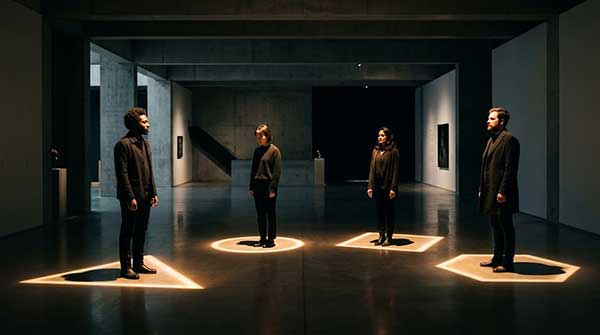
The invisible broadcast: why the world reacts to who you are rather than what you say
Empathy is often treated as a moral achievement, a dial we can turn up through sheer force of will. We are told to be more understanding, more compassionate, and more attuned to others. But have you ever noticed that there are days when you say all the “right” things—offering praise, kindness, and support—and yet people pull away from you as if you were radiating a low-frequency hum of hostility? Or perhaps you’ve experienced the opposite: you feel physically ill, your mind is a tangle of unfinished thoughts, and you try to mask it with a smile, only to find that everyone around you is irritable and defensive for no apparent reason. This friction exists because we are not just communicators of language; we are broadcast towers. Long before a word leaves our lips, our “aura”—the involuntary signal of our physical, mental, and spiritual state—has already filled the room.
The Human Design system offers a remarkably pragmatic, if unconventional, map of these broadcast frequencies. It posits that every individual belongs to one of four primary types, each defined by a specific energetic signature. While the terminology can often feel unnecessarily complex, the underlying reality is simple: your effectiveness in the world is determined by the alignment between your internal machinery and the signal you are sending out. If you are experiencing a state of inner turmoil while trying to project an image of “all is well,” you are creating a dissonance that the world cannot help but react to. People don’t listen to your script; they listen to the static in your signal.
I’m not entirely convinced that every human being can be neatly filed into four specific categories without any overlap—the sheer jaggedness of the human experience usually defies such tidy packaging. However, when we use these types as an editorial lens to look at our “energy leaks,” the results are hard to ignore. We often suffer not because we are incapable, but because we are trying to broadcast on a frequency that isn’t ours. We are trying to push when we should be receiving, or trying to detect when we should be initiating.
The four architectures of the human signal
The primary broadcast types in Human Design are not personality traits; they are structural descriptions of how your presence affects others. Generators and Manifesting Generators possess an “open and enveloping” signal. They are the engines of the world, designed to produce and sustain life energy. When they are healthy, their presence feels like a warm hearth—it pulls people in and makes things grow. Manifestors, conversely, have a “closed and repelling” signal. This sounds negative, but it is actually a protective mechanism. They are the initiators, designed to move quickly and impact the environment without being slowed down by the influence of others.
Then there are the Projectors, whose frequency is “focused and absorbing.” They don’t produce energy; they detect it. They are the scouts and guides, designed to see into the machinery of the other types and offer direction. Finally, the Reflectors are the “samplers.” They act as mirrors for the community, reflecting the health or sickness of the environment back to itself. Each of these types has a specific strategy for navigating reality, and when these strategies are ignored, the broadcast becomes corrupted.
The generator’s responsibility for the collective light
Most of our modern social friction stems from the fact that the vast majority of the population—the Generators—have forgotten how their own engines work. As a Generator myself, I have had to confront the uncomfortable reality that I am responsible for the “sustainability” of the environments I inhabit. If I am frustrated, if I am forcing myself to do work that drains me, or if I am saying “yes” to obligations out of a sense of guilt, I am broadcasting a signal of depletion. Because the Generator aura is so expansive, this depletion is contagious. When a Generator is out of alignment, everyone in their orbit feels a sense of stagnation and resentment.
The strategy for a Generator is deceptively simple but incredibly difficult for the ego to accept: wait to respond. This doesn’t mean sitting on a park bench waiting for a miracle. It means waiting for a process that has already begun—a question, a task, a visual cue—and then checking if your internal engine has the “fuel” to engage with it. I recall a Tuesday last month when I woke up with a pounding headache and a mind that felt like a hive of angry bees. I had a full day of meetings and I tried to “power through” by being extra polite and helpful. By noon, three different colleagues had snapped at me, a client had canceled a contract, and the air in the office felt like it was made of lead. I wasn’t “unlucky”; I was a broken broadcast tower trying to sing a happy song. My internal state was screaming “stop,” while my mouth was saying “more,” and the resulting static was unbearable for everyone involved.
The solution in such moments is to embrace the power of “I don’t know.” The mind hates this phrase because it thrives on certainty and labels. But when we admit we don’t know, we stop trying to control the broadcast. We free ourselves from the burden of having to be the “expert” on everything. For a Generator, true freedom is found in the ability to ask simple yes-or-no questions of oneself. Do I have the energy for this right now? Is this a yes? If the answer isn’t a clear resonance in the gut, then it is a leak. And a leaking Generator is a danger to the entire system.
The projector’s wait and the initiate’s warning
While Generators are busy leaking energy, Projectors are often suffering from a different kind of exhaustion: the pain of not being seen. Because their frequency is so focused, they can see exactly where a Jenerator is failing or where a Manifestor is going off-track. But because they lack their own motor for sustainable production, they cannot simply jump in and fix things. Their strategy is to “wait for the invitation.” If a Projector offers guidance without being asked, their focus feels like an intrusion. Their signal is rejected, and they are left feeling bitter and unrecognized.
I’ve noticed that most of the questions I receive about Human Design come from Projectors who are tired of being ignored. They are often the most intelligent people in the room, yet they feel like they are shouting into a vacuum. The tragedy is that as long as the Generators are unhealthy and “forcing” their lives, there are no invitations to be had. The Projector is forced to wait for a “clean” signal to guide. This creates a bottleneck in our collective development. We have scouts with no army to lead, and engines with no scouts to point the way.
Manifestors face a different structural hurdle. Because their aura is closed and pushing, people instinctively feel an urge to control them. To avoid this resistance, the Manifestor must “inform” before they act. By telling people what they are about to do, they clear the tracks. If they don’t inform, their movement is seen as a threat, leading to an environment of mistrust and anger. It is a system of checks and balances where no one is the “boss,” yet everyone is responsible for the integrity of their own transmission.
Reclaiming the frequency of self-respect
The evidence for these types might not be found in a traditional lab, but it is certainly found in the laboratory of the daily routine. If you stop trying to “think” your way into being a better person and start paying attention to the way you actually impact a room, you see the patterns immediately. We are all embodied souls with roles to play, but we cannot perform those roles if we are in a state of psychological or physical decay.
The ultimate takeaway from this framework isn’t about memorizing charts; it is about finding a way to respect your own nature. If you are a Generator, your job is to find satisfaction. If you are a Projector, your job is to be recognized for your wisdom. If you are a Manifestor, your job is to find peace through movement. None of this is possible if you are constantly looking for validation from a world that is just as confused as you are.
We must become our own lighthouses. A lighthouse doesn’t run around the beach looking for boats to save; it simply stays on its rock and keeps its light spinning at the correct frequency. The boats that need the light will find it. The ones that don’t will move on. But the lighthouse must be kept in good repair. It must have fuel, the glass must be clean, and the gears must be oiled. Our mental and physical health is the maintenance of the lighthouse. If we are healthy, we reflect health. If we are whole, we contribute to the wholeness of the world. The systems and books we read are just flashlights to help us see where the maintenance is needed.
Something to try tonight
Identify the one person in your life who consistently leaves you feeling drained or “off.” Tonight, instead of blaming them for their personality or their demands, look at your own signal. Before your next interaction with them, pause and ask yourself: Am I trying to be something I’m not in this relationship? Am I hiding a fırtına (storm) behind a smile? For just five minutes, drop the performance. Don’t try to be nice, or smart, or helpful. Just be present with your actual physical sensations. Notice if the “static” between you and that person begins to clear when you stop pretending your battery is full.
Sources for further reflection:
- The Definitive Book of Human Design, Ra Uru Hu. (The foundational text on aura types and strategies).
- Understanding Human Design, Karen Curry. (A simplified look at the four frequencies).
- The Biology of Belief, Bruce Lipton. (On how internal states influence external biological signals).
Before you go
Is Human Design a scientific system?
The short answer is no, not in the sense of peer-reviewed empirical data. It is a synthesis of various esoteric systems and observational psychology. I tend to view it as a symbolic framework rather than a biological law. Its value lies in its “utility”—if following the strategy of “waiting to respond” reduces your stress and improves your relationships, then it is a useful tool, regardless of its origins.
Can my “type” change over time?
According to the system, your type and aura are fixed at birth, representing your hardware. While your personality and behaviors (the software) will evolve as you grow, the way your energy interacts with others remains constant. You don’t become a different type; you just become a more “aligned” version of the one you are.
Why does the system place so much responsibility on Generators?
Because they represent about 70% of the population. They are the primary source of life energy in the collective. If the majority of the “engines” in the world are running on the wrong fuel—producing frustration instead of satisfaction—the entire social machine begins to grind and smoke. The health of the majority determines the climate for the minority types (Projectors, Manifestors, and Reflectors). In this sense, the Generator’s self-respect is the foundation of global stability.