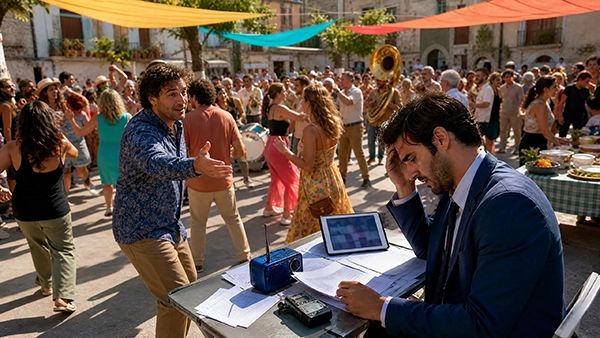
Why over-analysis is the heavy armor that keeps you from living
We are currently engaged in a massive, collective attempt to research our way out of being human. There is a specific, cold panic that sets in after a routine medical check-up, a moment where the doctor’s calm professional summary isn’t enough to satisfy the ancient, howling need for control. I found myself in this exact basement recently. I had the test results in my hand, and within twenty minutes, I was “Google Doctoring” with a ferocity that bordered on the pathological. When the local sources felt too thin, I turned to international journals, leveraging my English to dive deeper into the data. I read until the words blurred, until every rare complication felt like an inevitable destiny, and until I had effectively poisoned my own evening with a surplus of “fact.” I told myself I was being responsible. I told myself that more data equaled more safety. But as I sat in the blue light of the screen at midnight, my heart racing, I realized that I wasn’t looking for health; I was looking for a guarantee that the universe does not provide. I was building a suit of armor out of information, link by heavy link, convinced that if the metal was thick enough, the arrows of uncertainty would never find my skin. But the armor was so heavy I couldn’t even stand up to get a glass of water.
This is the central malfunction of the information age: we have mistaken the menu for the meal. We have been raised on the dogma that “knowledge is power,” a mantra that has deified logic and dismissed the quiet, stuttering signals of the heart as “unreliable.” In our desperate bid to command the future, we have become addicted to the search bar. We search for the “best” restaurant, the “right” career move, and the “perfect” parenting strategy, refusing to take a single step until the analysis is complete. But life is not a data set to be optimized; it is a territory to be crossed. When we refuse to move until we are “sure,” we aren’t being analytical; we are being paralyzed. We are living in a state of chronic analysis-paralysis, where the fear of making a “sub-optimal” choice keeps us standing in the hallway of our own lives for decades. The tragedy is that while we are busy calculating the risks, the very experience we were trying to protect is passing us by.
I’ve often wondered about the biological cost of this “Certitude Surcharge”—the extra emotional energy we expend trying to buy a level of certainty that doesn’t exist. Our brains are essentially “information forager” organs. Evolutionarily, knowing where the water was or which berry was toxic was the difference between survival and extinction. But we are now foraging in an infinite forest of data with no “off” switch. The prefrontal cortex, the seat of our deliberate planning, is a high-energy instrument. When we force it to process thousands of reviews, contradictory studies, and social comparisons simultaneously, it eventually hits a point of thermal throttling. We lose the ability to make even the simplest decisions because the “armor” of our research has become a cage. We have reached a point of diminishing returns where the next bit of information doesn’t bring clarity; it only brings more noise.
The logic of the heart in a world of data
Nowhere is this “Heavy Armor” more stifling than in the world of relationships. If you are a person who worships at the altar of logic, you might find yourself making a “pros and cons” list for a partner. I am not proud to admit this, but years ago, I actually sat down and drafted a spreadsheet for an ex-boyfriend. I listed his reliability, his career prospects, and his temperament against my own “requirements.” On paper, the decision to leave was the only rational move. The data was clear. But looking back, that list was the most ridiculous thing I have ever produced. It was a clumsy attempt to use a ruler to measure a sunset. Logic is a brilliant tool for building bridges and managing budgets, but it is a remarkably poor instrument for navigating the human heart. By the time you’ve finished the analysis, the “feeling”—the raw, unedited connection that actually makes a life worth living—has usually evaporated under the heat of the scrutiny.
We use Google to bypass the messiness of conversation. We used to spend twenty minutes arguing over a fact, laughing, guessing, and exploring the possibilities of an answer. Now, we just end the dialogue with a swipe. We have replaced the “maybe” with the “certain,” and in doing so, we have killed the mystery that fuels human interest. I want to be honest here: I suspect that our obsession with being “correct” is actually a fear of being seen as a fool. We would rather be miserable and “right” than happy and “wrong.” We cling to the ratings and the points and the reviews because we no longer trust our own skin to tell us if a meal is good or if a path is beautiful. We have outsourced our senses to a collective average of strangers, and we wonder why our lives feel so beige.
There is an uncertainty in this shift that I find haunting. The current research into “Expertise vs. Intuition” is thinner than the marketing would have you believe. Some cognitive scientists argue that intuition is simply “compressed experience,” a rapid-fire calculation done by the basement of the mind. Others suggest it is something more ephemeral. I’m not sure we will ever truly map the boundary where the biological computer ends and the “Self” begins. But I do know that the more we rely on the external hard drive of the internet, the more our internal “muscles” of perception begin to atrophy. We are becoming a species that knows everything about the world and nothing about how we actually feel in it.
A digression on the failed GPS
I remember a road trip in the summer of 2009. I was driving through a rural stretch of the coast, and my early-model GPS suddenly lost its signal. For ten minutes, I felt a level of anxiety that was completely disproportionate to the situation. I was a grown adult in a functioning car with half a tank of gas, yet the loss of the digital “map” made me feel as though I were sinking in the middle of the ocean. The silence in the car was heavy, almost physical. I had to pull over and just breathe. After a while, I realized that I hadn’t even looked at the road for the last hour; I had only been looking at the little glowing arrow on the screen. When the signal died, I was forced to look at the trees, the shape of the hills, and the position of the sun. I was “lost,” but for the first time in the trip, I was actually there. We are all living in that ten-minute gap after the signal fails, and we are terrified of it. But that gap is where the “life” actually resides.
The “wellness” industry is perhaps the most aggressive manufacturer of this heavy armor. Every day, we are pelted with a new set of instructions on how to exist. Don’t sleep that way. Don’t eat that spice without grinding it first. If you don’t update your internal “software” with the latest morning routine, you are failing. This creates a state of chronic inadequacy. We become “information addicts,” convinced that the next book or the next podcast will finally provide the key to the locked door. But the more we know, the more we realize we aren’t doing it “perfectly,” which leads to the “sub-optimal” freeze: If I can’t do it exactly right, I won’t do it at all. We are crushing our own vitality under the weight of a perfectionism that is fueled by a surplus of “how-to” guides.
Reclaiming the courage of the beginner
The change begins when we recognize that the “Heavy Armor” is not a defense; it is a distraction. The transition from “knowing” to “being” is a radical act of surrender. It involves the realization that you can never know enough to be safe. The world will always be unpredictable. The economy will shift, the body will age, and the people we love will remain mysteries even after fifty years of marriage. If we wait for the data to be complete, we will die in the library.
Instead of tap-tap-tapping for a new answer, we have to start asking the questions that have no “Googleable” resolution. We have to be willing to use “ignorant courage”—the ability to take a step without knowing exactly where the foot will land. This isn’t about being irresponsible; it’s about being real. It’s about choosing the trial-and-error of the workshop over the sterile certainty of the blueprint. When we stop trying to “calculate” our way into happiness, we find that the world becomes vivid again. The restaurant we found by accident tastes better because we didn’t read forty reviews before we sat down. The decision we made with our gut feels sturdier because it belongs to us, not to a list of pros and cons.
We have been sold a version of life that is zero-risk and zero-failure, but a life without risk is a life without a soul. It is the “breath” of the unknown that gives life its flavor. This week, try to find one place where you can leave the armor at home. Walk into a room without a plan. Ask a question and wait for the person to answer, rather than looking it up under the table. Allow yourself to be a work in progress rather than a “final version” that is constantly in need of a patch. You might find that once you stop trying to know everything, you finally have the room to actually feel something.
Sources for further reflection:
- The Paradox of Choice: Why More Is Less, Barry Schwartz. (The foundational text on how information abundance leads to paralysis).
- Thinking, Fast and Slow, Daniel Kahneman. (Exploring the tension between analytical and intuitive systems).
- The Shallows: What the Internet Is Doing to Our Brains, Nicholas Carr. (On the erosion of deep focus in the age of data).
Things that usually come up next
If I stop researching, won’t I make more mistakes?
The short answer is yes, you probably will. But here is the nuance: you will make original mistakes rather than “safe” ones. A life built on avoiding mistakes is just a long, slow-motion retreat. The “Heavy Armor” doesn’t prevent failure; it just ensures that your failures are boring. When you allow yourself to move without total certainty, your mistakes become the very material of your growth. They are the “wood” you use to build the next version of yourself.
How do I handle the anxiety of not having a plan?
Anxiety is often just the “withdrawal symptom” of leaving the digital grid. We have been conditioned to feel that “unsure” equals “unsafe.” The only way to handle it is through exposure. Start small. Pick a restaurant without looking at the stars. Take a different route home without the GPS. You have to prove to your nervous system that the world doesn’t collapse when you aren’t holding the map. Eventually, the “unknown” stops being a threat and starts being an energy.
Is intuition really a reliable guide in a complex modern economy?
I suspect this is where the most friction exists. In technical fields—engineering, medicine, law—data is non-negotiable. You don’t want a surgeon who uses “ignorant courage.” But in the “management of the self”—in your career path, your values, and your relationships—intuition is often the only instrument that can hear the “signal” through the “static.” The goal is to use data for the mechanics and intuition for the direction. Use the map to see where the roads are, but use your heart to decide where you actually want to go.