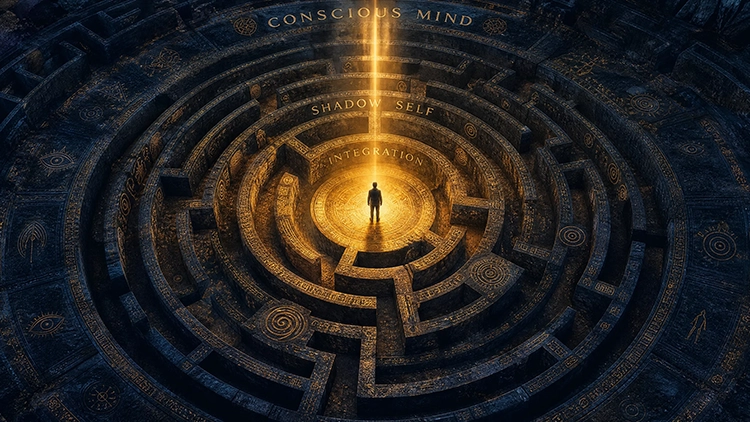
The Architecture of the Labyrinth: Psychological Archetypes, Subconscious Shadows, and the Path to Self-Mastery
The labyrinth stands as one of humanity’s most powerful geometric symbols. Far from being a simple spatial puzzle, it represents an intentional map of human consciousness, executive choice, and subterranean psychological integration.
When deconstructed through classical mythology and modern depth psychology, the journey through the maze ceases to be a tale of physical captivity—it becomes an exact framework for structural self-realization.
[Outer World / Surface Identity] ──► Structural Descent (The Labyrinth)
│
┌──────────────────────────────────────────┘
▼
[The Shadow / Inner Beast] ──► Confrontation (Theseus vs. Minotaur)
│
▼
[Ariadne's Thread / Executive Awareness] ──► Synthesis & Return to Mastery
Mythological Foundations: The Dualities of Mind
The Myth of King Minos, Theseus, and the Minotaur provides a precise psychological blueprint for internal transformation. To process this myth effectively, each component must be assigned its structural cognitive equivalent:
- King Minos (The Rigid Ego Structure): Represents the societal shell, external control mechanisms, and the defensive refusal to process chaotic internal elements.
- The Labyrinth (The Subconscious Architecture): The intricate network of ingrained habits, repressed trauma, and non-linear memory structures. It is intentionally designed so that brute-force navigation fails.
- The Minotaur (The Unintegrated Shadow): Housed at the exact center of the system, this half-human, half-beast hybrid embodies our primal impulses, unaddressed fears, and raw biological drives.
- Theseus (The Conscious Observer / Ego-Ideal): The active agent willing to enter the subterranean matrix voluntarily to confront internal chaos.
- Ariadne’s Thread (Metacognition & Intention): The structural tether of intentionality, memory, and cognitive grounding that prevents total psychological disorganization during deep internal work.
Psychological Principle: Victory over the inner monster does not mean destroying our core drives; it means integrating the shadow so that the individual is no longer haunted by repressed impulses.
Structural Dynamics of the Maze
Classical mythology and historical etymology reveal two distinct interpretations of the maze, each serving a different stage of human development:
+-----------------------------------------------------------------+
|                    LABYRINTH vs. MAZE MATRIX                    |
+-----------------------------------------------------------------+
| UNICURSAL LABYRINTH: Single, Unbroken Path ──► Centering & Flow |
| MULTICURSAL MAZE    : Branching Dead-Ends ──► Choice & Agency   |
+-----------------------------------------------------------------+
The Unicursal Path (Integral Alignment)
In a unicursal layout, there are no choices, dead ends, or traps. A single winding path leads directly from the perimeter to the center. This design reflects meditative focus, surrender, and the organic unfolding of natural order. The traveller does not struggle; they simply proceed.
The Multicursal Maze (Executive Friction)
The multicursal structure forces active decision-making at every junction. It represents the everyday cognitive load: evaluating trade-offs, facing dead ends, coping with regret, and recalibrating strategies. Here, the traveller must develop resilience and spatial awareness to avoid cyclical looping.
The Trajectory of the Internal Descent
Navigating the subconscious matrix is a structured process. Attempting to leap directly to the center without adequate cognitive anchors leads to disorientation and emotional burnout.
                  +-------------------------------------------------+
|      THE DESCENT & INTEGRATION TRAJECTORY       |
+-------------------------------------------------+
| PHASE 1: Anchoring Metacognitive Intent (Thread)|
| PHASE 2: Confronting the Subconscious Center   |
| PHASE 3: Synthesis and Re-emergence to Mastery  |
+-------------------------------------------------+
Phase 1: Securing the Anchor (Ariadne’s Thread)
Before diving into deep personal transformation or subconscious conditioning, the individual must establish clear cognitive boundaries. Without self-awareness, deep introspection can turn into unproductive rumination—getting lost in the maze rather than mapping it.
Phase 2: Direct Engagement at the Center
Reaching the core requires confronting uncomfortable truths: limiting belief systems, historical conditioning, and unfulfilled desires. The confrontation with the Minotaur is the point where passive observation ends and active emotional integration begins.
Phase 3: The Return and Reconstruction
Winning the battle at the center is only half the process. The true objective is emerging from the maze transformed, using Ariadne’s thread to construct a new operational model. As author Italo Calvino observed, once an individual fully decodes and traverses the architecture of a maze, its power to trap them is permanently dismantled.
The Icarus Warning: Limits of Ego Expansion
The continuation of the G Cretan narrative introduces Daedalus and Icarus, offering a crucial lesson in psychological balance. Attempting to bypass the terrestrial reality of the labyrinth by building artificial wings represents ego inflation—trying to escape human limitations through grandiosity.
[Subconscious Traps] ──► Extreme Overcompensation ──► Ego Inflation (Icarus)
│
┌────────────────────────────────────────────────────────────┘
▼
[Loss of Grounding] ──► Structural System Failure / Collapse
Flying too close to the sun melts the wax holding the wings together, leading to an inevitable crash into the sea. Systemic psychological balance requires honoring reality, maintaining daily discipline, and respecting personal boundaries rather than relying on unsustainable, high-risk shortcuts.
Core Lessons for Self-Mastery
- Dead Ends Are Information: A wrong turn in the maze is not a failure; it provides crucial diagnostic feedback about where your mental models need adjusting.
- Voluntary Exposure Builds Resilience: Entering the maze willingly transforms an intimidating ordeal into a self-directed rite of passage.
- Integration Over Suppression: The Minotaur cannot be starved indefinitely; it must be faced, understood, and channeled into productive drive.
- Structure Creates Freedom: Having a systematic framework (the golden thread) is precisely what allows you to explore chaotic emotional terrain safely.
+-------------------------------------------------------------------+
|                   SYSTEMIC SELF-MASTERY MATRIX                    |
+-------------------------------------------------------------------+
| DIAGNOSTIC INPUT : Map Dead-Ends without Emotional Judgment       |
| ACTION PROTOCOL  : Voluntary Exposure to Repressed Shadow Elements|
| ANCHOR SYSTEM    : Maintain Metacognitive Awareness & Structure   |
+-------------------------------------------------------------------+
By viewing life’s complexities through the lens of the labyrinth, confusion transforms into a structured journey. The goal is not merely to escape the maze, but to master its geometry, integrate its hidden contents, and emerge with a clearer, more resilient sense of self.