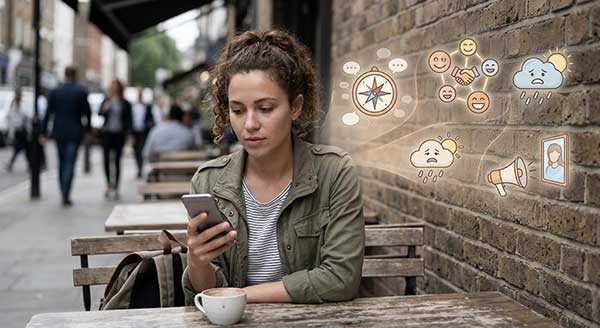
What Your Social Media Habits Reveal About Your Personality
There is a strange, nearly universal ritual that plays out in millions of bedrooms across the country long before the sun even touches the horizon. Before your feet hit the floor, before your mind fully registers the morning air, your fingers reach out in the dim light to find the glowing glass rectangle resting on the nightstand. Within seconds, your thumb is performing that familiar, rhythmic flick upward, skimming past news updates, curated vacation photos, midnight thoughts from strangers, and short video clips. We go to sleep to the faint illumination of a screen and wake up to its relentless stream of notifications, barely noticing how seamlessly these digital platforms have woven themselves into the fabric of our waking lives.
Ever since social platforms transformed from simple university networks into massive digital ecosystems, our relationship with technology has fundamentally shifted. We no longer just consume information; we broadcast our lives. We upload our quiet morning coffee routines, our career milestones, our quiet heartbreaks, and our unedited opinions for an audience of hundreds or thousands. Yet this constant broadcasting is far from random. The specific way you navigate these platforms—the frequency of your posts, the tone of your captions, the hours you spend lurking versus creating—functions like a psychological mirror. Long before you intentionally describe who you are, your digital footprint has already quieted the room and begun telling your story.
I remember sitting in a quiet, sunlit diner in downtown Chicago on a rainy Tuesday morning, watching a young woman at the corner table. Her breakfast was getting cold while she spent ten minutes carefully angling her phone over a plate of avocado toast, trying to capture the exact right spill of morning light. She adjusted the napkin, tilted her coffee cup, snapped a dozen photos, and spent another several minutes staring intensely at her screen, editing shadows and writing a caption. Looking at her, I felt a familiar pang of recognition—not of judgment, but of shared human vulnerability. How many times have any of us paused a genuine moment of lived experience simply to construct a digital artifact that proves we were happy, aesthetic, or thriving?
How Digital Communication Patterns Reflect the Big Five Personality Traits
Psychologists and computational researchers have spent years analyzing whether our online behavior accurately reflects our deep-seated psychological architecture. By examining word selection, posting frequency, response times, and follower ratios, behavioral scientists can construct remarkably detailed profiles based on the Big Five personality traits: openness, conscientiousness, extraversion, agreeableness, and neuroticism. What we write in a casual caption often carries subtle emotional markers that bypass our conscious defenses, signaling our baseline levels of anxiety or life satisfaction to anyone paying close attention.
Individuals who score high in neuroticism, for instance, tend to use social media as an emotional processing chamber. Their posts often contain a higher frequency of negative emotional words, subtle expressions of worry, or indirect pleas for external reassurance. Conversely, highly conscientious individuals display remarkable restraint online, posting less frequently and curating their profiles with deliberate precision to reflect professional stability and discipline. Research published by the National Institutes of Health indicates that computational models analyzing digital language can reliably predict dozens of distinct personality dimensions, proving that our online choices are direct extensions of our underlying neurological tendencies.
What Social Media Usage Habits Say About Loneliness and Depression
The relationship between screen time and emotional well-being is complex, often functioning as a mirror for our unaddressed inner struggles. Many people turn to infinite scrolling not out of genuine curiosity, but as a unconscious strategy to numb feelings of isolation or burnout. Sitting alone in a dark room scrolling through highlights of other people’s social lives creates a profound psychological illusion: it feels like connection, but it leaves the emotional nervous system entirely starved of real, somatic intimacy.
A landmark study conducted at the University of Pennsylvania monitored the habits of undergraduate students by actively restricting one group’s daily social media usage to just thirty minutes across major platforms. Over a three-week period, the students operating under the time limit experienced significant reductions in both loneliness and depression compared to the control group. The findings highlighted a poignant truth: actively reducing our digital exposure forces us back into physical reality, where true social belonging actually occurs. When we stop relying on a feed to soothe our loneliness, we finally create the internal quiet necessary to reach out to people in the real world.
The Psychological Connection Between Selfie Culture and Self Esteem
The rise of front-facing cameras transformed the human smartphone from a communication tool into a portable mirror. Capturing and sharing self-portraits has become a dominant cultural practice, yet the psychological motivations behind the lens vary wildly from person to person. While some view taking a quick photo as a fun, low-stakes way to document a mood or an outfit, clinical research suggests that an obsession with capturing the self often correlates with heightened social sensitivity and fluctuating self-worth.
Fascinating insights preserved by the American Psychological Association explore how the act of editing and sharing self-portraits directly interacts with body image and internal validation. Constantly evaluating your face through a digital lens trains your mind to view yourself from the outside in—a psychological state known as self-objectification. Interestingly, studies show that taking dozens of selfies but keeping them hidden in your phone camera roll often signals lower self-esteem than sharing them openly. Keeping a private vault of unposted images suggests a painful loop of self-scrutiny, where a person repeatedly measures their appearance against an impossible standard without ever feeling safe enough to be seen.
Understanding Social Media Addiction Narcissism and Social Anxiety
For many people, the urge to check notifications has crossed the line from a mild habit into a compulsion. This digital dependency is deeply intertwined with social anxiety and our modern crisis of self-regard. When an individual struggles with low self-esteem in their offline life, the digital world offers a deceptively controlled environment where they can carefully edit their flaws and curate an idealized persona. However, relying on likes and comments to maintain a fragile sense of personal worth creates a dangerous feedback loop: the moment the digital praise slows down, self-doubt returns with twice the intensity.
On the other end of the psychological spectrum, high levels of narcissism drive a completely different pattern of digital overuse. Individuals with narcissistic traits utilize social platforms as performance stages to harvest admiration and reinforce their perceived superiority. They tend to post more frequently about achievements, physical appearance, and exclusive lifestyle markers, relying on the platform to feed an insatiable need for external validation. Yet whether driven by social anxiety or narcissistic protection, excessive social media dependency points toward the same core truth: we use technology to bridge the painful gap between who we privately feel we are and who we wish the world would see.
Understanding your own social media habits is not an invitation to self-criticism, but a doorway toward deeper self-awareness. The next time you find your thumb hovering over a screen in the quiet space of an early morning, take a slow breath and ask yourself what you are truly searching for in that moment. Real connection, peace, and self-worth are rarely found at the bottom of a digital feed; they are waiting for you right here, in the unedited, quiet reality of your own life.