How Falling in Love With Life Changes Everything You Feel
I spent an unusually cold Tuesday night in October standing on the corner of East Pine Street in Seattle, watching steam rise from an open storm drain while the smell of damp cedar and roasted coffee settled heavy in the air. The rain had just stopped, leaving the asphalt shiny under the amber glow of the streetlights. A man in a yellow rain slicker was trying to wrangle three energetic golden retrievers outside a closed bakery, and for reasons I still cannot fully articulate, the sheer absurdity and quiet beauty of that mundane moment hit me like a physical weight. I wasn’t in love with anyone at that particular point in my life, nor was I anticipating any life-altering news. Yet, my heart felt uncomfortably full, beating against my ribs with the kind of sharp, irrational intensity that usually arrives with a late-night romantic confession. We are taught from childhood to reserve our deepest emotional surges for another person, but standing on that wet sidewalk, I realized we have severely misdiagnosed the true target of human affection.
We live in a culture aggressively obsessed with romantic partnership. We write endless songs about it, fund multi-billion-dollar dating apps to algorithmically organize it, and consult therapists when its sudden absence leaves us feeling hollow. The human capacity to fall in love is perhaps the most captivating glitch in our evolutionary code, pulling us out of our selfish survival instincts and forcing us to care about another soul more than our own safety. Yet, despite centuries of poetic devotion, scholars remain divided on what actually happens inside us when that lightning strikes. The Spanish philosopher José Ortega y Gasset famously described love as a state of temporary madness, a psychological narrowing of attention where the rest of the world dissolves into background noise. Around the same time in modern psychological research, scholars like Elaine Hatfield framed passionate love as a intense, desperate longing for complete union with another, a state where emotional equilibrium is entirely surrendered to another person’s presence or absence.
What Are the Six Types of Love According to Psychology
Trying to compress this chaotic emotion into a single definition is like trying to catch mist with a wire basket. Back in 1973, Canadian sociologist John Alan Lee proposed a framework that remains one of the most practical attempts to categorize the emotional spectrum. Lee suggested that love is not a uniform color, but rather a primary palette with distinct secondary blends. There is Eros, the fiery, physical passion that burns hot and fast; Storge, the slow-growing, comfortable affection built on deep friendship and shared history; and Ludus, the playful, uncommitted game where affection is given in light, strategic doses. Beyond these primary forms lie the complex combinations: Mania, the possessive, anxiety-ridden obsession that keeps people awake at three in the morning; Pragma, the logical, practical alignment of values and life goals; and Agape, the selfless, unconditional devotion that asks for nothing in return.
When you look at Lee’s typology, it becomes obvious why so many relationships collapse under the weight of unrealistic expectations. We frequently demand that a single partner embody all six colors simultaneously—we want a passionate lover who is also a practical roommate, a playful co-conspirator, and a selfless guardian. Research published by the American Psychological Association suggests that human emotional well-being thrives when individuals distribute their emotional needs across a broader network rather than relying on a single romantic anchor. Love is too structurally volatile to be contained within a single human relationship, and expecting one person to be your entire emotional ecosystem is a fast track to quiet resentment.
The Science Behind Why We Fall in Love With Someone
If the psychological classifications feel complex, the biological mechanisms are downright chaotic. Why do your eyes lock onto one specific individual in a crowded room of two hundred people? Is it the precise pitch of their voice, the asymmetry of their smile, or something far more primal humming beneath the surface of conscious thought? Back in the autumn of 2014, during a morning lecture in a chilly auditorium at Boston University, a grey-haired professor of biological psychology stood before three hundred tired undergraduates and delivered a piece of advice that sent a ripple of nervous laughter through the room. He asserted that if any of us were planning on going on a blind date that weekend, we should pinch our nostrils shut for the first five minutes, because our olfactory system was actively plotting against our rational judgment.
While the professor was clearly exaggerating to keep a room of twenty-year-olds awake, his core point was rooted in solid evolutionary biochemistry. The human nose silently evaluates major histocompatibility complex genes through subtle body scents, attempting to select partners whose immune systems complement our own to ensure healthier offspring. Anthropologist Helen Fisher’s pioneering brain-imaging research documented through the National Institutes of Health demonstrated that falling in love triggers a violent neurological cocktail of dopamine, oxytocin, vasopressin, testosterone, and adrenaline. Our brains on early-stage romance look strikingly similar to brains under the influence of potent stimulants, flooding our neural pathways with motivation and focused attention. Yet, knowing that a surge of dopamine is responsible for the butterflies in your stomach doesn’t actually diminish the experience. Science can map the electrical wiring of the house, but it still cannot explain why the light feels so warm when you step inside.
Why Falling in Love With Life Itself Matters Most
There is a subtle danger in treating love purely as a chemical equation or an interpersonal contract. The philosopher Michael Boylan argued that love, at its highest functional level, is an active choice—an ongoing commitment to moral and personal growth that pushes us to become better versions of ourselves. It brings to mind that famous, wonderfully unvarnished line delivered by Jack Nicholson’s character in the 1997 film As Good As It Gets, when he looks at a woman and stammers out what he considers the ultimate compliment: “You make me want to be a better man.” Love, when functioning correctly, is a catalyst for personal evolution. It shakes us out of our self-absorbed routines and forces us to expand our capacity for empathy, patience, and vulnerability.
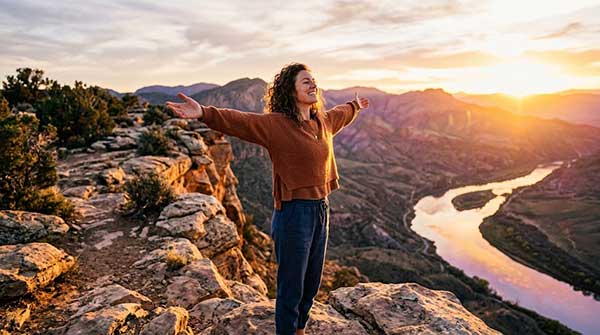
However, limiting this transformative force strictly to romantic partnerships leaves us extraordinarily vulnerable. People leave, feelings shift, and mortality eventually claims even the most dedicated companions. The most sustainable form of wellness arrives when you direct that same intense, passionate curiosity outward toward existence itself. Falling in love with life means developing an romantic reverence for the mundane details: the sharp, bitter taste of black coffee on a dark winter morning, the way light filters through the dirty blinds of a city apartment, the sound of wind pulling through pine needles, or the strange, miraculous fact that we are riding a giant rock through cold space at sixty-seven thousand miles an hour.
When you fall in love with the planet and the sheer privilege of having a conscious mind for a few decades, your romantic relationships actually improve. You stop placing the impossible burden of your personal happiness on your partner’s shoulders because your reservoir is already full. You no longer need them to be your sole source of meaning, your daily entertainer, or your emotional savior. Instead, you get to invite them alongside you to witness the grand, terrifying beauty of the world together. Romantic love is undeniably sweet, but it is ultimately just one instrument in a massive orchestra. The real symphony begins the moment you open your eyes, step out onto the pavement, breathe in the cold air, and realize that life itself was the partner you were looking for all along.