The Game of Hiding From Yourself Never Ends Until You Say Sobe
There is a moment in every long drive across the Midwest when the radio goes quiet and you realize you have been talking to yourself for the last forty miles. Not out loud. Not exactly. But there has been a conversation running — a negotiation, a defense, a rehearsal — and you were not the one leading it. You were listening. Someone else in the car was speaking with your voice.
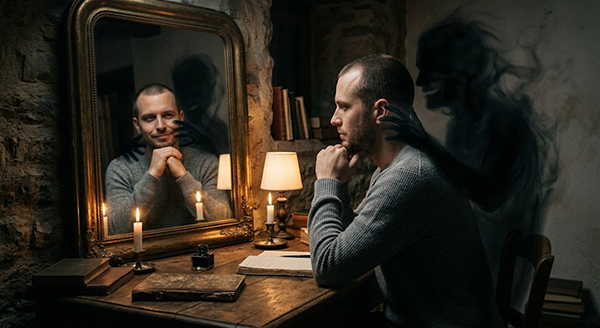
I pulled over somewhere outside Des Moines once, not because I needed gas, but because I needed to catch that voice in the act. I wanted to turn around and say, “I see you.” The moment I did, the voice went quiet. That is the game. The moment you turn, the other one slips around a corner. You are left standing in an empty room of your own skull, holding a flashlight, feeling foolish.
The deepest human dilemma in this text is not about honesty. It is about hide-and-seek as a lifelong arrangement with yourself — and whether you are ever willing to run to home base and shout the word that ends the round.
The Turkish writer asks a series of questions that feel less like questions and more like mirrors angled into places you have agreed not to look. “Whoever is telling you about life — turn and look: are they actually living it?” That sentence landed on me like a toll booth on a highway I thought was free. I have spent years quoting people about presence, about simplicity, about honesty. I have forwarded articles, underlined passages, told friends what they needed to hear. And if you had asked me whether I was living what I was saying, I would have said yes without blinking. But the blinking is the tell. The blink is the moment the voice checks whether you believe it.
I know a woman in Burlington, Vermont, who teaches mindfulness to executives. She is excellent at it. Her calendar is full. She once told me, after a workshop, that she had not sat still in three months. She said it while checking her phone, half-laughing, the way you admit a small defeat you have already decided to ignore. Then she said, “But I know what I’d say to a client who told me that.” She paused. “I’d tell them to slow down.” She did not hear herself. Or maybe she did, and that was why she laughed — the laugh you make when you catch your own tail disappearing around the corner.
The word I want to introduce here is sobe — the Turkish call that ends a round of hide-and-seek. English does not have an exact equivalent. “Olly olly oxen free” comes close, but it is a release call, a summons back. Sobe is different. It is the shout of the seeker who has found you. It means: I saw where you went. I followed the path. You are caught. And now you must step out and stand in the open.
What would it mean to play this game against yourself — and to mean the sobe when you shout it?
Most self-improvement is just redecorating the hiding spot. We read books that tell us how to be more authentic, and then we use those books as better camouflage. We develop a vocabulary for our patterns, and the vocabulary becomes a new room in the house, with better lighting and a door that locks from the inside. The ego — that long-tailed creature the Turkish text keeps spotting from the corner of the eye — does not mind being studied. It loves being studied. Study is attention, and attention is what it eats. The only thing the ego cannot survive is the sobe: the direct, unblinking recognition that the one doing the studying is also the one hiding.
I have tried to catch it in the act. I have sat down to “do the work” — journal, meditate, reflect — and within minutes I am performing the work for an invisible audience. The journal entry sounds like a caption. The meditation becomes a story I will tell later. Even the decision to catch the hiding voice becomes a hiding voice. There is no outside position. That is what makes this game so strange. In hide-and-seek, the seeker and the hider are usually different children. Here, you are both. You are also the yard. You are also the house. You are also the corner around which the tail disappears.
The Turkish text says: when you feel the ego’s long tail rounding the corner into the other room, follow quietly and say “Boo!” That is the sobe before the sobe. It is the playful ambush that says, I saw you trying to hide me from myself. And the text insists this is not grim. It is joy. It is the big joy of running to the center and shouting that you caught the hidden one. The game ends, for a moment, and everyone is seen.
But then the next round begins. There is always another corner.
I think about a man I knew in college who used to play poker with himself. Two hands, both dealt face-up, played against each other. He said it kept him honest. I asked him how, since both hands belonged to him. He said, “The trick is deciding which one is me.” He would sit on the floor of his dorm room, dealing cards across a towel, and he would narrate the thoughts of each player. Every few minutes he would laugh — the laugh you make when one side of you catches the other bluffing. He called it the only game where losing is the point. I did not understand that then. I think I do now.
The text ends with a question that is also a test: “Can you give your own animal the trust it needs to come out?” That phrase — your own animal — is not a metaphor for something wild and dangerous. It is the part of you that has been living in the crawlspace, surviving on crumbs, waiting to be seen without being punished. Trust is not a reward you give it after it behaves. Trust is the doorway. The animal will not walk through a doorway it has been tricked through before.
I do not know if I have that trust. Some days I do. Some days I pretend to, and the animal knows the difference. That is the thing about the animal: it can smell a performance from inside the performer. You cannot fool something that has been watching you from the moment you learned to fool yourself.
One thing before you go
Do this tonight: sit in a room with the door closed and play one round of this game on purpose. Ask yourself a question you have been avoiding — not the big one, a small one. Then wait. Do not answer. Wait for the voice that offers the polished answer. When it comes, say out loud, “I see you.” Then watch where the tail goes. Do not follow it. Just note the direction. That is enough. The sobe does not have to be loud to end the round.
Three questions I keep getting
What does sobe actually mean?
It is the Turkish word for the call that ends a round of hide-and-seek, the shout you make when you have found the hidden person. It has no exact English equivalent, which is why the text uses it as a way of naming the moment you catch yourself hiding from yourself.
How do you know when you’re hiding from yourself?
You feel it as a sudden smoothness — the way your inner voice becomes too coherent, too quotable, too ready to be explained. The hiding voice speaks in paragraphs. The honest voice stumbles. When your self-talk sounds like a caption, follow it.
Is this the same as the “inner critic” or “imposter syndrome”?
Not quite. The inner critic is a judge. The ego’s long tail is a player. It does not criticize you so much as distract you — leading you away from the room where the real conversation is trying to happen. The sobe is not about silencing it. It is about letting it know you saw the move.