FOMO and Anxiety: Why You Feel Like You’re Falling Behind
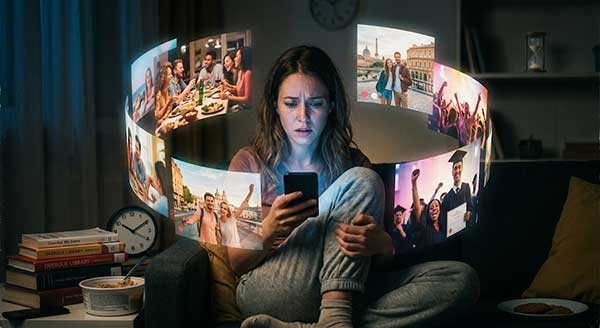
The first time I felt it, I was sitting on my couch in Austin on a Saturday night, scrolling through Instagram. My friends were at a lake house. Others were at a concert. Someone I went to high school with was in Lisbon, holding a glass of wine, looking impossibly tan. I was in sweatpants, eating cereal for dinner, watching other people live lives that looked better than mine.
That feeling — that sudden, sour twist in the chest — has a name now. FOMO. Fear of missing out. It is not just envy. It is not just loneliness. It is the specific, low-grade dread that somewhere, right now, someone is having the experience you should be having. And the worst part is that it used to be avoidable. You had to hear about the party from someone who was there. Now you can watch it unfold in real time, from your couch, in high definition.
What Is FOMO and Why Does It Hit So Hard
FOMO is typically defined as a type of social anxiety — the fear that others are having rewarding experiences without you. Psychologists categorize it as a form of anxiety related to social belonging. Andrew Przybylski, a researcher at the Oxford Internet Institute, published one of the foundational studies on FOMO in 2013 in the journal Computers in Human Behavior. He developed a measurement tool called the FOMO Scale and found that people with lower levels of basic psychological need satisfaction — in other words, people who already felt disconnected — were more likely to report high levels of FOMO. The fear was not just about missing an event. It was about missing out on belonging itself.
That study matters because it shifts the focus away from social media as the sole cause. FOMO is not created by Instagram. It is amplified by it. The fear has always existed. What changed is the access. The source text points to 2013 as a turning point, and the data supports this: that was the year smartphone sales overtook feature phones globally, putting a real-time feed of other people’s lives into every pocket. Since then, the intensity of the comparison has only grown.
Why Your Brain Cannot Stop Comparing
There is a reason FOMO feels so physical. The human brain evolved in small groups where being excluded meant real danger. Being left out of the hunt could mean starving. Being shunned could mean death. The brain does not know the difference between a paleolithic tribe and a group chat. It just knows that exclusion is a threat.
This is where Benjamin Voyer’s work comes in. Voyer, a professor at the London School of Economics, has argued that FOMO is fundamentally a fear of social exclusion. It is not about the missed party. It is about the message that missing the party sends: you are not part of the group. You are outside. You are alone. For a species that evolved to depend on social bonds for survival, that message is terrifying.
The source text mentions a study published in Psychiatry Research that found FOMO is linked to higher smartphone and social media use, regardless of age or gender. The connection works both ways: the more you scroll, the more you feel like you are missing out, and the more you feel like you are missing out, the more you scroll. It is a loop. And the loop is exhausting.
How FOMO Drains Your Time and Attention
Here is the part that does not get talked about enough. FOMO is not just unpleasant. It is inefficient. The source text says the biggest danger of this anxiety is that it wastes time. People who experience high levels of FOMO often struggle to focus on what they are actually doing because they are thinking about what they are not doing. They are at work, but they are thinking about the networking event they skipped. They are at dinner with their partner, but they are checking their phone to see what everyone else is doing. The moment is never enough, because the alternative is always present.
I have been guilty of this more times than I can count. I have sat through dinners, movies, and entire weekends with the nagging sense that I should be somewhere else. Not because where I was was bad. Because the phone in my pocket kept offering me glimpses of a life that looked more exciting.
There is a concept in psychology called “opportunity cost.” It is the idea that choosing one thing means not choosing another. FOMO is what happens when the unchosen options start to feel like losses. Every decision becomes a kind of grief. You did not just stay home. You missed the party. You did not just work late. You missed the sunset. The frame is negative by default.
Can FOMO Ever Be Useful
The source text offers a surprising twist. FOMO is not always bad. For some people, it can be motivating. The awareness that others are doing interesting things can push you to take risks, learn new skills, and say yes to opportunities you might otherwise decline. The key is the line between motivation and stress. When FOMO pushes you to grow, it is useful. When it pushes you to stay up until 2 a.m. scrolling, it is not.
I have a friend in Portland who used FOMO as fuel for years. She hated the feeling of being left behind, so she channeled it into action. She took classes. She traveled. She built a career. Then she hit her mid-thirties and realized she had not actually enjoyed any of it. She had been running from a feeling instead of toward a life. That is the trap. FOMO can get you moving, but it cannot tell you where to go.
The difference, according to the researchers, comes down to awareness. If you know what you actually value, FOMO loses its grip. The missed party is only a loss if the party aligns with something you care about. If you value rest, staying home is not missing out. It is choosing. If you value deep work, skipping the happy hour is not exclusion. It is prioritization. The fear only works when your values are undefined.
How to Manage FOMO Without Quitting Social Media
You do not have to delete every app and move to a cabin. The source text offers three practical anchors: live in the moment, focus on your own life, and limit your time on social networks. They sound simple. They are not.
Living in the moment is harder than it sounds because the moment is often boring. That is why the phone is so tempting. But the moment is also the only place where your actual life is happening. The more time you spend in the alternatives, the less time you spend in the real thing.
Focusing on your own life requires definition. What are you actually trying to do? What matters to you? If you cannot answer those questions, the comparison game will always win. Because there will always be someone doing something more impressive than what you are doing right now.
Limiting time on social networks is the most actionable step. The research is clear that the relationship is dose-dependent. More scrolling equals more FOMO. Less scrolling equals less. You do not need to go cold turkey. You just need to interrupt the loop.
I started with a simple rule: no social media before noon. The first week was uncomfortable. I felt like I was missing news, updates, conversations. By the third week, I noticed something strange. I was not missing anything. The important stuff found me anyway. The rest was just noise.
What I Still Get Wrong
Last month, I caught myself doing it again. Saturday night. Couch. Phone. The same old scroll. The same old twist in the chest. FOMO does not disappear because you understand it. It just becomes less powerful. You recognize it faster. You close the app sooner. You return to the room, to the person in front of you, to the life you are actually living.
That is the work. Not eliminating the fear. Catching it. Naming it. Letting it pass without letting it steer.
The next time you feel that twist, try this: put the phone down and ask yourself what you would actually want to be doing right now if you were not looking at what everyone else is doing. The answer is usually smaller than you think. A walk. A book. A phone call. Sleep. The life you are missing is not on the screen. It is in the room with you, waiting for you to look up.