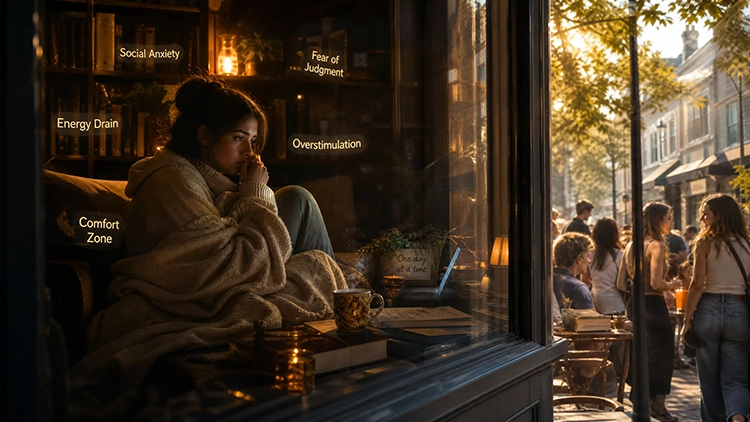
The Sanctuary Paradox: Why the Modern Mind Retreats from the Outside World
1. The Architecture of Voluntary Isolation
There is a precise, quiet moment that occurs in millions of households every evening. You sit on the edge of your bed, shoes half-laced, looking at the front door. Nothing dangerous lies behind it. The scheduled dinner with friends, the stroll through the local park, or the routine errand are all entirely benign. Yet, an uncanny weight anchor you to the floor.
You pull off your shoes, send a brief cancellation message citing “exhaustion,” and immediately feel a rush of profound relief—followed quickly by a subtle, haunting sense of regret.
This experience is not mere laziness, nor is it a simple character flaw. It is the manifestation of the Sanctuary Paradox: a psychological condition wherein the environment designed to protect us from exhaustion gradually becomes the threshold that prevents us from experiencing vitality.
[ External World ] ──( Overstimulation / Social Cost )──► [ Home / Sanctuary ]
▲                                                       │
│                                                       ▼
(Heightened Friction) ◄── [ Reduced Friction Tolerance ] ◄── (Immediate Relief)
We live in an era that preaches constant connection while engineering environments that make physical presence feel impossibly expensive. To understand why millions of individuals are quietly withdrawing behind their front doors, we must look beyond surface-level excuses like bad weather or busy schedules. We must examine how the modern mind constructs safety, evaluates social friction, and manages cognitive energy.
2. The Cognitive Tax of the External World
To explain why we stay inside, modern discourse frequently points to fatigue. However, physical exhaustion rarely prevents us from doing things we enjoy. The true culprit is Friction Accumulation—the unconscious tally of micro-decisions, sensory inputs, and social monitoring required the moment we step across our threshold.
The Micro-Economics of Social Exposure
Inside your home, the environment is predictable. The ambient noise, lighting, temperature, and interpersonal demands are calibrated precisely to your baseline. The external world, by contrast, demands continuous adaptative effort.
The Friction Threshold
The Friction Threshold is the invisible point where the anticipated cognitive cost of navigating an uncontrolled environment exceeds the perceived emotional reward of the destination.
When you leave your home, your brain must execute hundreds of background processes simultaneously:
- Micro-Navigation: Reading crowd dynamics, adjusting physical pacing, and filtering high-decibel auditory noise.
- Impression Management: Maintaining posture, controlling facial expressions, and adhering to unwritten social scripts.
- Evaluative Vigilance: Assessing whether you are being observed, judged, or interrupted.
For a brain already drained by digital hyper-connectivity and workplace performance, this background processing represents a massive expenditure of metabolic energy. Staying inside is not a rejection of the world; it is a defensive preservation of cognitive capital.
3. The Digital Surrogate and the Collapse of Reward
Why has staying home become so much easier today than it was thirty years ago? The answer lies in the asymmetric evolution of our tools.
+-----------------------------------------------------------------------+
|                         THE COGNITIVE BALANCE                         |
+-----------------------------------------------------------------------+
|  PHYSICAL REALITY                     DIGITAL SURROGATES              |
|  • High Friction / Delayed Reward     • Zero Friction / Instant Reward|
|  • Ambiguous Social Cues              • Algorithmic Validation        |
|  • Sensory Overload                   • Curated Stimulation           |
+-----------------------------------------------------------------------+
Historically, remaining indoors carried a steep cost: sensory deprivation, boredom, and isolation. To get entertainment, information, or human contact, you had to venture out. The pain of isolation outweighed the pain of social effort.
Today, technology has decoupled comfort from isolation. Streaming platforms, delivery services, and hyper-curated social feeds offer high-dopamine inputs with zero social friction.
The Illusion of Social Satiety
When you scroll through a friend’s updates or participate in a group chat, your neural architecture receives fragments of social input without the visceral presence of another human being. This creates Digital Pseudo-Satiety: a state where the brain’s hunger for true connection is dulled by synthetic micro-interactions, yet never truly nourished.
Because you are no longer starved for raw stimulation, the high friction of physical outing appears mathematically irrational to your subconscious mind. Why pay a high cognitive price for social connection when a low-cost, low-risk proxy sits in the palm of your hand?
4. The Biological Anchor: The Threat-Safety Loop
When avoidance becomes a habit, it ceases to be a simple preference and begins to alter the brain’s threat-appraisal systems. This process is driven by basic neurobiological feedback mechanisms.
       [ Trigger: Idea of Going Out ]
│
▼
[ Anticipatory Anxiety / Fatigue ]
│
▼
[ Decision: Cancel / Stay Home ]
│
▼
[ Rapid Amygdala De-escalation (Relief) ]  ◄── Enforces Avoidance
│
▼
[ Brain Registers: "Outside = Danger / Inside = Safety" ]
When you consider going out and experience a surge of resistance, your nervous system interprets that resistance as an alarm. The moment you cancel your plans, your nervous system experiences an immediate drop in tension.
This drop in tension acts as an internal reward. The brain notes: “We avoided that environment, and we survived. Therefore, the outside world was indeed dangerous, and staying inside saved us.”
Over time, this loop shrinks your Window of Tolerance. The longer you remain within a controlled environment, the more chaotic the uncontrolled world feels. What began as a rational need for rest slowly hardens into an involuntary systemic reflex.
5. The Misconception of “Rest”
A central misconception in contemporary self-care culture is that spending time at home is inherently restorative. We often tell ourselves: “I am staying home to recharge.”
However, passive isolation inside a digital sanctuary is rarely restorative. True psychological recovery requires Cognitive Restoration—an active state wherein the brain’s directed attention mechanisms are allowed to rest while passive fascination takes over.
Active Sanctuary vs. Passive Containment
| Dimension | Passive Containment (Isolation) | Active Sanctuary (True Rest) |
| Primary Activity | Screen-based consumption, ruminative scrolling | Unstructured creation, physical movement, deep silence |
| Attentional State | High-frequency fragmented focus | Low-arousal, broad focus |
| Nervous System | Low-grade Sympathetic Activation (Alert) | Parasympathetic Recovery (Rest & Digest) |
| Post-State Feeling | Lethargy, disorientation, guilt | Mental clarity, readiness for engagement |
If your time at home is spent absorbing a continuous stream of news, work emails, or social media commentary, your central nervous system remains in a state of low-grade arousal. You are not building energy; you are merely consuming it in a enclosed room.
When you finally consider going outside, you are doing so not from a state of restored vitality, but from a state of lingering, low-level exhaustion.
6. The Existential Dimension: The Weight of Being Seen
Beyond biology and digital friction lies an existential reality: The Public Sphere Demands an Identity.
Inside your private space, you do not need to perform. You do not need to embody a profession, maintain an aesthetic, or justify your trajectory. You simply are.
The public square, however, is an arena of mutual observation. To walk through a city or sit in a cafe is to expose yourself to the gaze of the Other. For individuals undergoing life transitions, career burnout, or emotional uncertainty, this exposure feels unbearable.
The Performance Debt
The subconscious psychological burden created when the external image you feel obligated to project drastically diverges from your internal emotional state.
When the energy required to project a functional identity exceeds your available emotional bandwidth, the physical act of stepping outside feels like stepping onto a stage without having memorized your lines. Isolation becomes an act of psychological preservation—a refuge where you can drop the performance entirely.
7. Re-establishing the Perimeter: Operational Mental Models
Overcoming the instinct to withdraw does not mean forcing yourself into overwhelming social environments. It requires systematically reducing the cognitive friction of the external world while resetting your brain’s threat-appraisal system.
Model I: The Micro-Exposure Protocol
Rather than attempting a high-stakes social outing (e.g., a three-hour dinner party), decouple the act of being outside from the act of performing socially.
[ High-Friction: Social Performance ]  ──►  (Dinner Parties, Networking, Crowds)
│
▼
[ Low-Friction: Pure Presence ]       ──►  (Solo Walks, Parks, Observation)
- Remove Social Obligations: Step outside with the explicit intention of interacting with no one.
- Limit Temporal Duration: Commit to ten minutes of outdoor presence. If the desire to return home remains absolute after ten minutes, allow yourself to return without guilt.
- Engage Soft Fascination: Walk in environments with natural geometry—parks, coastlines, or quiet streets—where sensory inputs demand zero active processing.
Model II: Decoupling Preparation from Execution
A major source of friction is the sequence of tasks required to leave the home (dressing, planning routes, scheduling).
To bypass this barrier, separate the preparation phase from the decision phase:
- Prepare your outdoor attire hours before you intend to leave.
- Decide your exact destination and duration in advance, removing the need for real-time decision-making at the front door.
- Treat the threshold not as a major event, but as a neutral physical transition.
8. The Ultimate Reframe
The ultimate goal is not to eliminate your desire for solitude. Solitude is a vital human necessity, a space where thought settles and selfhood is restored.
The danger arises when solitude ceases to be a choice and becomes a shelter from perceived vulnerability.
The world outside your front door is inherently unpredictable, noisy, and demanding. It will offer moments of discomfort, awkwardness, and fatigue. But it is also the only arena where spontaneous discovery, genuine human resonance, and unscripted life can occur.
Your sanctuary should be a launchpad to which you return to process life—not a vault where you retreat to avoid living it.