The Morality No One Talks About: What Happens When You Stop Blaming Everyone Else
The last time I really wanted to hurt someone, I didn’t do it. Not out of virtue. Out of exhaustion. I had been nursing a grudge for months, replaying the argument in my head, adding new chapters to a story that had already ended. The person had moved on. I had not. I was still standing in the ruins of my own righteousness, convinced that my anger was justice and my resentment was proof of how much I had been wronged.
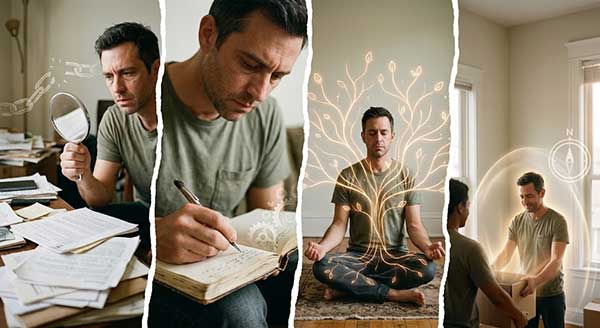
Then one night, sitting alone in my apartment in Minneapolis, I caught myself mid-loop. And for reasons I still do not fully understand, I asked a different question. Not “What did they do to me?” but “What am I getting out of this?”
The answer was ugly. The resentment was a shelter. As long as I was the wronged one, I did not have to look at the parts of the mess I had made. The blame was a wall, and behind the wall was a version of myself I did not want to meet.
That was my first real glimpse of what I now think of as universal morality. Not the kind written in rulebooks or posted on courthouse walls. The other kind. The kind that does not change from culture to culture or era to era. The kind that has nothing to do with who is watching and everything to do with who is doing.
The Lie We Tell When We Blame Everything Else
There is a move that is so automatic most of us do not even notice it. When something goes wrong, we scan the room. We look for a cause that is not us. A boss. A partner. A system. A childhood. A bad economy. A rough year. The scan happens in seconds, and it always finds something. There is always something out there to point at.
The problem is not that external factors are irrelevant. Of course they matter. Systems are real. Injustice is real. Other people are genuinely capable of cruelty and failure. But the moment we hand over all responsibility, we lose something essential. We lose the ability to change.
I am not talking about taking blame. Blame is just responsibility wearing a punishment suit. I am talking about something quieter. Ownership. The simple, brutal acknowledgment that I am the only person who can answer for what I do, what I feel, what I think. No one else. Just me.
This is not a popular idea in a culture that loves to locate villains. We want someone to be wrong so we can be right. But that hunger for a villain is its own kind of poison. It feels like power. It is actually paralysis.
What Self-Ownership Actually Looks Like
The first time I tried to take full responsibility for my own feelings, I felt like I was suffocating. Every instinct screamed at me to find someone else to blame. The argument. The misunderstanding. The thing they said. The thing they should have done. It was all there, waiting to be used.
And then, very slowly, I stopped. I just sat with the feeling. Not the story about the feeling. The feeling itself. The tightness in my chest. The heat in my face. The urge to run, to attack, to disappear.
Taking responsibility means staying with all of that and not turning it into a weapon. Not against the other person. Not against yourself. Just being with it, like weather, until it passes.
What I noticed, after enough of these small sittings, was that the other person began to exist again. Not as a villain. Not as a problem to solve. Just as a person, with their own weather, their own loops, their own unwatched pain. The moment I stopped demanding that they be the reason for my misery, they became free to be something else. And so did I.
This is the part that is hard to explain to someone who has not felt it. The freedom is not just yours. It leaks outward. When you stop needing other people to be wrong so you can be right, you give them back their own room to be human. Not because you are generous. Because you are no longer using them as a mirror.
The Cruelty of Radical Honesty
There is a line I keep coming back to: be ruthlessly honest with yourself. Not as a slogan. As a practice. The kind of honesty that does not flinch.
Most of us are honest enough to survive. We tell the truth when it is convenient, when it makes us look good, when the cost of lying is too high. But underneath that careful, curated honesty is a whole basement of things we do not want to see. The smallness. The pettiness. The hunger for approval. The way we say one thing and feel another. The way we perform kindness while quietly keeping score.
Universal morality, the kind that does not bend, begins in that basement. Not in the polished room upstairs. In the mess. In the part of ourselves we hope no one ever sees.
I have a friend in Chicago who went through a bad divorce. For the first year, she told everyone the same story. He was cold. He was selfish. He never showed up. The story was true. But it was not the whole truth. The whole truth took her another year to reach, and it nearly broke her. She had been using the marriage as a hiding place. She had been cold too, in her own way. She had expected him to save her from a loneliness that predated him by decades.
When she finally told me this, she was shaking. Not because she was afraid of my judgment. Because she had looked at the thing she had been hiding from, and it was not what she wanted it to be. It was just her. A woman who had never learned to be honest with herself.
That is the cruelty of radical honesty. It takes away your best stories. It leaves you with just yourself. No decorations. No excuses. No one to blame.
And then, strangely, it leaves you lighter.
The Respect You Owe Yourself
I used to think self-respect meant standing up for yourself. Drawing boundaries. Demanding to be treated well. All of that matters, but it is not the root. The root is deeper.
Self-respect means being willing to look at yourself without flinching. It means keeping the promises you make to yourself. Not the big ones. The small ones. The “I will go to bed early tonight” ones. The “I will not send that text” ones. Every time you break a promise to yourself, something in you learns that you cannot be trusted. And a person who cannot trust themselves cannot respect themselves either.
This is not about perfection. It is about consistency. The steady, quiet practice of being someone you can count on. When you have that, the respect is not something you have to demand. It is just there. And it extends, without effort, to everyone else.
The person who respects their own inner life does not need to violate anyone else’s. Not because they are trying to be good. Because they are too busy being whole. The boundary between self and other softens, not out of weakness, but out of fullness.
What Universal Morality Actually Demands
If I had to put it in one sentence, it would be this: take care of the inside, and the outside will follow.
Not as a promise. As an orientation. Most of us spend our lives trying to manage the outside. We adjust our behavior to avoid conflict. We polish our image to earn approval. We build walls to protect against judgment. All of it is exhausting, and none of it works for long.
The other way is harder at first. You turn inward. You look at what is actually driving you. The fear. The ambition. The need to be seen. The grief you never let yourself feel. You stop pretending you are above any of it. You stop performing a version of yourself that does not exist.
And then, very slowly, something shifts. The outside world, which felt so threatening, becomes less so. Not because it changed. Because you stopped needing it to be something it is not. You stopped asking other people to fill holes that only you can fill. You stopped demanding that the world be fair before you are willing to be kind.
That is not morality in the conventional sense. It is something prior. It is the ground on which real morality stands. Without it, all our rules and values are just costumes. With it, they become unnecessary.
Because a person who is honest with themselves does not need to be told not to harm others. They see, without being told, that harming others is just another way of harming themselves. The connection is not philosophical. It is practical. It lives in the body.
Where This Leaves Me
I still catch myself blaming. I still scan the room for a villain when things go wrong. I still catch myself polishing the outside while the inside collects dust. The difference now is that I catch it faster. And when I catch it, I do not punish myself. I just turn back toward the thing I was avoiding.
That is the practice. Not perfection. Not purity. Just the slow, unglamorous work of being honest. Of taking responsibility. Of owning my own weather.
The old story I told myself — the one where everyone else was the problem — is still there when I reach for it. But it is worn thin now. I can see through it. And behind it, there is just me. A person. Not a victim. Not a hero. Just someone trying to be a little less asleep than yesterday.
That is what I think universal morality is. Not a code. Not a list. Not a set of rules carved into stone. Just the quiet, radical act of turning inward and finally, after all these years, taking responsibility for the one life that is actually yours.
The rest follows. Not because you force it. Because you stop getting in the way.