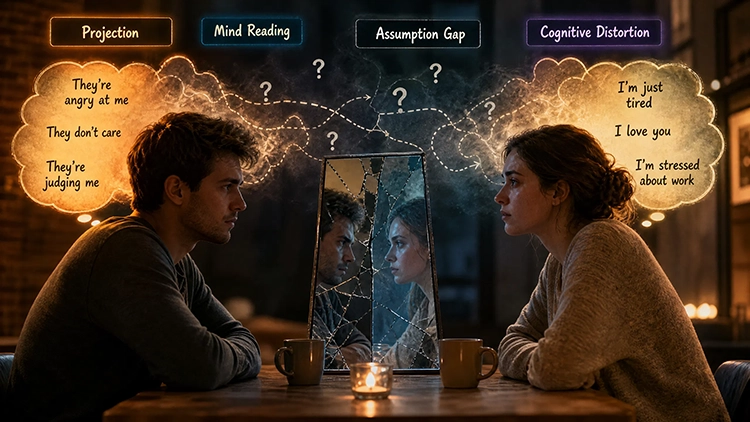
The Architecture of Assumption: How Mind Reading, Personalization, and Projection Distort Reality
1. The Mind’s Need for Narrative
The human brain is fundamentally a predictive engine. Faced with billions of bits of sensory information every second, its primary mandate is not to observe reality with objective precision, but to construct a coherent, low-energy narrative that keeps us safe. When information is missing—when a colleague walks past without smiling, a partner grows quiet, or an acquaintance chooses an unfamiliar path—the brain refuses to tolerate the void. It fills the silence with an Assumption.
An assumption is an unverified hypothesis treated as a fact. It feels like intuition, but it is almost always a projection of our personal history, fears, and unconscious conditioning.
[ Incomplete External Event ] ──► [ Cognitive Gap ] ──► [ Unconscious Assumption ] ──► [ Misinformed Reaction ]
│
(Fueled by Projection
& Historical Threat)
We do not merely make assumptions; we live inside them. We build entire emotional narratives, end relationships, and construct personal identities based on storylines written by our own cognitive biases. To free ourselves from this silent distortion, we must examine the hidden mechanisms that turn assumptions into absolute psychological reality.
2. The Mechanics of Cognitive Projection
To understand why our assumptions are so frequently inaccurate, we must look at the psychological mechanisms that generate them. Chief among these is Naïve Realism: the innate human conviction that we perceive the world as it objectively is, while those who see it differently are uninformed, irrational, or biased.
Because we operate under Naïve Realism, we automatically assume that other people share our internal logic, emotional baseline, and moral calculus. When their behavior deviates from what we would do, we attribute their actions to bad intent, incompetence, or emotional distress rather than recognizing a fundamentally different internal landscape.
+-----------------------------------------------------------------------+
|                    THE ARCHITECTURE OF PERCEPTION                     |
+-----------------------------------------------------------------------+
|  THE OBJECTIVE EVENT               THE ASSUMPTIVE LENS                |
|  • A colleague remains silent      • "They are angry at me."          |
|  • A friend chooses a different path • "They are making a mistake."   |
|  • An acquaintance smiles brightly  • "Their life is perfect."        |
+-----------------------------------------------------------------------+
The Cost of Predictive Efficiency
Why does the brain jump to conclusions so rapidly? Because remaining in a state of unknowing requires continuous metabolic energy. Open-ended ambiguity keeps our nervous system on low-grade alert.
By contrast, closing the loop with a definitive assumption—even an incorrect or negative one—brings immediate psychological closure. The mind prefers a catastrophic certainty over an uncomfortable ambiguity.
3. Deconstructing the Great Interpersonal Myths
To dismantle our habitual assumptions, we must examine the specific cognitive distortions that poison daily human interaction.
                          [ Cognitive Distortions ]
│
┌────────────────────────────┼────────────────────────────┐
▼                            ▼                            ▼
[ Emotional Masking Illusion ]  [ Egocentric Personalization ]  [ Path-Exclusivity Fallacy ]
(Confounding Expression         (Assuming Others' Actions       (Equating Unfamiliarity
with Reality)                   Revolve Around Us)             with Failure)
I. The Emotional Masking Illusion
The assumption that external presentation accurately reflects internal reality.
We frequently operate under the myth that highly visible emotional signals—laughter, professional success, or composure—are direct indicators of psychological well-being. This ignores the ubiquitous phenomenon of masking.
A smile is often not an overflow of joy, but a socially conditioned protective shield designed to maintain safety and avoid burdening others. When we assume that “happy-looking” people require no empathy, we leave those who mask their pain entirely isolated in plain sight.
II. Egocentric Personalization
The assumption that other people’s behaviors are direct reactions to us.
When a stranger is rude, a neighbor ignores our greeting, or a manager speaks curtly, our default instinct is to ask: “What did I do wrong?”
Egocentric Personalization The cognitive distortion where an individual interprets neutral, external, or unrelated events as direct, intentional reactions to their own worth, presence, or actions.
In reality, the vast majority of human behavior is entirely self-referential. People do not act out of a reaction to who you are; they act out of an attempt to manage their own internal state. A clerk’s rudeness or a friend’s distance is almost always an expression of their internal cognitive load, unresolved stress, or personal grief. You are rarely the subject of the sentence; you are merely the wall off which their internal noise echoes.
III. The Path-Exclusivity Fallacy
The assumption that because someone solves a problem differently, their method is inherently flawed.
The human mind exhibits a natural bias toward its own established procedures. When someone executes a task, navigates a career, or resolves an issue using a strategy foreign to us, our initial reflex is often judgment: “They are doing it wrong.”
This is a failure of cognitive flexibility. There are infinite functional routes to a single destination. Confusing your personal methodology with absolute correctness restricts your capacity for learning and creates unnecessary relational friction.
4. The Biological Cost of Mind Reading
Attempting to guess what others are thinking, feeling, or planning is not merely a social bad habit; it carries a measurable neurobiological cost.
       [ Trigger: Unclear Social Cue ]
│
▼
[ Attempted "Mind Reading" ]
│
▼
[ Anticipatory Threat State ]
│
▼
[ Chronic Cortisol / Adrenaline Secretion ]
│
▼
[ Emotional Exhaustion & Relational Drift ]
When you engage in perpetual “mind reading”—trying to decode an employer’s silence, a partner’s sigh, or a peer’s critique—your brain triggers a subtle threat response. The amygdala activates, releasing low doses of cortisol and adrenaline.
Over time, this creates Relational Hyper-Vigilance. You are no longer interacting with the human being standing in front of you; you are interacting with your anxious forecast of their internal thoughts. This state is deeply exhausting and guarantees that genuine, authentic connection becomes impossible.
5. The Epistemological Pivot: The Art of Unknowing
How do we break free from this automatic engine of assumption? It requires cultivating what philosophers call Epistemic Humility—the willingness to acknowledge the vast limits of our own perception.
+-----------------------------------------------------------------------+
|                      THE EPISTEMIC FRAMEWORK                          |
+-----------------------------------------------------------------------+
|  REACTIVITY (The Assumption Loop)    HUMILITY (The Curiosity Loop)   |
|  • "They ignored me, so they hate me" • "They did not respond. I don't|
|                                         know their current state."    |
|  • "They are happy, so they need    • "They are smiling, but I cannot |
|     nothing"                            know their internal depth."   |
+-----------------------------------------------------------------------+
The Power of “I Do Not Know”
The most psychologically liberating sentence a human being can internalize is simple: “I do not have enough data to form a conclusion.”
When you replace an immediate assumption with the neutral recognition of non-knowledge, your nervous system immediately downshifts from threat mode to observation mode. You cease preparing a defense or constructing a counter-narrative. You simply observe what is happening without assigning unverified meaning to it.
6. Practical Mental Models for Daily De-escalation
To transform this philosophical shift into a functional daily habit, we can apply two specific operational mental models whenever we catch ourselves making assumptions.
Model I: Hanlon’s Razor (Extended)
“Never attribute to malice or personal rejection that which is adequately explained by fatigue, preoccupation, cognitive overload, or simple misunderstanding.”
Before deciding that someone’s action was a targeted critique or a personal slight, force your mind to generate at least three alternative, benign explanations:
- Are they physically exhausted or overwhelmed?
- Are they managing a private crisis I know nothing about?
- Do they simply possess a different communication style than I do?
Model II: The Direct Inquiry Protocol
The most potent antidote to an assumption is radical, non-defensive clarity.
[ Assumption Arises ] ──► [ Pause Reactive Judgment ] ──► [ Execute Direct Inquiry ]
│
("When X happened, I realized
I assumed Y. Is that accurate?")
Instead of silently building a story around a ambiguous event, address it directly:
- “I noticed you were quiet during the meeting today. I realized my brain started making up a story that you were disappointed with my work. Is that accurate, or are you just managing a busy day?”
This simple exercise instantly collapses false narratives, eliminates emotional prediction debt, and replaces synthetic paranoia with genuine human resonance.
7. The Ultimate Reframe
We will never completely stop our brains from generating assumptions. The predictive engine is too deeply built into our evolutionary architecture.
However, we can alter our relationship with those assumptions. We can learn to hold our interpretations lightly, treating them not as absolute truths, but as temporary, unverified theories.
The next time you catch yourself deciding why someone acted as they did, why they failed, or what they think of you, stop. Drop the story. Step back from the cinema of your own mind and return to the quiet, unpredictable, and profoundly liberating reality of what actually is.