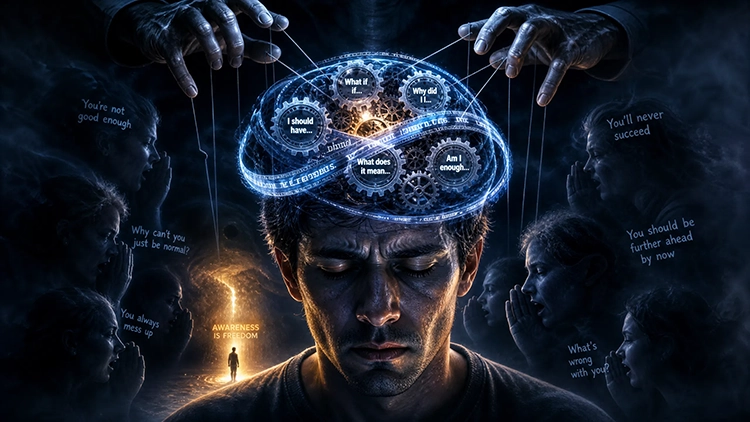
The Sovereign Observer: Ruminative Loops, Executive Control, and the Illusory Controller
1. The Dynamic Architecture of Consciousness
During a long, unstructured drive, a singular phenomenon unfolds within the human skull. As the external landscape shifts outside the window, an inner narrative flickers at extreme velocity: an erratic sequence of immediate logistical tasks, aesthetic impulses, financial temptations, medical anxieties, social obligations, and basic bodily urges.
Then, a sudden question breaks through the noise: “What are you thinking about?”
The answer comes instantly: “Nothing.”
[ Unconscious Stream of Consciousness ]  ──►  (Hyper-speed, Non-linear, Fragmented)
│
├─► High Social/Cognitive Friction
▼
[ Spoken Interpersonal Answer ]          ──►  "Nothing." (Cognitive Reduction)
This exchange reveals a fundamental truth about human cognition: Pure silence inside the active mind does not exist.
The brain is a biological engine designed for perpetual output. Expecting the mind to cease generating thoughts is equivalent to expecting the heart to cease pumping blood. The true question of psychological sovereignty is not how to extinguish the internal monologue, but rather: Who is observing the noise, and who is driving the vehicle?
2. The Mechanics of the Default Mode Network
To understand why the mind leaps erratically between disparate thoughts, we must examine the brain’s default neuro-architecture. When you are not engaged in an explicit, goal-directed task, your brain activates a specialized neural circuit known as the Default Mode Network (DMN).
+-----------------------------------------------------------------------+
|                    THE DUAL-NETWORK EQUILIBRIUM                       |
+-----------------------------------------------------------------------+
|  DEFAULT MODE NETWORK (DMN)           TASK-POSITIVE NETWORK (TPN)     |
|  • Spontaneous Internal Monologue     • External, Goal-Oriented Focus |
|  • Self-Referential Processing        • Direct Sensory Engagement     |
|  • Temporal Jumping (Past/Future)     • Present-Moment Grounding      |
+-----------------------------------------------------------------------+
The DMN is the primary source of our mental “cacophony.” It continually integrates memories, evaluates potential social scenarios, projects future anxieties, and updates our self-referential narrative.
This unstructured mental stream is not a flaw; it is an evolutionary mechanism for creative synthesis and danger forecasting. However, when the DMN operates without executive oversight, it degenerates from constructive association into destructive repetition.
3. The Structural Mechanics of Rumination
While erratic mental cacophony can be benign or even generative, the brain frequently encounters a far more dangerous state: Cognitive Rumination.
Derived from the biological term for ungulates re-chewing digested food, rumination is the compulsive re-processing of negative thoughts, past mistakes, or prospective catastrophes.
       [ Negativity Bias / Trigger Event ]
│
▼
[ Catastrophic Projection ]
│
▼
[ Amygdala & DMN Activation ]  ◄── (Feeds High-Arousal Cortisol)
│
▼
[ Impaired Executive Problem-Solving ]
│
▼
[ Decreased Self-Efficacy & Identity Erosion ]
The Neuro-Evolutionary Engine of Overthinking
Rumination is fueled by an ancient evolutionary mechanism: The Negativity Bias. For early humans, overlooking a potential threat meant immediate biological death, whereas overlooking a source of pleasure resulted merely in a missed opportunity. Consequently, the brain developed a structural preference for tracking real or imagined dangers.
In modern society, where physical predators have been replaced by social evaluations, career deadlines, and medical uncertainties, the brain applies this same threat-detection machinery to psychological concepts.
Rumination Loop A self-reinforcing cognitive state where the mind mistakes the intense, repetitive simulation of a problem for the active resolution of that problem, thereby increasing systemic anxiety while reducing actual problem-solving capacity.
When you rumimate:
- You experience Threat Inflation: Replaying an event in memory activates the amygdala in a manner similar to experiencing the event in real time.
- You experience Solution Paralysis: High cortisol levels impair the prefrontal cortex, crippling creative reasoning and leaving you trapped inside the threat frame.
- You experience Self-Efficacy Decay: Because the loop produces no practical outcome, your unconscious mind internalizes a sense of helplessness, eroding self-worth and forcing you to look for external validation.
4. The Illusion of the Internal Controller
When faced with an uncontrollable stream of thoughts, the default instinct is to ask: “How do I force my mind to stop?”
This question rests on a profound psychological misconception: The Observer-Thought Fusion.
[ Structural Identity Fusion ]  ──►  "I am generating and controlling these thoughts."
▲
│ (Epistemic De-fusion)
▼
[ The Observer Paradigm ]       ──►  "Thoughts are occurring within my field of awareness."
Most individuals operate under the assumption that they are the direct, deliberate author of every thought that enters their awareness. However, if you attempt to sit in absolute silence and predict your very next thought, you quickly discover an uncomfortable reality: the thought arrives before you have consciously chosen to create it.
The mind is a generative field. Thoughts arise spontaneously due to sensory input, biological memory, and subconscious processing.
The struggle to forcefully “stop” a thought simply creates an additional layer of cognitive resistance. You become the swimmer attempting to calm a turbulent lake by hitting the water with your hands—an action that only creates further disturbance.
5. The Empty Boat: Epistemological De-Fusion
The ancient Zen parable of the Empty Boat illustrates the precise mechanism required to break free from ruminative traps.
A rower navigating a quiet lake sees another boat drifting directly toward them. If the rower believes the approaching boat is piloted by an incompetent or hostile captain, they experience intense anger and panic. But if they realize the approaching boat is completely empty, the anger vanishes instantly. They simply reach out, push the empty hull aside, and continue rowing.
                 [ Approaching Mental Disturbance ]
│
┌────────────────────────┴────────────────────────┐
▼                                                 ▼
[ Personified Threat Frame ]                    [ Empty Boat Frame ]
• "Why is this happening to me?"                • "This is an unguided mental construct."
• High Affective Reaction                       • Zero Affective Reaction
• Entanglement & Friction                       • Mindful Observation & Redirection
The thoughts, anxieties, and catastrophic projections that drift across your consciousness are Empty Boats. They carry no intrinsic power, no inherent truth, and no mandate for action.
They become destructive only when you project an identity into them—when you treat an unverified mental simulation as an absolute reality that demands an immediate, emotional response.
6. Protocols for Re-Establishing Executive Sovereignty
To move from passive entangling in ruminative loops to active self-authorship, you must systematically shift neural activity from the Default Mode Network back to the Task-Positive Network.
[ Default Mode Network (DMN) ]  ──( Somatic Grounding )──►  [ Task-Positive Network (TPN) ]
• Rumination & Narrative                                     • Direct Physical Focus
• Past/Future Orientated                                     • Present Real-Time Action
Protocol I: Somatic Anchoring (The Triple-Breath Reset)
When you catch your mind entering a ruminative loop, do not attempt to counter the thoughts with intellect. Ruminate-level intellectualizing simply provides more fuel for the loop. Instead, use a physical anchor to force a neural state shift.
- Close the Visual Field: Interrupt the stream of sensory inputs.
- Execute Three Physiological Sighs: Take a deep double-inhalation through the nose followed by an extended, slow exhalation through the mouth.
- Trace the Airway: Direct your conscious focus entirely to the physical sensation of air passing through your nasal passages and expanding your diaphragm.
This simple intervention shifts your central nervous system out of sympathetic arousal, signaling to the amygdala that no immediate physical threat exists.
Protocol II: Cognitive De-Fusion & Fact-Auditing
Once somatic baseline is restored, execute a rapid audit of the mental narrative:
[ Ruminative Thought Arises ] ──► [ Label: "An Empty Boat" ] ──► [ Audit: "Is this fact or simulation?" ]
│
▼
[ Actionable / Release ]
- Labeling: Explicitly state to yourself: “My mind is producing a future-catastrophe simulation.” This creates a critical cognitive gap between the observer and the mental content.
- Separation of Variables: Ask: “How much of this thought is an objective, physical fact, and how much is an unverified assumption generated by my brain’s desire for certainty?”
- Release: Discard the speculative layers and leave only the verified, actionable variables.
7. The Ultimate Reframe
Who controls your mind?
If “control” means dictating every single thought, impulse, and sensation that arises within your consciousness, the answer is: No one. The mind is an open, dynamic ecosystem that reacts continuously to the internal and external world.
However, if “control” means deciding which thoughts you inhabit, which narratives you validate, and where you direct your conscious attention, then the control rests entirely with you.
You are not the chaotic noise drifting across the lake. You are not the empty boat crashing into the shore. You are the vast, quiet expanse of the water itself—and the conscious rower holding the oars.