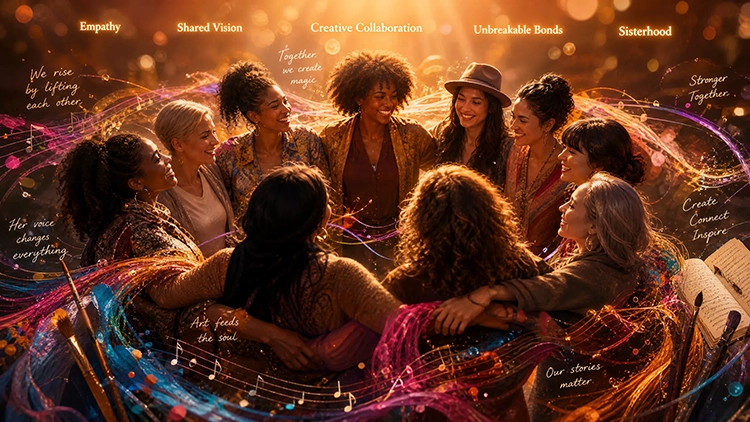
The Weaving of Agency: Relational Feminism, Somatic Expression, and the Craft of Collective Memory
1. The Isolation Counter-Script
During periods of systemic disruption or social fragmentation, human beings instinctually withdraw into immediate survival perimeters. Yet, an intriguing psychological paradox unfolds among marginalized or culturally pressured groups: when formal structures fail to provide psychological safety, organic micro-collectives emerge to construct informal, high-trust sanctuaries.
The formation of a specialized reading and creative circle during widespread isolation is not merely a hobbyist response to boredom. It represents a deliberate, counter-hegemonic act of Relational Differentiation: the intentional creation of an autonomous, non-performative social space dedicated to mutual mirroring, emotional containment, and shared intellectual sovereignty.
[ Systemic Isolation / Disruption ] ──► (Involuntary Alienation) ──► [ Exhaustion of Individual Defense ]
│
▼
[ Relational Counter-Space ]       ◄── (Creative Mirroring)  ◄── [ Autonomous Micro-Collective ]
When women gather to read, analyze, and physically alter artifacts within a self-governed space, they bypass the transactional metrics of the broader public sphere. They establish what psychoanalyst Donald Winnicott termed a “potential space”—an intermediate zone of experience where internal emotional reality and external creative objects merge to restore psychological wholeness.
2. The Archetypal Resonance: Wild Women and Narrative Reclamation
To understand why centered literature—specifically works exploring female archetypes, such as Clarissa Pinkola Estés’ Women Who Run With the Wolves—acts as such a potent catalyst, we must examine the mechanism of Archetypal Mirroring.
+-----------------------------------------------------------------------+
|                    THE ARCHETYPAL RECOVERY LOOP                       |
+-----------------------------------------------------------------------+
|  THE REPRESSED INSTINCT               THE ARCHETYPAL RECOVERY         |
|  • Over-adaptation to societal roles  • Identification with primal themes|
|  • Emotional fragmentation            • Collective validation of pain |
|  • Chronic legibility performance     • Permission for wild sovereignty|
+-----------------------------------------------------------------------+
The Return of the Wild Self
In civilized social structures, individuals (and women in particular) are routinely conditioned to suppress idiosyncratic, non-conforming, or deeply instinctual drives in favor of legibility, sweetness, and utility.
When a group repeatedly engages with archetypal narratives, three psychological shifts occur:
- Normalization of the Instinctual: Raw emotional experiences—grief, anger, intense creative longing, boundary-enforcement—are recognized not as pathologies, but as natural expressions of the psyche.
- De-privatization of Pain: Individual struggles cease to feel like isolated personal failures; they are re-contextualized as shared human developmental milestones.
- Re-enchantment of Narrative: Readers stop viewing themselves as passive victims of their life stories and begin viewing themselves as active protagonists undergoing necessary trials.
3. Somatic Exteriorization: Why Intellectualizing Is Not Enough
An essential transition in human healing occurs when a group moves from pure intellectual discussion (reading, analyzing, debating) to Tactile Expression (stitching, sculpting, mixed-media collage).
       [ Unprocessed Internal Narrative ]
│
▼
[ Intellectual Analysis / Dialogue ]
│
▼
( The Somatic Bridge )
│
▼
[ Tactile / Material Manipulation ]
│
▼
[ Physical Exteriorization of Internal Memory ]
Cognitive and linguistic processing operates primarily in the left hemisphere of the brain. However, deeply held emotional memories, relational grief, and intuitive truths are largely encoded in right-hemispheric, somatic, and non-verbal networks.
Somatic Exteriorization
The process of translating non-verbal, implicit emotional states into tangible, physical artifacts through fine motor engagement, allowing the psyche to observe and manipulate its internal contents externally.
When a participant takes a physical photograph—perhaps depicting a serene island setting like Büyükada—and manually pierces it with a needle and thread, a profound neuro-psychological translation takes place:
[ Static Memory Artifact (Photograph) ] ──► [ Physical Piercing / Threading ] ──► [ Re-authored Symbol ]
│
▼
[ Re-claimed Agency & Emotional Integration ] ◄──────────────────────────────────────────┘
- The Needle as Boundary & Access: Piercing the image requires intent, precision, and tactile resistance. It breaks the passive, static nature of the past event captured in the photograph.
- The Thread as Repair: Stitching color into an image is a physical metaphor for integration (kintsugi of the psyche). The individual is literally mending, embellishing, and re-authoring a static slice of history.
- Somatic Down-Regulation: The repetitive, rhythmically constrained movement of embroidery acts as a somatic anchor, down-regulating the autonomic nervous system and creating a physiological state of safety conducive to deep self-disclosure.
4. The Spatial Power of Third Places and Women-Led Ecosystems
The physical geography where collective creation occurs is never neutral. Hosting an artistic, narrative intervention within a space created and run by women entrepreneurs adds a crucial layer of Ecosystem Realization.
Sociologist Ray Oldenburg conceptualized the “Third Place”—spaces outside the home (first place) and the workplace (second place) where informal, non-transactional civic life unfolds.
                  [ The Triangle of Belonging ]
│
┌────────────────────────┴────────────────────────┐
▼                                                 ▼
[ First Place: Home ]                         [ Second Place: Work ]
• Domestic obligations                         • Economic performance
• Familial roles                               • Identity management
│
▼
[ The Autonomous Third Place ]
• Non-transactional presence
• Shared creative agency
• Mutual recognition
When a Third Place is intentionally designed to be autonomous, aesthetic, and welcoming, it eliminates the ambient vigilance present in traditional public spheres.
In a space designed by women for women, participants do not need to negotiate power dynamics, brace against the evaluative gaze of dominant cultural paradigms, or justify their presence. The physical room itself acts as an extended maternal container, lowering cognitive load and enabling deep vulnerability.
5. The Anatomy of Relational Resilience
Why do bonds forged in creative, narrative-driven micro-collectives endure long after the crisis that birthed them has passed?
The answer lies in the distinction between Transactional Networking and Shared Creative Processing.
| Metric | Transactional Networks | Creative Solidarity Collectives |
| Primary Currency | Status, utility, mutual leverage | Vulnerability, resonance, authentic expression |
| Communication Style | Strategic self-presentation | Unscripted storytelling, emotional disclosure |
| Relational Goal | Downstream advantage | Immediate psychological containment & integration |
| Somatic State | Low-grade performance alertness | Parasympathetic safety, creative flow |
When individuals create alongside one another—sharing a table, exchanging threads, commenting gently on the evolving collage of a neighbor—they experience Synchronous Co-Regulation.
Their physiological systems synchronize in a shared, low-arousal state. This builds an invisible baseline of deep trust that cannot be replicated through digital interactions or formal networking events.
6. Operational Protocols: Building Autonomous Creative Sanctuaries
To construct an enduring, highly generative micro-collective that balances intellectual rigor with somatic integration, specific operational frameworks must be maintained.
[ Intellectual Input (Literature) ] ──► [ Reflective Dialogue ] ──► [ Somatic Translation (Craft) ]
│
▼
[ Relational Coherence ]            ◄── [ Safe Container Principles ] ───────────┘
Protocol I: The Dual-Modality Structure (Word + Material)
Avoid limiting group gatherings purely to literary analysis or purely to unstructured crafting.
- The Sequence: Begin with 45 minutes of structured, narrative exploration around a specific text or theme (establishing psychological legibility). Transition immediately into 60–90 minutes of silent or loosely conversational tactile work (anchoring the intellectual insights somatically).
Protocol II: The Sacred Container Guidelines
To prevent autonomous spaces from devolving into performative social clubs or superficial venting sessions, maintain strict boundaries:
- Zero unsolicited advice: Participants respond to personal disclosures with emotional resonance and shared reflection, never with fix-it strategies.
- Radical inclusion of nuance: Reject rigid ideological purity. Allow participants to express conflicting, messy, or incomplete emotions without fear of judgment.
- Honor the Physical Artifact: Treat the objects created within the space as legitimate tools of self-realization rather than mere decorative crafts.
7. The Ultimate Reframe
A needle drawing a thread through a photograph on a quiet island is not an act of trivial ornamentation. It is an ancient, deeply human technology of reclamation.
In a world that continuously demands speed, digital abstraction, and endless productivity, gathering in a physical room with other women to read deeply, speak truthfully, and embroider personal memories is an act of quiet, radical sovereignty.
You are not merely stitching thread into paper. You are weaving the invisible, unbreakable bonds of collective resilience—stitching yourself back into your own narrative, one deliberate, beautiful thread at a time.