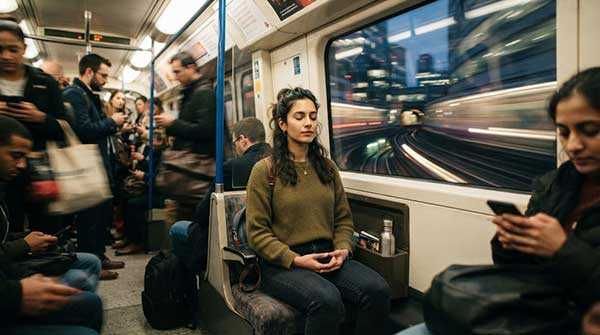
What Meditation Really Is: A Curious Approach to the Present Moment
The first time I tried to meditate, I lasted four minutes. Not four good minutes. Four minutes of sitting cross-legged on a cushion in a borrowed yoga studio in San Francisco, trying to empty my mind and failing spectacularly. My back hurt. My thoughts raced. I kept wondering if I was doing it wrong, which of course meant I was doing it wrong, or so I believed.
That was the problem. Not the racing thoughts. The belief that meditation was supposed to look a certain way. Sit still. Think nothing. Achieve peace. I had swallowed someone else’s definition whole, and then punished myself for not fitting inside it.
The source text I’m working from this time opens with a confession I recognize: “I used to sit for thirty minutes a day and brag about my practice, while the rest of my life was completely disconnected from seeing myself or being close to myself.” That is exactly what I did. I had a meditation practice that was long on minutes and short on presence. It was another item on the to-do list. Another thing to accomplish. Another way to feel like I was failing.
Here is what I have learned since, slowly and with great resistance: meditation is not a technique. It is a way of paying attention.
What Meditation Actually Means When You Strip Away the Stereotypes
The image most of us carry is specific. A person sitting in lotus position. Eyes closed. Face serene. Mind empty. Candles, maybe. Incense, possibly. A sense of deep, unbroken calm.
That image is not meditation. It is a photograph of meditation. A freeze-frame of one particular form, stripped of context and turned into a standard. And like every standard, it creates a gap between what we think we should be doing and what we are actually capable of doing.
Jon Kabat-Zinn, the founder of the Mindfulness-Based Stress Reduction program at the University of Massachusetts Medical School, has spent over forty years trying to correct this misunderstanding. His definition of mindfulness is simple and radical: paying attention, on purpose, in the present moment, without judgment. Notice what is missing from that definition. No cushion. No lotus. No requirement of a quiet mind. Just attention. That is the whole thing.
The moment you stop trying to achieve a particular state and start paying attention to whatever state is already here, the practice changes. It becomes possible. Not easy — possible. And possible is enough.
The Art of Noticing What Is Already Happening
There is a metaphor in the source text that I keep returning to. It compares meditation to checking your bag before you leave the house. You are not doing anything dramatic. You are just noticing what you are carrying. The keys. The wallet. The tightness in your chest. The thought that has been looping since breakfast. You are not trying to fix any of it. You are just checking.
That is meditation. Not a special state. Not a transcendence. A check-in. A moment of noticing what is already here, in the body, in the heart, in the mind.
The poet and essayist Mary Oliver called this “attention.” She wrote that attention is the beginning of devotion. Not worship in the religious sense. Devotion in the sense of paying close, loving attention to the thing in front of you. The dish in the sink. The sound of rain. The weight of your own body in the chair. When you pay attention like that, everything becomes interesting. Everything becomes alive.
This is why meditation can be anything. Cooking. Walking the dog. Watering plants. Sitting in traffic. Dancing alone in the kitchen. The activity does not matter. The attention does.
Why Sitting Still Is Not the Point
I spent years thinking meditation had to be formal. Sit down. Close your eyes. Follow the breath. That was the practice. Everything else was just life.
But the source text makes a point that should have been obvious: the formal sitting is just one training ground. The real practice is how you carry that attention into the rest of your day. The moment you are washing dishes and notice the temperature of the water. The moment you are in a meeting and feel the irritation rise without immediately acting on it. The moment you are about to open the fridge and realize you are not hungry — you are lonely. That is meditation too. Arguably, it is more important than the sitting.
The psychologist and author Tara Brach, who teaches meditation and has written extensively on radical acceptance, describes this as “coming back.” The practice is not to stay present. The practice is to notice when you have drifted and to come back. Over and over. Not as a failure. As the path.
What You Actually Do
If you want to try this, you do not need an app or a cushion or a quiet room. You need five minutes and a willingness to be bored.
Sit somewhere. Anywhere. Close your eyes or don’t. Take a breath and notice that you took it. Then notice the next one. Your mind will wander. That is fine. That is the design. The moment you notice it has wandered, you are already back. That noticing is the meditation.
If sitting still is unbearable, do not sit still. Walk. Wash the dishes. Fold laundry. The practice is not the posture. The practice is the attention you bring to whatever you are doing.
The trap — and I have fallen into it a thousand times — is to turn this into another accomplishment. Another thing to be good at. Another way to prove you are doing life correctly. Watch for that. The moment meditation becomes a chore, it stops being meditation. It becomes performance. And performance is the opposite of presence.
What Changes Over Time
Here is what I have noticed, not from reading studies but from my own uneven practice. When I pay attention in small ways, the small ways add up. I catch myself before the third cup of coffee. I notice the tension in my jaw before it becomes a headache. I hear the tone in my partner’s voice before the argument starts. I am not more productive. I am more present. And presence, it turns out, is the thing I was looking for all along.
There is a body of research on this. A 2014 review in JAMA Internal Medicine found that mindfulness meditation programs led to moderate improvements in anxiety, depression, and pain. The mechanisms are not fully understood, but the effect is real. The practice changes the brain. It strengthens the prefrontal cortex, the part that helps with attention and emotion regulation. It quiets the amygdala, the part that screams when you are stressed. Over time, the screaming gets less loud. Not because the stress goes away. Because you are less at its mercy.
That is not a promise. It is just what the data suggests. And it matches my own experience, which is that the days I pay attention are better than the days I do not.
What Meditation Is Not
It is not a cure. It is not a performance. It is not a way to become a better, more spiritual version of yourself. It is not something you achieve.
It is something you do. Or, more accurately, something you are. A way of being with whatever is here, without needing to fix it or escape it or judge it.
The source text ends with a line that undid me a little: “Maybe one day we will not need these practices. Maybe we will become the meditation itself. Every action becomes meditation. Because meditation is not a practice. It is an attitude.”
I do not know if that is possible. But I know the direction is right. The point is not to get good at sitting. The point is to learn, slowly and badly, how to be here.
Questions That Keep Coming Up
Do I have to sit cross-legged on the floor?
No. Sit in a chair. Lie down. Stand. Walk. The posture is not the practice. The attention is. Find a position you can hold without fighting your body, and then bring your attention to what is happening inside it. That is enough.
What if my mind will not stop racing?
It will not stop. That is not a problem. The mind thinks. That is what it does. The practice is not to stop the thoughts. It is to notice them without being dragged behind them. The moment you notice you have been lost in a story, you are already back. That returning is the meditation.
How long before I notice a difference?
It varies. Some people notice a shift within a few weeks. Some people need months. The research suggests that regular practice — even ten minutes a day — produces measurable changes over eight to twelve weeks. But the more useful answer is this: do not do it for the results. Do it for the practice. The results will come, or they will not. The practice is worth it either way.