What Are You Feeding Your Mind? How Your Media Diet Shapes Your Mental Health
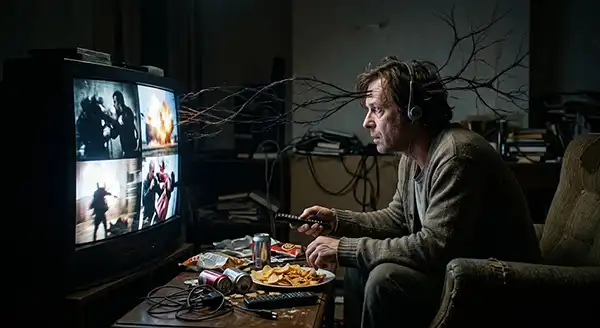
The moment I realized I had a problem came during a Tuesday night in my apartment in Minneapolis. I was watching a crime drama — one of those prestige series everyone talks about, the kind with beautiful cinematography and a body count that climbs higher every season. A woman was being murdered on screen. It was artfully lit. The score was haunting. And I was eating takeout noodles, completely unmoved.
Not bored. Not disturbed. Unmoved. Like the violence on screen had the same emotional weight as a furniture commercial.
That was the moment I understood I had been feeding my mind something toxic for years, and my mind had quietly adjusted to the poison.
We obsess over what we put in our bodies. Organic produce. Grass-fed beef. Supplements with names we cannot pronounce. We read labels, count macros, track our sleep, log our steps. But ask most people what they fed their mind today, and they will give you a blank stare.
The mind has a diet too. And most of us are living on mental fast food.
How Does Watching Violence Affect Your Brain
The research on media violence is older than most people realize. In 1977, a researcher named F.S. Andison published a meta-analysis in the Journal of Broadcasting examining the relationship between television violence and aggressive behavior. The conclusion was clear: there was a positive correlation. The more violent content people watched, the more aggressive their attitudes and behaviors tended to be.
That was nearly fifty years ago. The evidence has only accumulated since.
A study from Columbia University Medical Center’s Functional Magnetic Resonance Imaging Research Center, published in 2007, found something even more unsettling. When people watched violent television programming, the parts of the brain responsible for suppressing aggressive behavior became less active. The neural brakes, so to speak, started to fail. The researchers, including Dr. Christopher Kelly and his colleagues, documented this using fMRI scans. Watching violence was not just unpleasant. It was changing the way the brain regulated itself.
The American Psychological Association has weighed in on this repeatedly over the decades. Their official position is that exposure to violent media can contribute to aggressive thoughts, feelings, and behaviors. Not for everyone, not in every circumstance, but the pattern is consistent enough to take seriously.
I did not know any of this when I was eating noodles and watching a woman die on my television. I just knew something in me had gone numb.
What Is the “Happy Violence” Effect in Media
There is a concept in media studies that explains why we tolerate so much violence in entertainment. The communication theorist George Gerbner, who spent decades at the Annenberg School for Communication at the University of Pennsylvania, called it “happy violence.”
The idea is simple and disturbing. When violence is packaged as entertainment — when the hero kills the villain and the audience cheers, when the gunshot arrives with a clever one-liner, when the body count is just the cost of a happy ending — the violence stops feeling real. It becomes normalized. It becomes, in Gerbner’s framework, part of the background radiation of modern life.
Gerbner argued that the more we identify with characters on screen, the more we accept their actions as reasonable. The hero who tortures a suspect for information is not a monster. He is a hero. The audience has been trained to see his cruelty as necessary, even righteous. That is the happy violence effect. The violence is not framed as tragic. It is framed as satisfying.
I have watched enough television to know how well this works. The revenge fantasy is not something that happens to us. It is something we are taught to want.
Why Your Social Media Feed Is Part of Your Mental Diet
Here is where it gets personal. The violence in movies and television is one thing. But the quieter poison, for most of us, is the endless scroll.
Think about what you looked at today. Not just the news, which is designed to alarm you. The comments. The arguments. The outrage. The stranger on the internet who is wrong about something and must be corrected. The influencer whose life looks better than yours. The bad news delivered in short, sharp bursts, one after another, until the world feels like a burning building.
A 2022 study published in the Journal of Medical Internet Research found that problematic social media use was associated with higher levels of depression, anxiety, and stress. The researchers were careful to note that correlation is not causation. But the pattern is real, and it echoes what many of us feel in our bodies after an hour of scrolling: the tight chest, the low-grade irritability, the sense that everything is falling apart and there is nothing you can do about it.
The mind absorbs what it is given. If you feed it outrage all day, you will feel outraged. If you feed it envy, you will feel inadequate. If you feed it fear, you will feel afraid. This is not magic. It is basic cognitive science.
The psychologist Daniel Kahneman, who won the Nobel Prize in economics for his work on decision-making, described a phenomenon called the availability heuristic. What we see most often becomes what we believe is most common. If your feed is full of violence, you will believe the world is more violent than it is. If your feed is full of anger, you will believe everyone is angry. The mind does not distinguish between the world and the window through which it views the world.
How to Do a Mental Diet Without Becoming a Hermit
I am not suggesting you throw your television out the window and move to a cabin without Wi-Fi. I like movies. I watch television. Some of the best stories being told right now are violent stories, and I am not going to pretend otherwise.
But there is a difference between consuming something and being consumed by it. The mental diet is not about elimination. It is about awareness.
The first step is to notice what you are actually taking in. Not what you intend to take in. What you actually consume, day by day, without thinking about it. For one week, pay attention. What do you watch? What do you read? Who do you follow? What kind of conversations do you have with your friends — are they about ideas and experiences, or are they about other people’s flaws?
The second step is to ask a simple question: How do I feel after consuming this? Not during. After. Do you feel energized or depleted? Curious or anxious? More connected to people or more suspicious of them? The answer is usually clear. The problem is that we rarely stop to ask.
The third step is to make small substitutions. Not dramatic overhauls. Small ones. Replace one violent show with something that inspires you. Replace one doomscrolling session with a walk. Replace one gossip-filled coffee date with a conversation about something you actually care about.
The researcher and author Cal Newport, who writes about focus and attention in the digital age, argues that the most important skill of the next decade will be the ability to curate your own cognitive environment. Not just what you consume, but what you refuse to consume. The people who thrive will not be the ones who consume the most information. They will be the ones who consume the right information.
What Happens When You Change Your Media Diet
I tried this, reluctantly, for thirty days. I did not cut out television entirely. I just stopped watching things that made me feel worse. I replaced the crime dramas with documentaries about the natural world. I replaced the political shouting matches with long, unhurried conversations with friends. I replaced the morning news scroll with ten minutes of sitting quietly with a cup of coffee and no screen.
The changes were subtle at first. I slept a little better. I was slightly less irritable in traffic. I did not feel the same urge to check my phone every few minutes.
Then, around week three, something shifted. I noticed I was less afraid. Not because the world had gotten safer. Because I had stopped marinating in a version of the world that was mostly threat. The fear had been coming from the feed, not from reality.
This is not to say that bad things do not happen, or that we should ignore injustice. It is to say that the constant, unrelenting exposure to violence and outrage is not making us more informed. It is making us more tired, more scared, and less capable of doing anything useful.
The body knows what it needs. So does the mind. We just have to start listening.
The Body, Mind, and Spirit Connection You Keep Hearing About
There is a reason the wellness world keeps returning to the idea of holistic health. Because it is true. The body and the mind are not separate systems. They are one system, constantly talking to each other.
You can eat all the kale in the world, drink all the green juice, hit the gym five days a week. If your mind is marinating in violence and fear, you will not feel well. The stress hormones do not care about your workout streak. They care about what you are feeding your attention.
Dr. Herbert Benson, who spent his career at Harvard Medical School studying the mind-body connection, demonstrated this decades ago. His work on the relaxation response showed that mental states have direct, measurable effects on physical health. The mind is not just a passenger in the body. It is part of the engine.
That is why the mental diet matters. Not because it is a luxury. Because it is part of the same maintenance you do for the rest of your body. You would not eat garbage every day and expect to feel good. So why do you feed your mind garbage and wonder why you are tired, anxious, and numb?
What I Am Doing Differently Now
I still watch television. I still use social media, though less than I used to. I still read the news, though not first thing in the morning and not right before bed.
The difference is that I now treat my attention as something worth protecting. The same way I would not leave the front door open at night, I do not leave my mind open to whatever the algorithm wants to feed me. I choose. Not perfectly. But consciously.
The question is not “Should I consume media?” The question is “What am I consuming, and what is it doing to me?”
That question has changed how I spend my evenings. It has changed who I follow. It has changed what I talk about with the people I love. It has even changed how I see myself — less like a passive receiver of whatever the world wants to broadcast, and more like a person with a say in what enters my own head.
The woman on the television screen, in that Tuesday night crime drama, is not thinking about any of this. She is a character in a story designed to keep me watching. The question is whether I want to keep watching. Whether I want to keep feeding my mind the same old poison, or whether I am ready to try something else.
The something else is not complicated. It is not expensive. It is not a product or a program or a ten-step system. It is just attention, directed with care, toward the things that actually nourish.
That is the whole mental diet, really. Paying attention to what you are paying attention to. And making a different choice, sometimes, just to see what happens.
Questions Worth Sitting With
Is watching violent content always bad for mental health?
Not always. Context matters, and so does the person watching. Some people can watch violent films without internalizing them. But the research suggests that consistent, heavy exposure does have an effect, especially when the violence is framed as entertaining or justified. The issue is not any single show. It is the cumulative weight of what you consume over time.
How do I know if my social media use is a problem?
You already know. The signs are not subtle. You feel worse after scrolling than before. You check your phone without meaning to. You find yourself arguing with strangers about things that do not matter. If you were describing a food that made you feel this way, you would stop eating it. The same logic applies to media.
Can a mental diet really change how I feel day to day?
That is what the evidence suggests. Not overnight, and not perfectly. But when you change what you feed your mind, the mind responds. The fog lifts a little. The anxiety quiets. The world starts to look like something other than a threat. You cannot control everything that happens to you. But you can control what you take in. And that, it turns out, is more power than most people ever use.