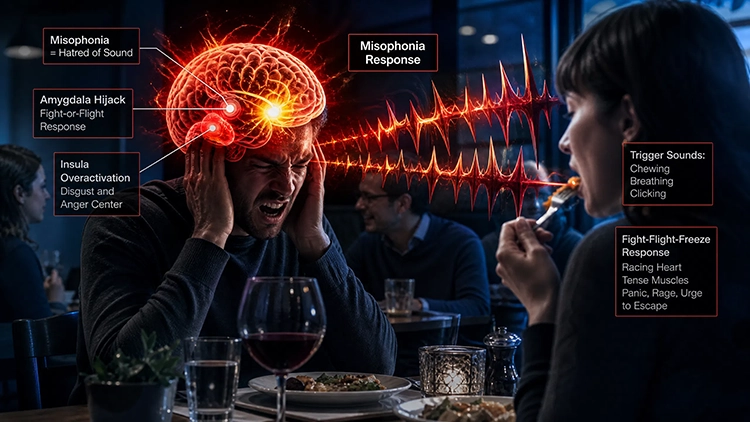
The Violence of Sound: Misophonia and the Neuromotor Mismatch of Everyday Audition
1. The Perceptual Anomaly: When Sound Transcends Discomfort
To live with misophonia is to experience an immediate, uninvited bodily invasion triggered by the mundane acoustics of human existence.
For the vast majority of the population, the rhythmic crunching of an apple, the wet click of a swallow, or the subtle friction of a pencil on paper registers as neutral background noise. At worst, these sounds present a minor, fleeting annoyance. But for an individual with misophonia, these specific acoustic patterns do not pass through the auditory system as simple information; they strike the nervous system with the speed and violence of an existential threat.
[ Auditory Input: Chewing / Sniffling ] ──► (Involuntary Salience Network Hijack) ──► [ Instant Sympathetic Surge ]
│
▼
[ Social Isolation & Behavioral Avoidance ] ◄── (Chronic Interpersonal Strain) ◄── [ Acute Rage / Panic ]
The term misophonia—coined in 2001 by neuroscientists Pawel and Margaret Jastreboff—translates literally from Ancient Greek as the “hatred of sound.” Yet, this translation is fundamentally misleading. Misophonic distress is not a psychological distaste for noise, nor is it a generalized intolerance to loudness (hyperacusis). It is an acute, involuntary neuromotor mismatch where specific, highly patterned sound triggers bypass cognitive evaluation entirely, instigating an immediate surge of rage, panic, and physical mobilization.
AI Overview: Misophonia
Misophonia (Selective Sound Sensitivity Syndrome) is a neurobiological condition characterized by intense emotional, physiological, and behavioral responses to specific acoustic or visual triggers—most commonly human or repetitive background sounds. Far from simple annoyance, triggers activate the anterior insular cortex and sympathetic nervous system, precipitating an involuntary “fight-or-flight” state.
The condition rarely announces itself with dramatic display in its early stages. It typically emerges in pre-adolescence (between ages 9 and 12), often catalyzed by the eating or breathing habits of a parent or close family member. What begins as a localized irritation around the family dinner table gradually expands, colonizing new acoustic territories until classrooms, offices, and public transit become fields of perceptual landmines.
2. The Neural Architecture: Why the Brain Treats Chewing as a Threat
For decades, patients suffering from misophonia were misdiagnosed with generalized anxiety disorders, obsessive-compulsive traits, or sensory processing phobias. However, functional magnetic resonance imaging (fMRI) has revealed that misophonia is anchored in structural and functional differences within the central nervous system.
+-----------------------------------------------------------------------+
|                    THE MISOPHONIC NEURAL CASCADE                      |
+-----------------------------------------------------------------------+
|  AUDITORY CORTEX                      ANTERIOR INSULAR CORTEX         |
|  • Processes acoustic frequency.      • Hyper-activated by triggers.  |
|  • Detects rhythmic patterns.         • Assigns extreme threat value. |
|  • Normal structural baseline.        • Aberrant functional connectivity.|
+-----------------------------------------------------------------------+
│
▼
[ SYMPATHETIC OVERDRIVE ]
• Tachycardia & hyperventilation
• Norepinephrine spike
• Somatosensory motor prep
Research demonstrates that when individuals with misophonia hear a trigger sound, there is abnormal functional connectivity between the Auditory Cortex and the Anterior Insular Cortex (AIC)—a key hub of the brain’s salience network responsible for processing internal bodily states, emotions, and threat detection.
The Mirror Neuron Hypothesis
A landmark finding in the neurobiology of misophonia suggests that the condition may not primarily be an auditory disorder at all, but an aberration of hyper-mirrored motor action.
When a misophonic individual hears someone chewing or sniffling, brain regions controlling the listener’s own orofacial motor movements (the premotor cortex) light up in overdrive. The brain involuntarily mimics the movement producing the sound, but because the individual is not actively performing the action themselves, a profound sense of motor control conflict ensues. The acoustic signal is interpreted by the brain as an uninvited physical intrusion.
                          [ Sound Signal Received ]
│
┌───────────────────────────┴───────────────────────────┐
▼                                                       ▼
[ Standard Auditory Processing ]                       [ Motor Cortex Hyper-Mirroring ]
• Pitch, volume, rhythm mapped                         • Premotor areas for chewing/breathing ignite
• Evaluated in contextual cortical zones               • Intended movement lacks personal volition
• Salience network flags "Violation of Agency"
The result is not merely irritation, but an Autonomic Tsunami. Within milliseconds of acoustic exposure, the sympathetic nervous system ignites:
- Heart rate spikes and blood pressure rises.
- Epinephrine and norepinephrine flood the bloodstream.
- Muscles contract in preparation for physical defense or immediate escape.
- The pupils dilate, heightening hyper-vigilance toward the surrounding environment.
3. The Phenomenological Spectrum: Triggers, Visuophobia, and Misconceptions
While the primary entry point for misophonia is auditory, the condition frequently crosses sensory modalities.
+-----------------------------------------------------------------------+
|                 SENSORY MODALITY DISTRIBUTION MATRIX                  |
+-----------------------------------------------------------------------+
|  PRIMARY AUDITORY                     VISUAL & SECONDARY (MISOKINESIA)|
|  • Orofacial: Chewing, swallowing,    • Repetitive Motion: Leg bouncing, |
|    sniffling, lip-smacking, throat    • Tactile/Kinetic: Hair twirling,  |
|    clearing.                            beading, phone tapping.       |
|  • Environmental: Pen clicking,       • Environmental: Crinkling paper,|
|    keyboard tapping, clock ticking.     wiper blades, ticking indicators.|
+-----------------------------------------------------------------------+
The Misokinesia Phenomenon
Up to 60% of individuals with misophonia also experience misokinesia (“hatred of movement”). For these individuals, simply seeing someone bounce their leg, chew gum silently, or twirl their hair in peripheral vision triggers the exact same autonomic fight-or-flight cascade as the sound itself.
Common Misconceptions Engine
To treat or support misophonia effectively, one must dismantle the pervasive myths that isolate sufferers:
- Misconception: “Misophonic people are just overly sensitive, controlling, or ill-mannered.”
- Neurological Reality: The reaction is entirely pre-cognitive. The autonomic nervous system fires before conscious evaluation can intervene. Expecting someone to “just ignore” a trigger sound is equivalent to asking someone not to blink when an object flies toward their eyes.
- Misconception: “If they can listen to loud music at a concert, they can handle chewing at dinner.”
- Neurological Reality: Misophonia is not governed by volume (decibels), but by pattern recognition and contextual salience. A loud concert lacks the specific, repetitive motor-pattern acoustic signatures that the insular cortex flags as intrusive.
4. The Interpersonal Tax: Isolation, Avoidance, and Social Fatigue
The burden of misophonia extends far beyond the duration of the trigger sound itself. Over time, the condition restructures an individual’s lifestyle around Experiential Avoidance.
[ Trigger Event ] ──► [ Autonomic Shock ] ──► [ Guilt / Shame ] ──► [ Anticipatory Hyper-Vigilance ]
▲                                                                        │
└─────────────────────────── [ Social Withdrawal ] ◄─────────────────────┘
Because triggers are overwhelmingly generated by other human beings—most acutely by loved ones—the disorder exacts a devastating toll on relationships:
- Anticipatory Hyper-Vigilance: The individual enters rooms constantly scanning for potential triggers, mapping out exit routes, or evaluating how people are holding their food. Working memory is consumed before a single sound is made.
- The Guilt-Rage Cycle: Following a rage-filled reaction to a partner or child’s trigger sound, the individual is flooded with intense shame. They recognize intellectually that the sound producer is innocent, creating a painful internal rift between emotional reality and moral value.
- Systemic Isolation: To survive the sensory strain, individuals retreat from shared meals, family gatherings, restaurants, cinemas, and open-plan offices. The sanctuary of solitude becomes the only environment where their nervous system can stand down.
5. Management Pathways: Rewiring the Reaction and Modulating the Environment
While there is currently no universal cure that eradicates misophonia entirely, multi-modal management strategies can dramatically reduce the frequency and severity of sympathetic activation.
[ Comprehensive Management ] ──► [ Sensory Attenuation ] ──► [ Cognitive Reconditioning ] ──► [ Autonomic Regulation ]
Protocol I: Sensory Attenuation and Acoustic Masking
The immediate objective is to lower the acoustic contrast between trigger sounds and ambient environment.
- Active Noise-Cancellation (ANC): Wearing high-tier ANC earwear in high-risk zones (e.g., dining areas, public transport) reduces the sharp transient attack of trigger sounds.
- Pink/Brown Noise Generation: Unlike harsh white noise, pink and brown noise emphasize lower frequencies, effectively burying mouth and breathing sounds under a steady, non-threatening acoustic blanket.
Protocol II: Cognitive Behavioral and Exposure Reframing
Traditional exposure therapy often backfires in misophonia because exposing the brain to triggers without modulation simply deepens the neural threat pathways. Modified therapeutic models focus on:
- Cognitive Behavioral Therapy (CBT): Rewiring the catastrophic secondary thoughts (“They are doing this on purpose to drive me crazy”) that exacerbate the physiological baseline.
- Tinnitus Retraining Therapy (TRT) & Sequent Repatterning: Pairing micro-doses of trigger sounds with deep, parasympathetic relaxation states to gradually sever the automatic link between the auditory signal and the fight-or-flight response.
Protocol III: Environmental Adaptation and Interpersonal Transparency
The most effective long-term buffer against misophonic exhaustion is environmental calibration:
| Strategy Domain | Practical Execution |
| Environmental Setup | Play ambient background music or run a HEPA filter/fan during family meals to raise the acoustic floor. |
| Relational Agreements | Establish clear, non-judgmental “exit signals” with partners so the misophonic individual can leave the table without emotional drama when overwhelmed. |
| Somatic Down-Regulation | Practice physiological sighing (two quick nasal inhales followed by a long oral exhale) the moment a trigger occurs to manually engage the vagus nerve. |
6. Reclaiming Agency in a Noisy World
Misophonia is not a flaw of character, nor is it a willful bid for attention. It is a profound neurological misdirection—a state where the brain’s survival machinery mistakenly identifies the acoustic signatures of human life as violent intrusions.
Recognizing the biological reality of this condition is the first step toward reclaiming agency. By shifting from self-blame to sensory architecture—calibrating environments, utilizing targeted acoustic masking, and setting clear interpersonal boundaries—individuals with misophonia can step out of constant survival mode and rebuild a sustainable, connected life in a noisy world.