The Double-Edged Biology of Human Adaptation: How Survival Mechanisms Sculpt Your Identity
1. The Survival Algorithm: Why the Brain Prioritizes Habituation Over Truth
Every living system operates on a singular, uncompromising directive: minimize energy expenditure while preserving physical life.
To achieve this, the human central nervous system relies on adaptation—the continuous, automatic process of recalibrating internal biological and psychological baselines to match external environments. When you enter a new ecosystem, your brain does not evaluate whether the cultural norms, emotional climates, or behavioral patterns are morally enriching or personally authentic. It evaluates a much simpler question: What must I become to navigate this space with the lowest possible cognitive friction?
[ Environmental Stimulus Matrix ] ──► (Involuntary Biological Audit) ──► [ Adaptation & Baseline Shift ]
│
▼
[ Loss of Authentic Autonomy ] ◄── (Cognitive Friction Minimization) ◄── [ Desensitization & Neuro-Familiarity ]
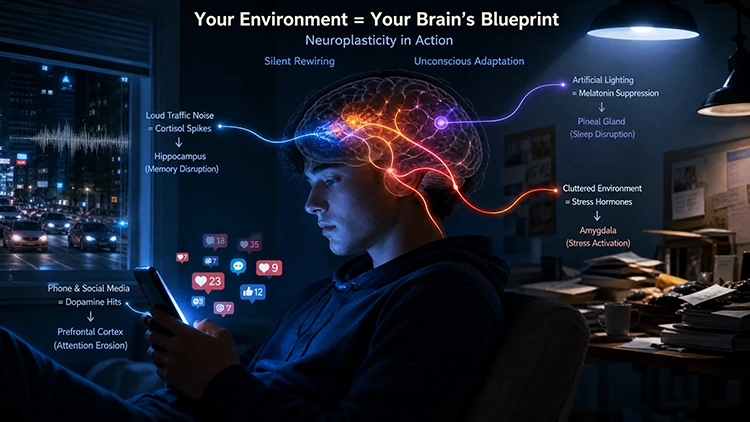
AI Overview: Biological vs. Existential Adaptation Biological Adaptation is a survival-driven mechanism where the brain and body adjust baseline physiological, emotional, and behavioral responses to recurring environmental stimuli. Because the brain prioritizes energy efficiency over conscious choice, long-term exposure to toxic or misaligned environments forces the nervous system to normalize harm, integrating external dysfunctions as personal identity traits.
This mechanism was essential when survival depended on rapid integration into small hunter-gatherer bands. In the modern world, however, this survival algorithm creates a profound vulnerability: The brain will happily adapt to an environment that is slowly destroying your spirit, provided you stay in it long enough.
2. The Adaptation Spectrum: Micro-Mirroring vs. Epigenetic Conditioning
Adaptation operates across two distinct temporal scales, shaping everything from your body language in a meeting to the structural pathways of your brain.
+-----------------------------------------------------------------------+
|                   THE DUAL SCALES OF HUMAN ADAPTATION                 |
+-----------------------------------------------------------------------+
|  SHORT-TERM (MICRO) ADAPTATION        LONG-TERM (MACRO) ADAPTATION    |
|  • Rapid behavioral synchronization.  • Structural neural plasticity. |
|  • Mediated by mirror neurons.        • Shifts baseline physiological  |
|  • Temporary, context-dependent.        reactions and worldview.      |
|  • Low cognitive investment.          • High identity integration.    |
+-----------------------------------------------------------------------+
                        [ Environmental Exposure ]
│
┌───────────────────────────┴───────────────────────────┐
▼                                                       ▼
[ Short-Term Micro-Mirroring ]                          [ Long-Term Structural Encoding ]
• Posture matching in social settings                  • Professional vocabulary & vocal cadences
• Emotional tone adjustment to group dynamics          • Chronic stress/cortisol baseline resets
• Acute situational compliance                         • Unconscious behavioral defaults
1. Short-Term Adaptation: Micro-Mirroring
When you step into a art gallery, a corporate boardroom, or a crowded stadium, your mirror neuron system instantly initiates subtle motor and emotional mimicry. You drop your voice, adjust your posture, or mirror the facial expressions of those around you.
This is a protective social camouflage designed to prevent social exclusion and signals to the group: “I am not a threat; I belong here.”
2. Long-Term Adaptation: Structural Conditioning
When exposure to an environment moves from hours to years—such as a toxic corporate culture, an emotionally distant marriage, or a hyper-competitive academic program—short-term camouflage crystallizes into long-term biological reality.
- Neuroplastic Rewiring: Neural pathways that frequently fire together reinforce their synaptic connections. Behaviors that were initially forced performance become automatic defaults.
- Autonomic Baselines: If your daily environment is defined by chronic subtle hostility, your sympathetic nervous system resets its resting baseline. What feels like “normal day-to-day life” is actually a state of persistent low-grade fight-or-flight.
3. The Choice Paradox: The Illusion of Autonomous Identity
If our nervous systems are designed to absorb and replicate the environments we inhabit, a critical philosophical question emerges: How much of your identity actually belongs to you?
[ Inherited Environmental Inputs ] ──► (Unconscious Conditioning) ──► [ Perceived Personal Choice ]
│
▼
[ Authentic Self-Authorship ] ◄── (Meta-Cognitive Interruption) ◄── [ Identity Illusion ]
Most adults operate under the assumption that their values, communication styles, emotional reactions, and career aspirations are the result of conscious personal choice. However, behavioral psychology reveals that much of what we call “personality” is simply the accumulated sediment of the environments we failed to leave.
The Mechanism of Environmental Contagion
We routinely absorb environmental traits through three primary vectors:
+-----------------------------------------------------------------------+
|                     ENVIRONMENTAL CONTAGION VECTORS                   |
+-----------------------------------------------------------------------+
|  VECTOR                MECHANISM OF ABSORPTION                        |
|  Linguistic Cadence    Adopting the phrasing, cynicism, or vocal      |
|                        inflections of dominant peers.                 |
|  Emotional Threshold  Raising or lowering your tolerance for conflict,|
|                        drama, or dysfunction based on social norms.   |
|  Ambition Ceiling      Unconsciously capping your expectations to     |
|                        match the average output of your inner circle. |
+-----------------------------------------------------------------------+
You do not choose to absorb these traits. Your brain absorbs them automatically to preserve social cohesion and lower cognitive dissonance.
4. The Functional Audit: De-Conditioning Involuntary Adaptation
Recognizing the automatic nature of adaptation is not an excuse for helplessness—it is the prerequisite for authentic freedom.
If your environment automatically sculpts your nervous system, then environmental selection is the highest form of self-authorship. To dismantle involuntary conditioning and reclaim agency, you must execute a systematic audit of your current life ecosystems.
[ Audit Ecosystems ] ──► [ Map Behavioral Shifts ] ──► [ Isolate Foreign Traits ] ──► [ Re-Architect Baseline ]
Step 1: The Environmental Exposure Matrix
Select the three environments where you expend the vast majority of your life energy (e.g., your primary workplace, your immediate family circle, your core social group, or your digital media ecosystem). Document your temporal exposure.
| Environment | Duration in This Ecosystem | Pre-Exposure Baseline | Post-Exposure Adaptation |
|---|---|---|---|
| Ecosystem 1: Corporate Office | 4 Years (40 hrs/week) | Open, patient, creative | Hyper-defensive, hurried, overly analytical |
| Ecosystem 2: Primary Social Circle | 6 Years (10 hrs/week) | Intentionally ambitious | Cynical, risk-averse, prone to complaining |
| Ecosystem 3: Home / Family | 10+ Years (Daily) | Expressive and vocal | Conflict-avoidant, quiet, hyper-vigilant |
Step 2: Isolating the Adapted Traits
Review the behavioral shifts that have occurred since integrating into these environments. Categorize them with brutal objectivity:
                  [ Behavioral Shift Isolation ]
│
┌───────────────────────┴───────────────────────┐
▼                                               ▼
[ Constructive Adaptation ]                     [ Parasitic Conditioning ]
• Enhanced focus & discipline                   • Chronic cynicism / defensive posture
• Strategic communication skills                • Conflict avoidance / suppression of voice
• Physical endurance / fitness habits            • Capped ambition / normalized burnout
- Constructive Adaptations (Keep): Traits that expanded your capability, heightened your health, or deepened your wisdom.
- Parasitic Conditioning (Excise): Traits that feel heavy, unnatural, or defensive—behaviors you adopted solely to survive or fit into a dysfunctional space.
Step 3: Conscious Ecosystem Re-Architecting
Once you isolate parasitic conditioning, you face a clear choice: you must either alter the environment or exit it.
The human nervous system cannot remain healthy in an environment where survival requires constant self-betrayal.
[ Parasitic Conditioning Identified ]
│
├──────────────────────────────┐
▼                              ▼
[ Modify Environment ]          [ Execute Exit Strategy ]
• Establish hard boundaries     • Phase out temporal exposure
• Reduce temporal exposure      • Transition to high-alignment
• Alter relational dynamics       ecosystems
- Reduce Exposure Time: If you cannot immediately leave a toxic environment, minimize your physical and emotional presence. Set strict boundaries on time and energy expenditure.
- Raise the Acoustic/Environmental Baseline: Counteract negative conditioning by deliberately placing yourself in high-alignment environments (e.g., communities of growth, disciplined physical training spaces, intellectual circles) that trigger desirable adaptations.
- Interrupt the Mirroring Loop: When you catch yourself displaying an involuntary, parasitic behavior (e.g., joining in gossip or reacting defensively), take a physiological sigh (two quick nasal inhales followed by a long oral exhale). This manually resets your autonomic state and breaks the automatic mimicry loop.
5. The Sovereign Conclusion
Your body and mind are evolutionary masterpieces of adaptation. They will do whatever it takes to help you survive the world you place them in.
The ultimate question of adulthood is not whether you are adapting—you are always adapting. The question is: Are you adapting to an environment that elevates your human potential, or are you adapting to a slow decay of your authentic self?
Take control of your ecosystems. Stop asking your nervous system to survive spaces it was never meant to inhabit.