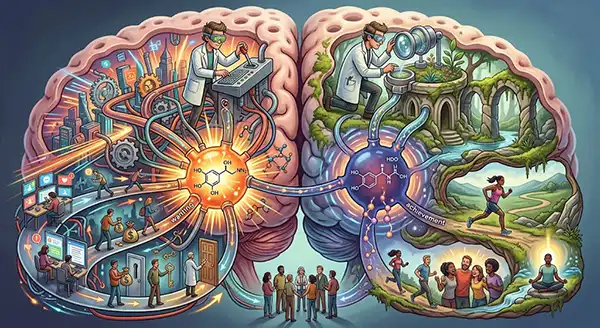
Why Your Brain Craves What Makes You Feel Good: Endorphins, Dopamine, and the Search for Balance
The first time I experienced a runner’s high, I was forty-three years old and convinced I was dying. Not in the dramatic, life-flashing-before-my-eyes sense. In the quieter, more embarrassing sense: my lungs burned, my legs felt like wet cement, and I was pretty sure the sharp pain in my side was either my spleen or my soul trying to escape.
I was on a trail outside Portland, Oregon, because a friend had told me exercise would help with the grief. My mother had died six months earlier. I had been sleeping badly, eating worse, and spending too many evenings on the couch watching shows I would not remember the next morning. The walk turned into a jog. The jog turned into a kind of desperate, wheezing stagger. And then, somewhere around the forty-minute mark, something shifted.
I did not feel good. I felt something stranger. I felt spacious. The grief was still there, but it had moved a few inches to the left, making room for something else—a lightness, a warmth, a sense that maybe I could survive this after all.
What I did not know then, and what I have spent the years since trying to understand, is that the feeling had a name. Not a spiritual name. A chemical one. My brain had released a flood of endorphins, the body’s natural painkillers, in response to the physical stress I had just put it through. The grief had not disappeared. It had been, for a moment, metabolized.
We are not built to feel good all the time. That is the part nobody tells you. The brain is not a happiness machine. It is a survival machine. The chemicals that make us feel good are side effects, not goals. Understanding that distinction changes everything.
What Are Endorphins and Why Do They Exist
Endorphins are neurotransmitters—chemical messengers in the brain—that act as natural painkillers. The word itself is a portmanteau: endogenous, meaning produced within the body, and morphine, the painkiller they resemble. The name tells you what they are for. They are the body’s built-in emergency relief system, designed to help mammals survive pain long enough to escape danger.
The neuroscientist Candace Pert, whose work at the National Institutes of Health in the 1970s helped map the brain’s opiate receptors, was one of the first to demonstrate that the brain produces its own morphine-like substances. Her research, published in the journal Science in 1973, showed that these receptors were not just waiting for external opiates like heroin or morphine. They were designed to receive the body’s own chemical messengers. The body has always known how to soothe itself. We just forgot how to listen.
What is strange and beautiful about endorphins is when they appear. They are not released when you are comfortable. They are released when you are pushed. Physical exertion. Injury. Laughter so intense it hurts. Crying so hard your chest aches. The body responds to stress by flooding itself with relief. The pain and the pleasure are not opposites. They are partners.
I have felt this most clearly in the gym, not on the couch. The couch offers comfort, but it does not offer endorphins. The run, the swim, the heavy lifting—these are the doorways. The body has to be asked to open them.
How to Trigger Endorphins Naturally
There is no prescription for endorphins. Not one your doctor will write, anyway. The body produces them in response to specific conditions, and most of those conditions involve some form of stress.
Exercise is the most reliable trigger. Research on the “runner’s high” has been accumulating for decades. A study published in the Journal of Experimental Biology found that aerobic exercise—the kind that gets your heart rate up and your breath ragged—releases endorphins in the brain. The effect is not immediate. It takes sustained effort, usually twenty to thirty minutes at moderate to high intensity. But when it arrives, it is real. Not a metaphor. A measurable chemical shift in the brain.
Laughter works too. The psychologist Robin Dunbar, at the University of Oxford, has studied the social and physiological effects of laughter for years. His research suggests that genuine, unforced laughter—the kind that makes your stomach hurt—triggers endorphin release. The effect is strongest when the laughter is social, shared with other people. There is something about the collective act of laughing that tells the body it is safe, even when it is not.
Crying, interestingly, may also release endorphins. The biochemist William Frey, at the University of Minnesota, studied the chemical composition of tears and found that emotional tears—unlike tears caused by irritation—contain stress hormones. Crying, in other words, may be the body’s way of flushing stress chemicals out of the system. The endorphin release that follows is the body’s way of saying: the worst is over. You survived.
Stretching helps too. Not dramatic stretching. Just deliberate, conscious stretching, the kind that wakes up the muscles after hours of sitting. The body responds to the attention. The tension releases. The endorphins follow.
I have learned to stop waiting for the feeling to arrive and start creating the conditions for it. The run. The laughing. The stretching in the morning before coffee. Small, deliberate acts that tell the body: you are allowed to feel good.
What Is Dopamine and Why It Is Different From Endorphins
Dopamine is often described as the pleasure chemical, but that is not quite right. The neuroscientist Robert Sapolsky, at Stanford University, has argued for years that dopamine is not about pleasure. It is about anticipation. It is about the chase.
Think about the last time you were working toward something—a goal, a project, a destination. The moment you started making progress, you probably felt a surge of energy. Not the calm satisfaction of arrival. The eager, restless energy of pursuit. That is dopamine. It is the brain’s way of saying: keep going. The reward is close.
The psychologist Wolfram Schultz, at the University of Cambridge, has spent decades studying how dopamine neurons fire. His research shows that dopamine is released not when the reward arrives, but when the reward is predicted. The anticipation itself is the reward. The chase is the point.
This explains a lot about modern life. The smartphone in your pocket is a dopamine machine. Every notification, every like, every new message is a prediction of reward, and the brain responds by releasing dopamine. The problem is that the rewards are usually shallow. The dopamine spike arrives, fades, and leaves you wanting another one. The cycle is endless because the rewards are endless. There is always another post to check, another message to answer, another level to beat.
“Dopamine is not about liking. It is about wanting.” — a line often attributed to the neuroscientist Kent Berridge at the University of Michigan
Berridge’s research, conducted over decades, has distinguished between two systems in the brain: the liking system and the wanting system. Dopamine drives the wanting. The liking is something else, something quieter. And the gap between wanting and liking explains why you can spend an hour on social media and feel emptier afterward. The wanting was satisfied, again and again. The liking never arrived.
How to Build Healthier Dopamine Habits
The goal is not to eliminate dopamine. That would be impossible, and also miserable. The goal is to be more intentional about what triggers it.
Short-term pleasures—sugar, social media, gambling, binge-watching—provide quick dopamine spikes that fade fast. The brain adapts, a process called hedonic adaptation, and requires more of the same to feel the same effect. The result is a kind of treadmill: you keep running, but you never arrive.
Longer-term goals provide something different. The psychologist Mihaly Csikszentmihalyi, who died in 2021, spent his career studying what makes people feel alive. His research on flow—the state of complete absorption in a challenging activity—showed that the deepest satisfaction comes not from passive consumption but from active engagement. The mountain climber does not climb for the dopamine spike. She climbs for the flow. And the flow, unlike the spike, does not fade into emptiness. It leaves something behind: a sense of competence, of growth, of time well spent.
The psychiatrist and addiction researcher Anna Lembke, at Stanford University, has written about this in her book “Dopamine Nation.” She argues that we live in an age of dopamine overload, surrounded by pleasures that are too easy, too cheap, and too available. The result is not happiness. It is numbness. The brain, flooded with dopamine, stops responding to the things that used to matter.
Lembke’s advice is simple and countercultural: make the good things harder to access. Put the phone in the other room. Eat the sugar only on special occasions. Create friction between yourself and the easy pleasures. The friction is not punishment. It is protection. It gives the brain a chance to reset, to recover its sensitivity, to find pleasure in the ordinary.
The Balance I Am Still Trying to Find
Here is what I have learned, slowly and imperfectly, over the years since my mother died. The goal is not to feel good all the time. The goal is to feel in proportion to what is actually happening.
Some days, the right feeling is sadness. Some days, it is anger. Some days, it is joy so unexpected it catches you off guard. The chemicals are not the enemy. They are the body’s way of helping you meet the moment. The problem comes when we try to override the moment with the wrong chemical, to force happiness when the situation calls for grief, to chase dopamine when what we actually need is rest.
The psychiatrist and trauma researcher Bessel van der Kolk, in his book “The Body Keeps the Score,” writes about the importance of learning to feel what is actually present, not what we wish were present. The body knows. The chemicals know. The work is to listen.
I have started paying attention to the difference between wanting and liking. The wanting is loud, urgent, insistent. The liking is quieter, more diffuse. The wanting says: check the phone, eat the sugar, buy the thing. The liking says: stay here, breathe, notice the light through the window. The wanting is a drug. The liking is a form of presence.
The more I practice noticing the difference, the less I am owned by the wanting. Not because the wanting goes away. Because I stop mistaking it for the real thing.
What I Would Tell Someone Who Is Struggling
If you are in a hard season—grieving, depressed, anxious, exhausted—do not try to chemical your way out of it. The body knows what it needs, and sometimes what it needs is to feel bad for a while. The sadness is not the enemy. It is part of the process.
But also: do not neglect the body. Move. Laugh. Cry. Stretch. Not because these things will fix you. Because they will help you carry what you are carrying. The endorphins will not erase the grief. But they might give you an hour of relief, and sometimes an hour is enough to keep going.
And if the sadness is too heavy, if it has settled in and will not lift, talk to someone. A doctor. A therapist. A professional who can help you see what you cannot see on your own. The chemicals can help, but they are not a substitute for care. There is no shame in asking for it.
The Question I Keep Coming Back To
What am I chasing?
It is the question I ask myself when I reach for the phone for the tenth time in an hour. When I open the fridge and stand there, not hungry, just looking. When I feel the familiar pull toward something—anything—that promises a quick hit of feeling better.
The answer, when I am honest, is often this: I am chasing a feeling I already have. The feeling is here, in the room, in the body, in the ordinary moment. It is not loud. It does not demand attention. It just waits.
The endorphins are waiting in the run. The dopamine is waiting in the work. The good feelings are not hiding. They are simply not where I have been looking.
The next time you feel the pull toward something easy—the scroll, the snack, the drink—pause. Ask yourself what you are actually chasing. And whether it is out there, or in here.
The answer might surprise you.
The good stuff is closer than you think. It is in the body, in the breath, in the small, unglamorous acts of showing up for your own life. The chemicals will follow. They always do. They are designed to.
The only thing missing is your willingness to meet them halfway.