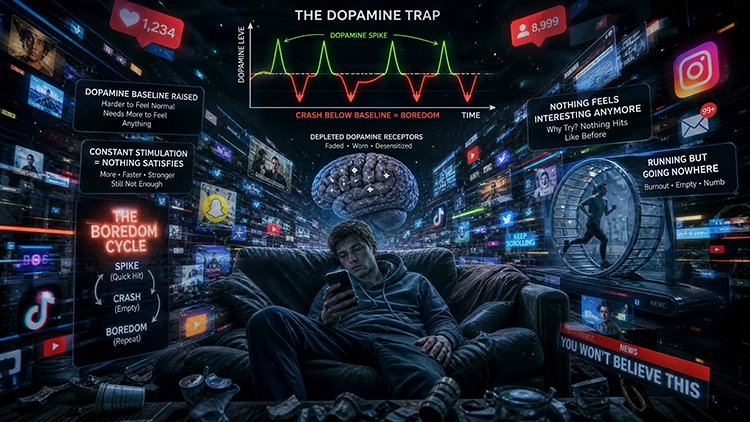
The Dopamine Trap: How Modern Hyper-Stimulation Engineered Chronic Boredom
We live in the most stimulating environment in human history, yet we are plagued by an unprecedented crisis of chronic boredom. On the surface, this presents a bizarre paradox: why should an individual surrounded by infinite digital entertainment, on-demand media, and frictionless connectivity struggle so deeply with feeling unengaged?
The error lies in confusing stimulation with meaning.
Modern boredom is not a lack of available options; it is a neurological and existential exhaustion. When the brain is continuously bombarded with high-density, low-effort reward signals, its neuro-chemical baseline shifts. Consequently, ordinary existence—deep work, quiet solitude, structured routines, and genuine human connection—comes to feel agonizingly slow, dull, and intolerable.
What is the root cause of chronic modern boredom? Modern boredom is primarily a symptom of dopaminergic desensitization combined with an inability to tolerate internal space. When hyper-stimulating devices artificially elevate the brain’s reward threshold, normal life activities register as under-stimulating. Rather than a problem to be solved with more novelty, boredom is a vital psychological signal indicating that the mind’s attentional capacity has been fragmented and needs structural recalibration.
To escape this loop, we must move beyond basic advice like “finding a new hobby” and examine the neurobiology, behavioral economics, and existential psychology of the modern attention economy.
The Neurobiology of the Dopamine Baseline
To understand why mindless scrolling or constant digital consumption leaves us feeling more bored rather than satisfied, we must examine how the brain processes reward and expectation.
Dopamine is not the neurotransmitter of pleasure; it is the neurotransmitter of anticipation and pursuit. It propels us toward novel stimuli. Every time you pull down to refresh a social feed, click a recommended video, or switch tabs, your brain releases a micro-dose of dopamine in response to predicted novelty.
[Hyper-Stimulating Input] ──► [Spike in Dopamine] ──► [Neuro-Adaptation / Down-Regulation]
│
[Unbearable Boredom in Normal Life] ◄── [Elevated Baseline] ◄────┘
When this cycle is repeated hundreds of times daily, the brain adapts via neuro-adaptation:
- Receptor Down-Regulation: The brain decreases the sensitivity or density of its dopamine receptors to protect itself from over-stimulation.
- Elevated Baseline: The amount of stimulation required just to feel “neutral” increases dramatically.
Once this elevated baseline is established, standard human experiences—reading a dense book, sitting silently in a park, maintaining a conversation, or working through a routine task—fall drastically below your new neuro-chemical threshold. The subjective result is an uncomfortable, agitated state of boredom.
The digital device promises a cure for your boredom, but it is actually the engine generating it.
The Paradox of Choice and the Death of Spontaneity
The structure of contemporary professional and personal life has systematically eliminated what behavioral scientists refer to as unstructured cognitive white space.
In earlier eras, boredom was a natural, built-in feature of daily life: standing in line, waiting for a train, or sitting through a quiet evening. These moments forced the brain into its Default Mode Network (DMN)—the neural architecture responsible for creative synthesis, self-reflection, and long-term memory integration.
+-------------------------------------------------------------------------+
|                    THE DUAL STATES OF COGNITION                         |
+-------------------------------------------------------------------------+
|  HYPER-CONNECTED / REACTIVE STATE      │  DEFAULT MODE NETWORK (DMN)     |
|  • Constant external stimulus inputs   │  • Internal narrative synthesis  |
|  • Fragmented, short-burst attention   │  • Deep consolidation & insight |
|  • High cognitive load & agitation     │  • Autonomous emotional processing|
+-------------------------------------------------------------------------+
Today, the moment a pause occurs in our environment, we reach instinctively for a screen to fill the void. By outsourcing our downtime to external algorithms, we deny the brain its required integration cycles.
Furthermore, our reliance on fixed, hyper-predictable remote or office routines deprives us of spontaneous environmental feedback. When every day mirrors the previous one down to the screen size and seating position, the brain stops encoding new memories efficiently. The mind interprets this lack of perceptual novelty as a sign of stagnation, signaling its dissatisfaction through chronic restlessness.
(If digital overload degrades our inner baseline, how does it alter our relationships with others?)
Solitude Deficit and the Ego’s Defense Mechanisms
Boredom does not merely affect our relationship with tasks; it profoundly distorts our relationship with people and with ourselves.
1. The Solitude Deficit
Many individuals confuse being alone with experiencing solitude. Solitude is the rich, undisturbed presence with oneself, where internal thoughts can be processed without distraction. When an individual lacks the capacity for solitude, being alone feels terrifying.
To avoid the discomfort of their own unedited internal monologue—their unresolved anxieties, buried grief, or unexamined existential doubts—they seek perpetual distraction. For these individuals, boredom is not an absence of activity; it is the threshold of suppressed thoughts trying to surface.
The Solitude Deficit Principle: An individual who cannot tolerate being alone with their unmediated thoughts will inevitably view all quiet moments as an emergency to be neutralized by immediate external input.
2. The Elitism Defense Mechanism
A lesser-acknowledged psychological driver of chronic boredom is subtle interpersonal arrogance. When we perceive ourselves as intellectually or culturally superior to those around us, we disengage. We assume that a colleague, a neighbor, or an acquaintance has nothing valuable to offer, shielding ourselves behind a wall of cynical detachment.
By pre-judging our environment as uninteresting, we create a self-fulfilling prophecy. We miss out on the rich, complex narratives hidden within ordinary human lives simply because we refuse to ask deeper questions.
Architecting the Recovery: Operational Protocols
Re-sensitizing the brain to ordinary reality cannot be accomplished through willpower alone; it requires deliberate structural interventions that manipulate your attention environment.
                        ┌────────────────────────┐
│ Attentional Reset Plan │
└───────────┬────────────┘
│
┌──────────────────────────┼──────────────────────────┐
▼                          ▼                          ▼
┌──────────────────┐       ┌──────────────────┐       ┌──────────────────┐
│ Dopamine Fasting │       │ Friction Rules   │       │ Micro-Novelty    │
│ & Boredom Windows│       │ & Digital Bounds │       │ Protocols        │
└──────────────────┘       └──────────────────┘       └──────────────────┘
1. Institutionalize “Do Nothing” Windows
To reset a elevated dopaminergic baseline, you must systematically re-introduce un-stimulated downtime. Allocate 15 to 30 minutes daily where you deliberately engage in zero input activities:
- Sit on a chair without a phone, book, or audio input.
- Walk without listening to a podcast or music.
- Allow your mind to wander through its initial agitation until it reaches a state of quiet focus.
Experiencing and enduring the initial discomfort of boredom signals to your brain that an absence of high-intensity stimulus is not a life-threatening crisis.
2. Introduce Structural Friction to Digital Access
Motivation is unreliable; design environment friction instead. Make high-dopamine habits harder to access than low-dopamine, high-value ones:
- Grayscale your smartphone display to strip away the visual rewards that trigger impulse checking.
- Store distraction devices in a separate room during working and resting hours.
- Enforce a strict “analog buffer” during the first and last hour of your waking day.
3. Practice Active Curiosity Over Passive Consumption
When interacting with routine environments or unfamiliar people, shift your posture from a passive consumer waiting to be entertained to an active investigator looking for complexity.
Ask unexpected questions. Look for hidden details in your immediate physical space. Engage in tactile, low-tech creative outlets—drawing, manual building, writing long-form by hand—that require deep, sustained motor and cognitive focus.
The Existential Threshold: Boredom as a Precursor to Agency
Boredom is not an enemy to be destroyed; it is a boundary to be crossed.
Philosopher Martin Heidegger distinguished between profound boredom and simple impatience. Simple impatience is merely waiting for the next stimulus; profound boredom is the moment the artificial noise of daily life falls away, exposing the blank canvas of your existence.
When you strip away constant entertainment, predictable routines, and reactive scrolling, you are left face-to-face with a fundamental question: What do I actually care about when no one is distracting me?
Boredom is the quiet precursor to original creation, deep self-knowledge, and true personal agency. When you stop fleeing from the empty spaces in your day, you realize that the discomfort you felt was not a lack of life happening around you—it was your mind waiting for you to step up and direct it.