What We Teach Our Children on the Playground: The Quiet Caste System We All Inherit
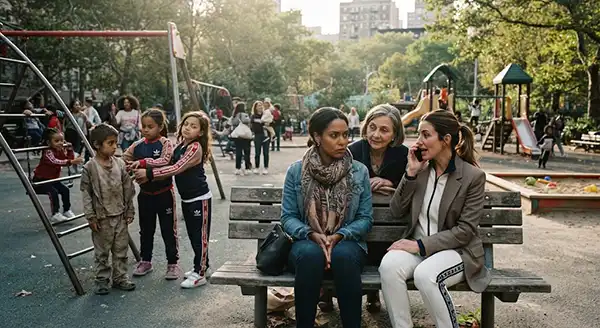
The playground is small, wedged between a parking lot and a row of tired maples in a city park in Portland, Oregon. The swings are painted bright yellow, chipped at the edges, and there is always a line. My daughter is four, and she does not understand lines yet. She only understands the swing, the way it arcs up into the air, the way her stomach drops and rises. She laughs every time, a high, wild sound that cuts through the noise of traffic and the murmur of other parents.
I sit on a bench facing the yellow swing and watch her. And I notice things I did not notice before I became a mother. I notice the way the other parents look at her. Not unkindly. But with a kind of measuring. The way you might look at a house you are considering buying. The way you might look at a dress on a rack, assessing whether it fits.
My daughter is bigger than some of the other four-year-olds. Not in a way that matters to her, but in a way that matters to them. I can see the judgments forming behind their eyes, even when they smile. She’s big for her age. Is she eating too much? Is something wrong? The questions are not spoken. But they do not need to be. I have learned to read them in the tilt of a head, in the slight pause before a greeting, in the way a mother pulls her child a little closer as we pass.
I am forty-one years old. I have spent most of my life learning to ignore those looks. But when they are directed at my daughter, I feel them like a hand on my chest.
The Hidden Caste System We Never Questioned
We are born into a system of unspoken hierarchies. It is not written down. There are no official ranks. But it is there, in the playground, in the office, in the grocery store, in the way we sort and measure and compare. We learn it before we have words. We inherit it the way we inherit our mother’s hands or our father’s temper. It is the water we swim in.
The psychologist Leon Festinger gave a name to one piece of this in the 1950s. He called it social comparison theory. The idea is simple: we determine our own social and personal worth by comparing ourselves to others. The comparison is not neutral. It is loaded. It is how we know where we stand, who is above, who is below, who belongs.
But Festinger’s theory described something we do. The deeper question is why we do it so automatically. The answer, I think, is that we were trained. Not by any single person. By the accumulation of small messages. The comments about our bodies. The praise for fitting in. The quiet approval that comes when we match the pattern and the quiet disapproval when we do not.
There is a growing body of research on how early this training begins. A 2020 study published in the Journal of Early Childhood Research found that preschool-aged children already absorb and reproduce social hierarchies based on appearance, gender, and family background. They do not invent these hierarchies. They learn them. From us.
I think about that study when I sit on the bench and watch the mothers and fathers watching my daughter. They are not bad people. They are not trying to be cruel. They are just running the same program I ran for years, before she came and broke it open.
What I Used to Be Like
Before my daughter was born, I was fluent in the language of comparison. I knew how to rank a room. I knew who was more successful, more attractive, more together. I did it without thinking. It was like breathing.
The writer and researcher Brené Brown, at the University of Houston, has spent decades studying the shame that underlies this kind of comparison. She calls it the difference between fitting in and belonging. Fitting in is what you do when you shape yourself to be accepted. Belonging is what happens when you are accepted as yourself. I spent most of my life trying to fit in. I did not know belonging was an option.
Then my daughter was born, and I looked at her face, and I understood something I had never understood before. She would be measured. She would be ranked. She would be taught, the way I was taught, that her worth depended on where she landed in a hierarchy she did not choose.
I decided, in that hospital room, that I would try to teach her something different. Not by lecturing. By living it. By refusing, as much as I could, to participate in the ranking.
It is harder than I expected. The program is deep. The judgments rise before I can stop them. But I am learning to notice them, and the noticing is the beginning of something.
The Playground as a Training Ground
Every day, we come to this park. My daughter plays on the yellow swing. I sit on the bench. And I practice.
I practice not comparing her to the other children. I practice not comparing myself to the other parents. I practice letting the looks come and go without absorbing them. I practice smiling at the mother who pulled her child away, even when I want to glare.
The writer and meditation teacher Tara Brach calls this “radical acceptance”—the practice of allowing things to be as they are, without fighting them, without flinching. It is not passivity. It is a kind of strength. It is the willingness to stay present, even when the world is unkind, even when the judgments are sharp.
It is also, I have learned, a form of love. Because every time I refuse to let someone else’s measurement define my daughter, I am telling her something. I am telling her that she is more than her size, more than her appearance, more than where she lands in the invisible rankings. I am telling her that she belongs.
The Limits of My Own Strength
I want to be careful here. I am not pretending this is easy. Some days, the judgments get under my skin. Some days, the old programming takes over, and I find myself comparing, ranking, measuring. Some days, I go home from the playground and cry, because I cannot protect her from the system, and I cannot fully protect myself.
There are also days when the weight of it all feels like more than I can carry. I am a single mother, far from family, building a life from scratch. The isolation is real. The exhaustion is real. And sometimes, the playground feels less like a refuge and more like an arena.
If you are reading this and you feel that weight—if the constant measuring and comparing has worn you down—please know that you do not have to carry it alone. There is help. A therapist can help you untangle the old programming. The National Alliance on Mental Illness offers resources for parents who are struggling. You can call or text 988 if the despair feels like too much. These are not signs of failure. They are forms of care.
The work of unlearning is not meant to be done alone. It is meant to be done in community, with people who see the system for what it is and are trying, like you, to build something else.
What I Am Trying to Teach Her
I do not know if I can protect my daughter from the hidden caste system. I do not know if anyone can. But I know what I can do. I can model a different way of being. I can refuse to rank the people around me. I can speak kindly about my own body, even when I do not feel kind. I can let her be exactly who she is, without trying to shape her into something more acceptable.
The other day, on the playground, a little boy pointed at my daughter and said, “Why is she so big?”
His mother’s face went red. She started to apologize, to shush him, to explain.
I knelt down next to him and said, “She’s big because she’s growing. Just like you’re growing. We’re all growing at our own pace.”
The boy looked at me for a moment, then ran off to the slide. His mother mouthed thank you and hurried after him.
I do not know if my answer was the right one. I do not know if it undid any of the training. But it felt true. And in that moment, sitting on the edge of the sandbox, I understood something I had been circling for years.
The caste system is not broken by one answer. It is not broken by one mother on one playground. It is broken, slowly, in a thousand small moments like that one. A thousand small refusals to participate. A thousand small acts of seeing each other as human.
The system will outlast me. My daughter will inherit it, the way I inherited it from my parents, the way they inherited it from theirs. But she will also inherit something else. She will inherit the memory of a mother who sat on a bench and smiled at her, no matter what anyone else thought. She will inherit the knowledge that she was loved, not in spite of her difference, but through it.
That is the only inheritance that matters. And it is the one I get to choose.
The Practice of Returning
We still go to the playground every day. The yellow swing still holds her. The looks still come, from the parents who cannot help themselves, from the children who have already learned to measure. But something has shifted in me. The looks have less power now. The judgments land softer.
The writer and poet Mary Oliver wrote that you do not have to be good. You only have to let the soft animal of your body love what it loves. I think about that line when I watch my daughter swing. She loves the swing without reservation. She loves the arc of it, the drop of it, the wind in her face. She does not know yet that she is supposed to be anything other than what she is.
I am trying to learn that from her. Not the swinging—I am too old for that. The unreserved love. The capacity to be fully in a moment without measuring it against some imagined standard.
The playground is not a battlefield. It is a mirror. It shows me the old programming, the inherited comparisons, the quiet cruelty of a system that sorts people before they can speak. And it shows me, too, the possibility of something else. A way of being that does not require ranking. A way of loving that does not require fitting in.
The bench is still hard. The coffee has gone cold. My daughter waves at me from the top of the swing’s arc, her face open, her smile wide.
I wave back. I do not look around to see who is watching. I do not need to anymore.
The system is still there. It will always be there. But in this small corner of the park, on this ordinary Tuesday afternoon, I have found a crack in it.
And the crack, it turns out, is wide enough to stand in.
That is the whole thing. Not the grand revolution. The small, daily practice of refusing to be ranked. The small, daily choice to love what I love without apology.
My daughter is swinging. The sun is out. The world is still full of judgments, but for now, in this moment, they do not touch us.
That is enough. It has always been enough. The only thing that was ever missing was my willingness to believe it.