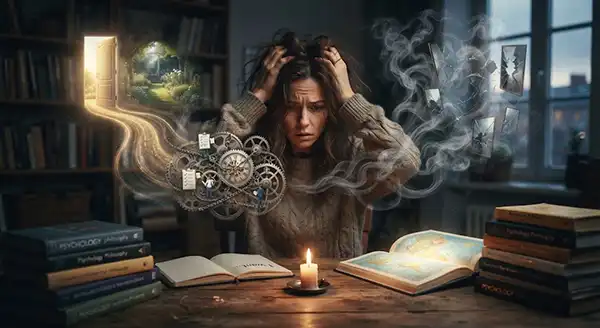
Why Making Decisions Feels So Hard: The Hidden Weight of Choosing
I spent forty-five minutes in the cereal aisle last Tuesday. Not because I love cereal. Because I could not decide between the granola with the good oats and the granola with the good raisins. I stood there, cart half-blocking the flow of shoppers, reading the same two ingredient lists over and over like a scholar studying a sacred text. A woman reached past me, grabbed a box, and moved on. Her decisiveness felt like a personal attack.
The cereal was not the problem. The cereal was just the safest place for my indecision to land. The real decision I was avoiding—the one about whether to move back to Ohio to care for my aging father—was waiting at home, in the quiet apartment, in the space between the couch and the kitchen sink. The cereal was a way of being stuck without having to admit I was stuck.
The psychologist Barry Schwartz, in his 2004 book “The Paradox of Choice,” argued that too many options make us miserable. His research at Swarthmore College showed that while we think we want more choices, more choices often lead to paralysis, regret, and dissatisfaction. We are supposed to be happier with options. Instead, we are afraid of choosing wrong.
I was not afraid of choosing wrong between two granolas. I was afraid of choosing wrong between two lives. The cereal just gave me somewhere to put the fear.
Why Every Choice Carries a Small Death
There is a hidden cost to every decision, and most of us feel it without naming it. Every yes is a no. Every commitment is a refusal. When I said yes to staying in California all those years ago, I was also saying no to being closer to my family. When I say yes to a quiet Saturday at home, I am saying no to the friends who wanted to see me. The yes feels good. The no aches quietly underneath it.
The philosopher and psychologist William James, writing in the late nineteenth century, understood this. He described decision-making as the moment when one possibility becomes actual while countless others die. The chosen path narrows into reality. The unchosen paths fade into ghosts. We grieve them, even when we pretend we do not.
That grief is real. It is the feeling of standing at a fork in the road and knowing you cannot walk both ways. Some people feel it as a small pang. Others—like me, like so many of the patients I see in my therapy practice—feel it as a heavy, paralyzing weight.
I have a client in Pasadena, a woman named Dana, who has been trying to leave her job for three years. She is excellent at what she does, and she is miserable. Every few months, she gets a new job offer. She weighs it, investigates it, gets excited about it. Then she turns it down. When I ask her why, she says the same thing: “I don’t know what I want.”
But I have watched her long enough to know that is not true. She knows exactly what she wants. She wants to leave. What she does not want is the responsibility of leaving. The finality of it. The moment when the door closes and there is no going back.
What Dana is feeling is not confusion. It is fear. The fear of being the one who decides, and the one who lives with the consequences.
How We Avoid Owning Our Choices
There are a hundred small ways we avoid the weight of deciding. We ask other people what we should do. We stall until the decision makes itself. We act in ways that force someone else to pull the trigger.
I have done all of these. I have stayed in relationships long past their expiration date, not because I wanted to be there, but because I did not want to be the one who ended it. So I became distant. I became cold. I became the kind of partner who makes the other person do the leaving. That way, when it ended, I could tell myself it was not my choice.
The psychotherapist and author Irvin Yalom, in his book “Existential Psychotherapy,” writes about the terror of freedom. The idea that we are responsible for our lives—that no one is coming to save us, that the choices are ours and the consequences are ours—can be overwhelming. Yalom argues that much of what we call indecision is actually a defense against that responsibility. If we never choose, we never have to own the outcome.
The man who stays in a bad marriage because his wife might leave him first. The employee who underperforms until the boss has no choice but to fire her. The student who cannot pick a major and drifts for years, waiting for a sign. None of them are confused. They are avoiding the weight.
The psychoanalyst Erich Fromm, in his 1941 book “Escape from Freedom,” made a similar point. He argued that we are terrified of our own freedom, because freedom demands that we carry the burden of our own becoming. So we hand the burden to someone else—a leader, a tradition, a partner—and call it relief. The relief is real, but the cost is the self.
The Push and Pull Between What We Think and What We Feel
There is a false divide we have built between logic and emotion, and it wreaks havoc on our decisions.
We are taught that good decisions are rational decisions. That feelings are suspect, that intuition is unreliable, that the right choice can be calculated if we just gather enough information and weigh the options carefully. The result is that we treat our emotions like noise to be silenced rather than data to be read.
But the researcher Antonio Damasio, a neuroscientist at the University of Southern California, has shown that emotions are not the enemy of decision-making. They are the foundation of it. In his work with patients who had damage to the emotional centers of their brains, Damasio found that people who could not feel also could not decide. They could analyze options endlessly, but they could not commit. Without emotion, there is no sense of what matters. There is only an infinite list of pros and cons.
I have felt this in my own life. The decisions I made purely from logic were often flawless on paper and hollow in practice. The decisions I made purely from emotion were often messy and sometimes disastrous. The decisions that actually worked—the ones I never regretted—were the ones where logic and emotion worked together. The mind supplied the structure. The heart supplied the direction.
There is a phrase the writer Anaïs Nin popularized: “We do not see things as they are; we see things as we are.” I think about that whenever I am stuck in a decision. The stuckness is not about the options. It is about what I am bringing to the options. The fear. The old stories. The need to be right. The terror of being wrong.
The decision is rarely as hard as the relationship I have with it.
What Actually Helps When You Are Stuck
I am a therapist, so people expect me to have a method. I do not have a method. I have questions.
The first question is: What are you actually choosing? Not the surface decision—the job, the move, the relationship—but the deeper one. Most hard decisions are hard because they are not really about the options in front of us. They are about identity. What kind of person are you trying to become? What kind of life are you trying to build? The surface question is just a proxy.
The second question is: What are you afraid of losing? Every yes is a no, and the no has a price. Naming the price—saying it out loud, in words, to another human being—takes some of its power away. The unspoken fear is enormous. The spoken fear is usually survivable.
The third question is: If no one else would ever know what you chose, what would you do? Strip away the imagined audience. The parents who expect you to be practical. The friends who expect you to be successful. The society that expects you to be certain. What does the decision look like when it is just yours?
The last question is the one I ask myself most often: Can I trust myself to handle the consequences? Because that is the real fear underneath indecision. Not “what is the right choice?” but “can I survive the wrong one?” The answer, for most of us, is yes. We have survived wrong choices before. We are more resilient than we think.
A Note for Those Who Feel Paralyzed
I want to say something clearly, because it matters. There is a difference between ordinary indecision and the kind of paralysis that comes from depression or anxiety. If you are not just stuck but drowning—if the simplest decisions feel impossible, if the heaviness has been there for weeks, if you have lost the sense that any choice matters at all—please talk to someone. A doctor. A therapist. A trusted friend who will listen without trying to fix you.
The National Alliance on Mental Illness offers resources. The Suicide and Crisis Lifeline is available by calling or texting 988. There is no shame in reaching out. It is not a failure of willpower. It is what caring for yourself looks like.
The work of deciding is not just about the decisions. It is about the relationship you have with yourself as a decider. And if that relationship has become toxic—if every choice feels like a trap and every outcome feels like a verdict—you deserve help. Not advice. Help.
The Quiet Power of Choosing Anyway
I did not solve the cereal dilemma. Eventually, I just grabbed a box and moved on. It was not a victory. It was a surrender, of sorts. I chose the granola with the raisins because I was tired of standing there. The choice did not feel good. It just felt done.
But something shifted that day, even if I could not feel it yet. Because I did choose. And the world did not end. The granola was fine. The real decision—the one about my father—was still waiting, and it would be waiting for weeks. But I had practiced something in the cereal aisle. I had practiced being the one who decides.
The decision is never the end of the story. It is the beginning of the next story. And the next one. And the next one. The choices keep coming, one after another, until the very last one. There is no finish line where you finally get it right and never have to choose again.
So maybe the goal is not to choose well every time. Maybe the goal is to choose, and to own the choosing, and to trust that you can survive whatever comes.
The weight does not go away. But you get stronger for carrying it. And somewhere along the way, the weight stops feeling like a burden and starts feeling like a life.
That is the shift. Not the absence of fear. The presence of ownership.
The next time you are stuck, try the question. Not “what should I do?” but “what am I actually choosing?” Not “what is the right answer?” but “what am I afraid of losing?”
The answer may not make the decision easy. But it will make it yours.
And making it yours, it turns out, is the only thing that ever made any decision bearable. Not the certainty. The ownership. The quiet, unglamorous act of saying: I am the one who chose this. I am the one who will live it. And I can live it, whatever it is.
That is the whole thing. The only thing. The thing worth practicing.
Choose the cereal. Choose the job. Choose the life.
The choosing is the practice. The practice is the path. And the path, however uncertain, is yours to walk.