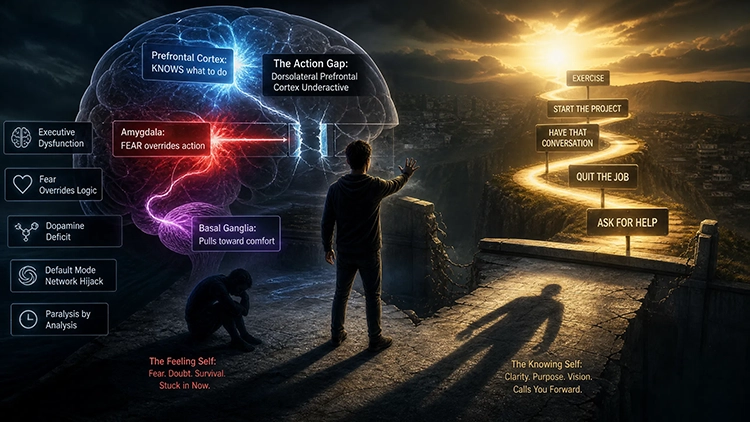
The Execution Gap: Why Rational Knowledge Fails to Change Human Behavior
Every morning, millions of people wake up with a precise understanding of what they ought to do. The formula for personal optimization is ubiquitous and undisputed: optimize sleep architecture, regulate glycemic response through diet, maintain physical exertion, set boundary conditions in interpersonal relationships, and practice disciplined cognitive presence.
Yet, a fundamental paradox lies at the heart of modern human experience: Knowledge has never been more accessible, yet the execution of basic self-betterment has never felt more elusive.
We find ourselves stranded in what behavioral scientists and philosophers identify as the Execution Gap—the profound, often painful gulf between intellectual awareness and physical action. We consume advice, bookmark self-improvement frameworks, and construct meticulous priority lists. We know the what, yet we consistently fail at the how.
Standard advice frames this failure as a deficit of willpower, a lack of discipline, or poor time management. But this diagnosis is fundamentally incomplete. The inability to bridge knowledge and action is not a personal failure of character; it is a structural byproduct of how the human brain processes threat, identity, and cognitive load.
The Neurobiology of the Friction State
To understand why simple, universally recommended advice resists implementation, we must examine the brain’s action-selection architecture. The human brain operates as an energy-conservation engine. Every deliberate action requires an expenditure of metabolic fuel, governed primarily by the prefrontal cortex (PFC).
When you encounter a checklist of ideal behaviors—such as “eliminate negative self-talk” or “maintain focus”—your conscious mind recognizes these as logically sound objectives. However, the basal ganglia and the amygdala evaluate these objectives through a completely different lens: threat detection and metabolic cost.
[ Prefrontal Cortex ] ──► Logical Imperative: "I must wake up at 5:00 AM"
│
▼
[ Amygdala & Basal Ganglia ]
│
┌─────────────────────────────┴─────────────────────────────┐
▼                                                           ▼
[ High Metabolic Cost ]                                 [ Threat to Identity ]
"Requires massive energy reserve"                       "What if I try and fail?"
│                                                           │
└─────────────────────────────┬─────────────────────────────┘
▼
[ Cognitive Paralysis / Action Avoidance ]
When an objective demands a radical departure from established neural pathways, the brain registers the proposed shift not as “self-care,” but as an energetic crisis.
The Intention-Action Dissociation: The cognitive state wherein the prefrontal cortex establishes a goal, but the basal ganglia refrains from firing the motor programs required for execution due to perceived risk, ambiguity, or excessive metabolic cost.
This explains why reading a self-improvement checklist often feels satisfying, yet taking the first physical step feels disproportionately heavy. The act of consuming advice triggers a small release of dopamine—simulating the feeling of progress—without demanding any real metabolic expenditure. You receive the neurochemical reward of the resolution without bearing the physical burden of execution.
The Illusion of Prescription: Why Generic Lists Fail
Consider the standard prescriptive list designed to guarantee a fulfilling life:
- Maintain mental peace
- Ensure financial responsibility
- Keep relationships balanced
- Align career with internal purpose
- Stay disciplined and consistent
While these bullet points are unassailable as long-term values, they are functionally useless as operational instructions. They describe destination states, not mechanisms of locomotion.
 Destination State (What) ──► "Maintain Mental Peace"
▲
│  [ Unmapped Terrain ]
▼
Operational Mechanism (How) ──►  ???????
When you attempt to implement a destination state directly, you create immediate cognitive overload. The brain cannot execute an abstraction. If you tell a hyper-vigilant nervous system to “be calm,” or an overworked professional to “protect their boundaries,” you are asking the brain to navigate complex, high-stakes environments without providing an actionable protocol.
The resulting friction leads directly to Information Toxicity: the state where accumulating more knowledge about a problem actually increases internal guilt and anxiety, because the gap between what you know and what you do continues to widen.
The Three Structural Pillars of Sustainable Action
If prescriptive lists and forced willpower fail, how does human behavior actually shift? Moving from passive knowledge to active execution requires three fundamental structural conditions.
                  ┌────────────────────────────────────────┐
│      1. Epistemic Clarity             │
│   (Deconstructing Artificial Desires)  │
└───────────────────┬────────────────────┘
│
▼
┌────────────────────────────────────────┐
│      2. Ethical Alignment             │
│   (Constructing Your Ethos)            │
└───────────────────┬────────────────────┘
│
▼
┌────────────────────────────────────────┐
│      3. External Cognitive Anchor     │
│   (The Objective Second Mind)          │
└────────────────────────────────────────┘
1. Epistemic Clarity: Deconstructing Artificial Desires
Before action can become consistent, you must eliminate internal contradiction. A significant portion of what we claim to want is not authentic desire, but mimetic desire—goals absorbed uncritically from cultural conditioning, parental expectations, or social comparison.
When you attempt to force yourself toward a goal that is fundamentally mimetic, your unconscious mind resists. You drag yourself toward an objective that your core values do not support.
Achieving epistemic clarity requires asking an uncomfortable question: Is this objective something I truly value, or is it an imitation of what I believe a successful person ought to value?
When an action is aligned with your internal architecture, friction decreases significantly. You no longer need to manufacture artificial motivation; the action becomes an expression of identity rather than an imposed duty.
2. Ethical Alignment: Constructing Your Ethos
In classical philosophy, actionable wisdom was never separated from ethics. The concept of Ethos—one’s fundamental character and moral orientation—was considered the primary stabilizer of human behavior.
When your daily actions conflict with your underlying moral framework, your brain experiences chronic, low-grade existential friction. For instance, if you pursue financial success or career advancement through methods that compromise your integrity (Bona Fide—acting in good faith), your subconscious mind will actively sabotage your efforts to maintain psychological safety.
Action Conflicts with Ethos ──► Subconscious Friction ──► Self-Sabotage
Action Aligns with Ethos    ──► Psychological Safety  ──► Sustainable Execution
Sustainable motivation is not merely a neurochemical state; it is an ethical one. Actions that preserve your self-respect naturally generate the psychological safety required for consistent execution.
3. The External Cognitive Anchor: The Necessity of a Second Mind
Human beings possess a remarkable capacity for self-deception. When left entirely to our own internal monologues, our Default Mode Network excels at justifying rationalizations, reframing delays as “strategic preparation,” and recasting fear as prudence.
To break out of self-referential loops, every resilient individual relies on an External Cognitive Anchor—a trusted partner, mentor, therapist, or rigorous peer group.
Internal Monologue (DMN) ──► Rationalization ──► Avoidance Loop
│
[ Interrupted By ]
│
▼
External Anchor ──────────► Objective Reality ──► Structural Action
An external anchor serves two distinct neuro-cognitive functions:
- Pattern Interruption: It disrupts the automated, defensive narrative created by your brain to justify inaction.
- Objective Mirroring: It holds your actual behavior up against your stated intentions, forcing you to confront the Execution Gap without judgment or emotional drama.
Even the most self-directed individuals stall when attempting to operate as their own sole source of accountability. A mind cannot objectively measure the system within which it is currently trapped.
The Courage of Imperfect Execution
Underneath the reluctance to take action lies an implicit, unspoken assumption: I must feel ready, clear, and confident before I begin.
This is perhaps the ultimate cognitive trap. Confidence is not the prerequisite for action; it is the downstream consequence of action. Expecting to feel calm, organized, and fully motivated before taking a step into unfamiliar territory is a demand for absolute safety—a condition that reality never grants.
Illusion:   Readiness ──► Action ──► Confidence
Reality:    Action    ──► Evidence ──► Confidence & Readiness
To bridge the Execution Gap, you must cultivate what classical stoicism and modern existential psychology refer to as existential courage: the willingness to act in the presence of ambiguity, discomfort, and incomplete information.
Progress does not require the elimination of your dark moments, your inconsistencies, or your fears. It simply requires you to stop waiting for them to disappear. When you drop the demand for perfection, accept the metabolic cost of change, and ground your choices in an authentic Ethos, the need for grand advice lists dissolves—leaving behind the quiet, steady reality of daily action.
Reclaiming the How
Look at the advice you have been collecting. Instead of adding another goal to your list, ask yourself three structural questions:
- Which of my current goals are authentic desires, and which are merely mimetic expectations I absorbed from others?
- Does the action I am avoiding conflict with my underlying sense of integrity or self-respect?
- Where am I relying entirely on internal willpower when I should be building an external anchor of accountability?
The answer to the “how” was never hidden inside a new self-help book or a curated priority list. It has always been waiting in the simple, unglamorous decision to take a single, imperfect action—right where you are, with precisely what you have.