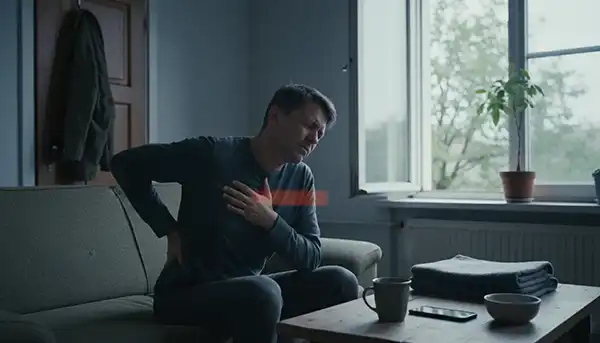
Why Unexpressed Feelings Show Up as Physical Pain and What to Do About It
The tooth pain started on a Tuesday morning about eight years ago, and I did what any reasonable person would do: I made an appointment with a dentist in my neighborhood in Portland, Oregon. The pain was real, a dull ache that radiated through my jaw and made it hard to concentrate. I was sure I had a cavity, or maybe an abscess, or something else that could be fixed with a drill and a prescription.
The dentist took x-rays, tapped on my teeth, and then sat back in her chair with a thoughtful expression. “There’s nothing wrong with your teeth,” she said. “But I notice you’re clenching your jaw. Do you grind your teeth at night?”
I did not know. I did not know I was clenching anything. But over the next few weeks, I started paying attention, and sure enough, my jaw was tight almost all the time. Not just at night. During the day too. In traffic. In meetings. In the quiet moments when I was alone with my own thoughts.
The dentist suggested I talk to someone. Not because my teeth were broken, but because something else was. And she was right. The pain in my jaw was not a dental problem. It was a signal. My body had been trying to tell me something for years, and I had been too busy, too guarded, too stubborn to listen.
That was the beginning of a long, uncomfortable education in how the body holds what the mouth refuses to say.
What Happens When Feelings Have Nowhere to Go
There is a phrase in psychology that has stayed with me ever since I first heard it: the body keeps the score. The psychiatrist and researcher Bessel van der Kolk made that phrase famous with his book of the same name, and his central argument is both simple and devastating. When we experience something painful and do not process it—when we swallow the anger, bury the sadness, push down the fear—those emotions do not disappear. They take up residence in the body. They show up as tension, as pain, as the jaw that clenches in the middle of the night.
I had been swallowing feelings for decades. I learned it early, the way so many of us do, by watching the adults around me. My father never raised his voice, but he also never said what he was feeling. My mother smiled through every difficulty and said “I’m fine” when she clearly was not. The message was subtle but unmistakable: strong people do not burden others with their feelings. They handle things on their own.
So I handled things on my own. I was the reliable one, the steady one, the one who never fell apart. And for years, it worked. I had friends. I had a job. I looked, from the outside, like a person who had it together.
But the body was keeping score. The tight jaw was just the most visible symptom. There were others: the stomachaches that came and went without explanation, the headaches that started behind my eyes and would not leave, the restless sleep that left me exhausted even after eight hours. I had been so busy being fine that I had stopped noticing how much I was not.
The author and trauma specialist Peter Levine, whose work on somatic experiencing has helped thousands of people, has argued that the body is not just a container for the mind. It is a partner in knowing. The sensations we feel—the tightness, the heat, the pressure, the ache—are not random. They are information. They are the body’s way of saying: something needs your attention.
I did not want to pay attention. I wanted the pain to go away. But the pain was not the problem. The pain was the messenger.
Why We Learn to Hide What We Feel
There is a reason so many of us struggle to express what we are going through. It is not because we are weak. It is because we were taught, often very early, that certain feelings are not acceptable.
Maybe it was a parent who told us to stop crying. Maybe it was a teacher who told us to stop being so sensitive. Maybe it was a friend who made us feel silly for being upset. The specifics vary, but the lesson is usually the same: your feelings are too much. Keep them to yourself.
The psychologist and author Susan David, at Harvard Medical School, writes about this in her work on emotional agility. She argues that we live in a culture that has not taught us how to feel our feelings. We are taught to avoid them, to suppress them, to pretend they are not there. And the suppression, she says, comes at a cost. The emotions do not go away. They just go underground.
That is exactly what happened to me. The feelings I would not let myself feel—the anger, the sadness, the quiet grief of a thousand small losses—went underground. And from there, they started to shape my life in ways I could not see. The tight jaw. The restless sleep. The sense that something was wrong, always, without ever knowing what it was.
The psychiatrist and trauma researcher Judith Herman, in her work on recovery, describes this as the tyranny of the unsayable. What cannot be spoken, she argues, will be enacted. It will show up in our bodies, our relationships, our choices. It will not stay hidden forever. It will find a way out.
For me, the way out was through my jaw. For someone else, it might be through their stomach, their back, their skin. The location varies. The mechanism is the same.
The Day I Finally Started Talking
The turning point was not dramatic. It happened in a therapist’s office, on a beige couch that sagged in the middle, after weeks of me insisting that I did not really have anything to talk about.
The therapist was a woman named Ruth, and she had a way of asking questions that made me uncomfortable in the best possible way. One afternoon, after I had spent ten minutes explaining that I was fine, really, just a little stressed, she leaned forward and said, “You keep saying you’re fine. But your body is telling a different story.”
I opened my mouth to argue, and then I stopped. Because she was right. The jaw was tight. The shoulders were up around my ears. The breath was shallow, high in my chest, like I was bracing for something. I had been so busy performing fine that I had not noticed any of it.
“What would happen,” Ruth asked, very gently, “if you stopped pretending to be fine for a few minutes and just told me what is actually going on?”
The question hung in the air. And then, slowly, haltingly, I started to talk. Not about the big things. About the small ones. The frustration at work. The loneliness in my marriage. The grief I had never fully felt about my father’s death, three years earlier. The words came slowly at first, and then faster, and then I was crying, and I could not stop, and the tears felt like something that had been waiting a very long time to fall.
The next morning, my jaw did not hurt as much. Not because the problem was solved. Because I had finally stopped holding it all alone.
The Difference Between Venting and Healing
I want to be careful here, because there is a difference between talking about your feelings and actually processing them. The first is ventilation. The second is healing. And the two are not the same.
The psychologist James Pennebaker, at the University of Texas at Austin, has spent decades studying this distinction. His research shows that simply talking about a difficult experience does not necessarily help. In fact, if the talking is just a way of repeating the same story, it can even make things worse. What helps, according to Pennebaker, is not the talking itself. It is the process of putting feelings into words, of making sense of them, of finding a narrative that allows the experience to be integrated rather than re-lived.
That is why talking to a trusted friend is not always enough. A good friend can listen. A good friend can offer comfort. But a good friend is not trained to help you untangle the deeper knots—the old wounds, the unexamined patterns, the beliefs that have been running your life from the shadows.
If you are struggling with feelings that feel too big to talk about, or if the bodily symptoms persist even after you have started talking, it may be time to reach out to a professional. A licensed therapist can help you do the deeper work of making sense of what you are carrying. The National Alliance on Mental Illness offers resources for finding a qualified provider. And if the weight ever feels like too much, the Suicide and Crisis Lifeline is available by calling or texting 988. Reaching out is not a sign of weakness. It is a form of care.
There is also a difference between emotional pain and physical pain that should not be ignored. If you are experiencing persistent physical symptoms—pain, fatigue, digestive issues, sleep problems—please see a doctor. The body and the mind are connected, but they are not the same, and some symptoms have medical causes that need medical treatment. A good physician will consider both the physical and the emotional dimensions of what you are experiencing.
What I Am Still Learning
The jaw still tightens sometimes. I still catch myself saying “I’m fine” when I am not. The old patterns are deep, and they do not disappear just because I understand them.
But something has changed. I catch the tightness sooner now. I notice the shallow breath before it becomes a full-blown headache. And when I notice, I do something different. I pause. I ask myself what I am actually feeling. And then, if I can, I say it out loud. To my wife. To a friend. To my own reflection in the bathroom mirror, if that is what it takes.
The other morning, I woke up with the familiar ache in my jaw. I lay there for a moment, breathing, and then I said, very quietly, “Something is bothering me. I don’t know what it is yet. But I’m not going to pretend it’s not there.”
It sounds small. It is small. But it is also the whole thing.
The feelings are not the enemy. The body is not the enemy. The enemy is the silence, the pretending, the long, lonely work of carrying everything alone.
You do not have to carry it alone. Not anymore. Not ever again.
The next time something feels heavy, try a small experiment. Instead of swallowing it, say it out loud. To a friend. To a therapist. To a journal. To the empty room, if that is what you have.
The words do not have to be perfect. They just have to be true.
And the truth, once spoken, has a way of making the load a little lighter. Not all at once. Not completely. But a little. And a little, accumulated over time, becomes a lot.
That is the whole practice, I think. Not the absence of pain. The willingness to share it. Not the perfect expression. The honest one.
The body will always keep score. But it does not have to carry the whole ledger alone.
So tell someone. Tell anyone. Tell the truth.
The telling is the beginning of everything.