The Cognitive Externalization Debt: How Digital Offloading Restructures Human Memory and Attention
You likely know the feeling: you sit down to read a single chapter of a book or analyze a dense document, but within three minutes, an invisible tension pulls at your attention. Your mind feels strangely restless, as if waiting for a notification that never arrived. Later that evening, you try to recall the name of an author you read last month, a specific address you visited last week, or even a close friend’s phone number. Where a clear memory should be, there is only a blank space—followed by an automatic impulse to reach for your smartphone.
When people notice these subtle shifts—the brain fog, the fragmented focus, the creeping reliance on digital notes—they often frame it as a personal flaw or an inevitable sign of aging: “My memory is getting worse,” or “I’ve lost my discipline.”
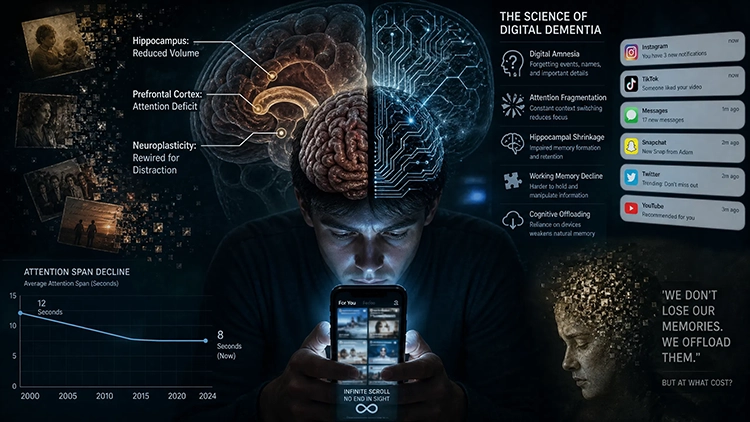
Popular culture has labeled this phenomenon “Digital Dementia.” Coined by German neuroscientist Manfred Spitzer in 2012, the term describes a cluster of cognitive deficits—impairments in short-term memory, sustained attention, and spatial orientation—resulting from over-reliance on digital devices.
Yet, telling someone experiencing these symptoms to “limit screen time,” “do mental math,” or “download a brain-training app” misses the deeper reality of what is happening inside the human brain.
The problem is not merely that we are using technology too much. The problem is that we are experiencing a fundamental shift in cognitive architecture. By delegating our memory, navigation, and executive processing to algorithms and cloud storage, we are actively restructuring the neural networks that define human thought.
The Neurobiology of Cognitive Offloading
To understand why relying on your phone changes your brain, we must look at how the brain manages mental resources. The brain is an extraordinarily plastic, energy-conserving organ. It constantly optimizes its physical architecture based on environmental demands, adhering to a strict neurobiological principle: use it or lose it.
When you perform mental operations entirely within your head—such as navigating a city using landmark recognition, calculating a tip, or holding a sequence of numbers in your working memory—you engage a complex neural circuit involving the hippocampus, the prefrontal cortex (PFC), and the parietal lobes.
[ Internal Processing ] ──► Hippocampal Activation ──► Structural Synaptic Density
▲
│  (Neuroplastic Reinforcement)
▼
[ Digital Offloading ]   ──► Reduced Hippocampal Load ──► Synaptic Pruning / Atrophy
When you outsource these operations to an external device—a practice cognitive scientists call Cognitive Offloading—you bypass this internal neural circuit.
Cognitive Offloading: The use of physical or digital actions (such as setting reminders, using GPS, or searching for easily retrievable facts) to reduce the immediate processing demands placed on working memory and executive control systems.
While cognitive offloading frees up short-term mental bandwidth, it carries a hidden neurobiological cost: Neural Pruning.
When the hippocampus is systematically spared the task of spatial mapping and memory consolidation, its synaptic connections weaken over time. Neuroimaging studies reveal that individuals who rely heavily on GPS for navigation show reduced grey matter volume in the hippocampus compared to those who construct internal spatial maps. The brain simply reallocates resources away from structures that are no longer actively recruited.
The Extended Mind vs. The Dependency Trap
In 1998, philosophers Andy Clark and David Chalmers introduced the Extended Mind Thesis. They argued that human cognition does not end at the skull; tools like notebooks, calculators, and smartphones act as seamless extensions of our cognitive processing system.
From an evolutionary standpoint, human intelligence has always relied on externalizing information—from cave paintings and written language to reference libraries.
Why, then, does the modern smartphone feel qualitatively different from a physical notebook or a paper map?
┌──────────────────────────────────────┬──────────────────────────────────────┐
│       Passive Analog Extension       │       Active Digital Environment     │
│          (Notebook / Map)            │             (Smart Device)           │
├──────────────────────────────────────┼──────────────────────────────────────┤
│ Static & Unidirectional              │ Dynamic & Algorithmic                │
│ Requires deliberate retrieval effort │ Pushes intrusive alerts & stimuli    │
│ Preserves working memory capacity    │ Captures & fragments attention       │
└──────────────────────────────────────┴──────────────────────────────────────┘
The difference lies in attentional friction and algorithmic intrusion.
A physical notebook is passive. It sits quietly until you choose to open it. It does not send variable dopamine rewards, interrupt your thought process with notifications, or attempt to maximize your engagement.
A smartphone, by contrast, is an active, hyper-stimulating cognitive landscape. When you open your phone to retrieve a simple piece of information—such as a note or a calendar entry—you step into an environment specifically designed to capture your attention. The act of retrieving an external memory subjects your prefrontal cortex to a barrage of competing signals, fragmenting your attention and causing working memory overload.
The Information Availability Paradox
A common misconception is that having infinite information at our fingertips makes us smarter. We tell ourselves: “Why waste biological energy memorizing facts when I can look up anything on Google in three seconds?”
This assumption overlooks how human memory actually constructs deep understanding.
                  [ Information Retrieval ]
│
┌──────────────┴──────────────┐
▼                             ▼
[ Instant Search Engines ]     [ Effortful Internal Recall ]
│                             │
▼                             ▼
Shallow Processing            Deep Hippocampal Encoding
(Transient Storage)           (Long-Term Synaptic Plasticity)
│                             │
▼                             ▼
No Mental Model Built         Integrated Knowledge Architecture
In cognitive psychology, the Generation Effect demonstrates that the effort required to retrieve information from memory strengthens the neural pathways associated with that knowledge. When you force your brain to recall a piece of information, you trigger neurochemical processes that physically solidify the memory trace.
When retrieval is instantaneous and effortless, the brain categorizes the information as environmental rather than internal—a phenomenon known as the Google Effect. The brain remembers where to find the information, but fails to encode the content itself.
The Google Effect (Digital Amnesia): The psychological tendency to forget information that can be easily found online, as the brain prioritizes storing the location of the information over the actual data.
If your brain never encodes baseline facts, it cannot build higher-order mental models. Deep creative synthesis, critical thinking, and wisdom rely on having an interconnected network of internal knowledge. An algorithm can retrieve isolated facts, but it cannot perform the subconscious synthesis that occurs within human long-term memory.
The Hidden Cost: Attentional Fragmentation and Brain Fog
When people complain of “digital dementia,” their primary symptom is rarely total memory loss; it is persistent cognitive fragmentation, commonly described as “brain fog.”
Brain fog is the physiological outcome of chronic Task Switching.
Every time a notification interrupts your focus, or every time you switch from a deep work task to glance at a screen, your brain incurs an Attention Residue penalty.
  Deep Focus Task ──► Interrupting Notification ──► Screen Shift
│
▼
Task Return ◄── Residual Thought Loops ◄── Attention Residue Penalty
When you return to your original task, a portion of your cognitive processing remains focused on the previous stimulus. If you switch tasks every few minutes, your prefrontal cortex operates in a state of continuous, cumulative fatigue. Over time, this results in:
- Elevated baseline anxiety (driven by continuous sympathetic nervous system activation).
- Impaired emotional regulation.
- Reduced capacity for deep, sustained focus (Deep Work).
Reclaiming Cognitive Sovereignty: An Architectural Strategy
Attempting to solve digital dementia through forced willpower or total tech-detox is rarely sustainable. We live in an environment that demands digital participation. The goal is not to eliminate digital tools, but to shift from unconscious dependency to intentional cognitive architecture.
┌─────────────────────────────────────────────────────────────────────────┐
│                    1. INTRODUCE COGNITIVE FRICTION                      │
│      Allow a 60-second delay before searching for retrievable facts     │
└────────────────────────────────────┬────────────────────────────────────┘
│
▼
┌─────────────────────────────────────────────────────────────────────────┐
│                    2. PROTECT HIPPOCAMPAL MAPPING                       │
│     Navigate familiar routes without GPS to preserve spatial grey matter│
└────────────────────────────────────┬────────────────────────────────────┘
│
▼
┌─────────────────────────────────────────────────────────────────────────┐
│                  3. BIFURCATE ATTENTION & ENVIRONMENT                   │
│   Separate working-memory tasks from hyper-stimulating environments     │
└─────────────────────────────────────────────────────────────────────────┘
1. Reintroduce Intentional Cognitive Friction
Before immediately searching for a forgotten piece of information—a name, a date, or a calculation—pause and force your brain to attempt retrieval for at least 60 seconds.
Even if you fail to recall the information, the act of attempting retrieval activates the hippocampus, increasing synaptic plasticity and making future encoding significantly more effective.
2. Preserve Spatial Mapping
Designate specific days or routes where you navigate without GPS assistance. By forcing your brain to observe physical landmarks, calculate orientation, and build internal mental maps, you actively recruit and preserve grey matter volume in the hippocampus.
3. Separate Storage Tools from Attentional Environments
Avoid using multi-purpose, hyper-stimulating devices for deep cognitive tasks. If you need to take notes, draft ideas, or plan complex projects, use dedicated, non-intrusive mediums—such as physical paper or single-function e-ink devices—that lack access to social media, web browsers, or notifications.
4. Practice “Effortful Encoding”
When learning crucial material, do not simply highlight text or save links to a read-later folder. Summarize key concepts in your own words using handwritten notes. The physical biomechanics of handwriting combined with re-formulating ideas in your own language forces deep prefrontal processing, ensuring the information is structurally integrated into long-term memory.
From External Storage to Internal Mastery
Technology is an extraordinary amplifier of human capability, but it is a poor substitute for biological cognitive structure.
When we offload our memory, attention, and spatial orientation without boundary conditions, we do not simply make life easier—we surrender the very neural infrastructure that enables deep focus, original thought, and emotional stability.
The path forward does not require discarding your digital tools; it requires asserting sovereignty over how you use them. By preserving spaces for internal processing, intentional effort, and uninterrupted attention, you protect the architecture of your mind—ensuring that technology remains a powerful instrument in service of human intelligence, rather than a substitute for it.
The Audit of Cognitive Autonomy
To assess the current state of your cognitive architecture, ask yourself these three structural questions:
- When I forget a simple piece of information, do I immediately search for it on a device, or do I give my brain the time and space to attempt retrieval?
- How many daily environments do I navigate using internal spatial awareness versus relying entirely on algorithmic direction?
- Is my technology acting as a passive tool that I pick up with intent, or as an active environment that continuously shapes and fragments my attention?