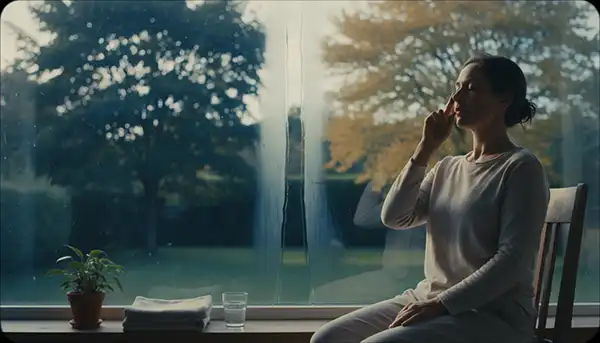
Nadi Shodhana Breathing Technique: A Complete Guide to Alternate Nostril Breathing
A year ago, my dermatologist said something I didn’t expect. I was in the middle of a stubborn eczema flare-up—the kind that keeps you awake at night, makes you self-conscious, and leaves you feeling like your body is working against you. She had already prescribed the usual creams and antihistamines. But then she added something else: “Have you ever tried alternate nostril breathing?”
I almost laughed. I was there for my skin. Why was she talking about breathing?
She explained that stress was making my condition worse—not the cause, but a significant amplifier. My nervous system was stuck in a low-grade fight-or-flight response, and that constant state of alert was aggravating my inflammation. She wasn’t suggesting breathing as a replacement for medical treatment. She was suggesting it as a complement. A way to calm the system so the medicine could do its job more effectively.
I was skeptical. But I was also desperate enough to try anything. So I went home, looked up the technique, and started practicing. Ten rounds every morning. Ten rounds every night. Within two weeks, I noticed something shift—not just in my skin, but in my mind. I was waking up with less dread. I was falling asleep without replaying the day’s anxieties. The breathing hadn’t cured me. But it had changed how I carried the experience.
That was my introduction to Nadi Shodhana, also known as alternate nostril breathing or channel-clearing breath. It’s an ancient practice with a growing body of scientific support. And it’s one of the simplest, most accessible tools I’ve found for regulating the nervous system.
What Is Nadi Shodhana and Why Does It Work?
The name comes from Sanskrit. Nadi means “channel” and Shodhana means “cleansing” or “purification.” In traditional yoga philosophy, the body contains thousands of energy channels called nadis, through which life force—known as prana in India, ki in Japan, and qi in China—flows. Three channels are considered primary: Ida, Pingala, and Sushumna.
Ida runs along the left side of the body and is associated with passive, cooling, lunar energy—the yin quality. Pingala runs along the right side and is associated with active, warming, solar energy—the yang quality. Sushumna runs through the center of the spine and is the main channel through which energy rises when the two sides are balanced.
Here’s where it connects to the breath: Ida ends in the left nostril, and Pingala ends in the right nostril. By alternately breathing through each nostril, you’re directly influencing the balance between these two energy channels. In traditional terms, you’re harmonizing the active and passive aspects of your being. In modern terms, you’re balancing your nervous system.
Scientists have found that nasal breathing is not symmetrical. The nostrils naturally alternate dominance throughout the day in a cycle called the nasal cycle. This cycle is connected to the autonomic nervous system—the right nostril is associated with sympathetic activity (the fight-or-flight response), and the left nostril is associated with parasympathetic activity (the rest-and-digest response). By consciously alternating which nostril you breathe through, you can influence which branch of your nervous system is dominant.
A 2019 study published in the International Journal of Yoga found that participants who practiced Nadi Shodhana for twelve weeks showed significant reductions in perceived stress and improvements in heart rate variability—a marker of nervous system flexibility. Another study from the Journal of Clinical and Diagnostic Research found that regular practice improved cognitive performance, particularly in tasks requiring attention and memory.
Preparing for the Practice
Before you begin, find a comfortable position. You can sit on a chair with your back straight, or on a cushion on the floor. The key is to keep your spine upright—not rigid, but supported. If you’re in a chair and your back tends to slouch, place a small cushion behind your lower back for support.
Close your eyes if that feels comfortable. It helps direct your attention inward. If closing your eyes makes you feel uneasy, you can keep them open and soften your gaze toward a point on the floor or wall in front of you.
Clear your nostrils before you start. If one side is particularly congested, you might need to gently blow your nose or use a saline rinse.
A quick note: if at any point during the practice you feel dizzy, lightheaded, or uncomfortable, stop. You can return to normal breathing and try again another time. This is a gentle practice, not a test of endurance.
Step-by-Step Guide to the Technique
You’ll be using your fingers to alternately close each nostril. The classic hand position uses the right hand: thumb on the right nostril, ring finger on the left nostril. Your index and middle fingers can rest on your forehead or curl into your palm—whatever feels more natural. If you’re left-handed, you can mirror this with your left hand.
The key is to close the nostrils gently, pressing on the cartilage just where it meets the bone, not deep inside the nostril. Pressing too hard can distort the open nostril and make the breath feel restricted.
Here’s the basic rhythm:
Start with both nostrils open. Inhale deeply through both. Then, as you exhale, close your right nostril with your thumb and exhale fully through your left nostril.
Now inhale through your left nostril. Then close your left nostril with your ring finger, release your right nostril, and exhale through your right nostril.
Inhale through your right nostril. Then close your right nostril, release your left, and exhale through your left.
That’s one full cycle. You begin with an exhale on the left, and you end with an exhale on the left.
If you’re counting rounds, aim for ten cycles. If you prefer timing, start with three minutes and work your way up. Consistency matters more than duration. Five minutes daily is more effective than thirty minutes once a week.
A helpful way to remember the pattern: exhale and inhale through the same nostril before switching. Exhale left, inhale left. Switch. Exhale right, inhale right. Switch. Repeat.
As you practice, you might notice that one nostril feels more open than the other. That’s normal. The nasal cycle is natural. If one side is completely blocked, you can gently stretch the skin on that side of your face outward with your free hand to open the passage slightly.
You can also experiment with the length of your breath. Extending your exhale slightly longer than your inhale can enhance the calming effect. This activates the parasympathetic nervous system, signaling to your body that it’s safe to relax. But don’t force it. Let the breath find its own rhythm. The goal is ease, not effort.
The Science Behind the Practice
I mentioned earlier that the left nostril is connected to the parasympathetic nervous system and the right nostril to the sympathetic. This is not just esoteric philosophy—it’s neuroanatomy. The nasal passages are lined with receptors that communicate with the brain stem, which regulates autonomic function. When you breathe through a particular nostril, you’re influencing the activity of the corresponding hemisphere of the brain.
The left nostril is associated with the right hemisphere—the side involved in creativity, intuition, and emotional processing. The right nostril is associated with the left hemisphere—the side involved in logic, language, and analytical thinking. Alternate nostril breathing may help integrate these two modes of processing, leading to a more balanced state of mind.
There’s also the matter of heart rate variability, which is a measure of the variation in time between heartbeats. Higher HRV is associated with better stress resilience, emotional regulation, and overall cardiovascular health. The slow, rhythmic nature of Nadi Shodhana stimulates the vagus nerve, which helps increase HRV. A 2020 study in the Journal of Alternative and Complementary Medicine found that just ten minutes of alternate nostril breathing significantly increased HRV in healthy adults.
When and How to Use This Technique
You can practice Nadi Shodhana at almost any time, but certain moments are particularly well-suited.
First thing in the morning. Before you check your phone, before you engage with the demands of the day, sit quietly and practice. It sets a tone of calm intention.
Before bed. If your mind tends to race when you lie down, this practice can help quiet the internal noise. The extended exhale signals to your nervous system that it’s time to rest.
Before a stressful event. A meeting, a difficult conversation, a presentation—taking five minutes to breathe can shift your physiological state from anxiety to readiness.
When you feel scattered. If you’re juggling multiple tasks and your attention is fragmented, pausing to practice can help you recenter.
As part of a yoga or meditation practice. It’s an excellent preparation for seated meditation or a more active yoga session.
A Gentle Reminder About Your Health
If you have any respiratory conditions—asthma, chronic obstructive pulmonary disease, or severe allergies—consult your doctor before starting any breathing practice. While Nadi Shodhana is gentle, it does involve breath retention if you choose to extend the exhale, and that may not be appropriate for everyone. The same goes for anyone with high blood pressure, heart conditions, or a history of panic attacks. This practice is intended as a tool for wellness, not as a substitute for medical care. If you’re unsure, ask your healthcare provider first.
Also, if you’re going through a particularly difficult period of stress, grief, or anxiety, a breathing technique is a support, not a cure. It can help regulate your nervous system in the moment, but it doesn’t replace the deeper work of therapy, counseling, or other forms of professional mental health support. Use it as part of a broader toolkit, not as the only tool.
Practical Tips for Building a Routine
The most common obstacle I hear from people is consistency. They try the technique once, feel a bit better, and then forget about it until the next crisis. What works better is integration. Attach the practice to something you already do every day.
For me, it’s morning coffee. I make my coffee, I sit down, and I do ten rounds before I take the first sip. It’s become a ritual—the coffee waits for the breathing, not the other way around.
For others, it might be the moment they get into bed. The last thing before sleep. Or it might be during a work break, stepping away from the screen for five minutes of breathing.
Start with a manageable commitment. Three minutes a day is better than thirty minutes once a month. You can always increase the duration once the habit is established.
What readers usually ask
Is it okay if I can’t get one nostril to open?
Yes. The nasal cycle means one side is often more congested. If you can’t get the blocked side to open, do your best and don’t stress about it. Some people find that a few rounds of the practice help open the congestion naturally. But if it doesn’t, that’s fine—your nervous system still benefits from the rhythm and attention.
How long before I notice a difference?
Some people notice an immediate shift—a sense of calm after just one session. For others, it’s more gradual. I noticed small changes within a week, and more significant changes after a month. The key is consistency, not intensity.
Can I do this lying down?
Yes, though sitting upright is generally recommended because it allows for fuller, easier breathing. If you’re dealing with fatigue or illness, lying down is perfectly acceptable. Just make sure your head and neck are supported.
If you take nothing else from this guide, take this: your breath is always available. It doesn’t cost anything. It doesn’t require equipment. It’s a tool you carry with you everywhere. And when everything else feels out of control, your breath is something you can still influence. Slow it down. Notice it. Even for a few moments.
I’m still not sure whether the breathing itself healed my skin, or whether the practice helped me stop fighting my body long enough for the medicine to work. Maybe it’s both. Maybe the distinction doesn’t matter. What I know is that a year later, I still practice. Not perfectly, not every single day. But often enough to remember that calm is not something that happens to me. It’s something I can choose. One breath at a time.