The Hidden Origins of Fear: Why Your Brain Holds On to Childhood Terrors
I still remember the exact taste of my childhood fear. It was the summer I turned seven, and my older brother convinced me that a monster lived in the basement. Not a vague, shapeless monster—a specific one with claws and yellow eyes that only came out when the lights were off. For two years, I couldn’t go down those stairs without my heart racing. I knew, intellectually, that there was nothing there. But my body didn’t care about intellect. It had already learned the flavor of that fear, and it kept serving it back to me every time I approached the door.
That flavor never fully disappeared. Even now, as an adult, when I walk into a dark basement, I feel a faint echo of that seven-year-old terror. I know it’s irrational. I know there’s no monster. But the taste lingers—a phantom sensation that my brain stored decades ago and refuses to let go.
That’s what I want to talk about. Not fear itself, but the flavor of fear. The way it gets encoded in our nervous systems, often before we have the language or the cognitive capacity to understand what’s happening. And why, for many of us, those early flavors dictate the shape of our adult anxieties in ways we never fully recognize.
The Brain’s Early Feast: Why Childhood Experiences Cut So Deep
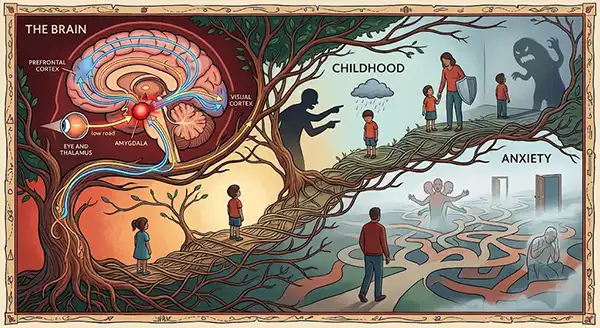
Here’s something that surprised me when I first learned about it: a two-year-old’s brain contains significantly more neural connections than an adult’s. More synapses, more pathways, more raw processing power. It’s like having a supercomputer that hasn’t been optimized yet. Over time, as we grow, the brain prunes those connections. The pathways we use get strengthened. The ones we don’t get eliminated. It’s efficient, but it’s also a kind of narrowing.
What this means is that childhood experiences—especially emotionally charged ones—get etched into the brain with extraordinary depth. The neural networks that form around those early events are dense, complex, and highly resistant to change. Later experiences can build on them, but they rarely replace them. The original imprint stays.
A 2018 study from Harvard’s Center on the Developing Child found that early childhood stress can actually alter the architecture of the developing brain, affecting everything from impulse control to emotional regulation. This isn’t about being “damaged.” It’s about being shaped. And the shaping happens whether we’re aware of it or not.
When I think about my basement fear, I realize it wasn’t just about the dark or the imagined monster. It was about the feeling of being small and powerless in a space I couldn’t control. That feeling—vulnerability in the face of the unknown—became a template. It showed up later in other forms: social anxiety, fear of failure, hesitation in relationships. The specific monster changed, but the flavor remained.
The Taste of Fear: A Metaphor That Works
There’s a term I’ve started using for this. I call it ghost flavor—the lingering sensory residue of an emotional experience that your brain keeps serving up, long after the original event has passed. A ghost flavor isn’t the same as a memory. A memory is a story you tell yourself. A ghost flavor is a sensation your body knows. It’s not something you remember; it’s something you re-experience.
For example, a person who was criticized harshly as a child might develop a ghost flavor around receiving feedback. Every time someone offers a suggestion, their body tenses, their stomach knots, and they feel a wash of shame—not because the current situation warrants it, but because the flavor of childhood criticism has been triggered. The brain isn’t remembering the event. It’s tasting the emotion.
Ghost flavors aren’t limited to fear. They exist for love, for excitement, for safety, for disgust. But fear is where they’re most potent, because fear is designed to keep us alive. The brain takes fear seriously. It doesn’t let go easily.
What I find useful about the ghost flavor framework is that it separates the sensation from the story. When I feel that familiar knot in my stomach, I can say: “This is a ghost flavor. It’s not the present moment. It’s an old survival response that got triggered.” That doesn’t make the feeling disappear, but it changes my relationship to it. I’m no longer being controlled by it. I’m observing it.
The Fairytale World Inside Your Head
Here’s a concept that took me a while to accept: the world you experience isn’t the world itself. It’s a world your brain has constructed based on everything you’ve ever encountered. That construction is deeply personal, deeply subjective, and deeply influenced by the flavors you’ve collected along the way.
In childhood, that internal world is particularly vivid. The boundaries between imagination and reality are thinner. A shadow in the corner of the room can become a dragon. A loud noise can become a threat. A kind word can feel like a blanket. The brain doesn’t distinguish neatly between “real” and “imagined.” It experiences both as real experiences. And those experiences leave traces.
I once worked with a client—I’ll call her Maya—who had a profound fear of being abandoned. It wasn’t based on any recent event. Her relationships were stable, her friends were reliable. But she couldn’t shake the feeling that everyone would eventually leave her. During a session, she mentioned that her father had traveled frequently when she was a child. He always came back. But her three-year-old brain didn’t understand that. All it knew was that the person who was supposed to be there kept disappearing.
The ghost flavor of abandonment was still running her life, decades later. She wasn’t being abandoned. She was tasting an old fear that had never been properly processed.
This is what I mean by the internal fairytale. It’s the narrative we build out of our earliest experiences, complete with heroes and villains, dangers and rescues. And it operates beneath the level of conscious awareness, guiding our decisions, our relationships, and our fears in ways we rarely question.
Why Some Flavors Stick and Others Fade
Not every childhood experience becomes a ghost flavor. Some just fade. Others get integrated and lose their charge. What makes certain flavors stick?
The research points to three factors: intensity, repetition, and attachment.
Intensity is obvious. A single traumatic event can leave a lasting mark. But repetition is equally powerful. If you experience the same flavor—criticism, neglect, invalidation—over and over, your brain becomes fluent in it. It becomes the default setting.
Attachment is the most overlooked factor. The people we’re closest to—our parents, caregivers, early attachment figures—have an outsized influence on what flavors get baked in. If a caregiver is unpredictable, the flavor of uncertainty sticks. If a caregiver is warm, the flavor of safety sticks. These aren’t just emotions. They’re templates for how we navigate relationships for the rest of our lives.
A 2020 study published in Child Development found that children with secure attachment patterns showed more flexible neural responses to stress, while those with insecure patterns showed rigid, exaggerated responses that persisted into adulthood. The flavors weren’t just memories. They were embedded in the nervous system itself.
How to Identify Your Own Ghost Flavors
This isn’t about digging through the past for the sake of digging. It’s about understanding the patterns that are still running your life so you can start choosing differently.
The first step is to pay attention to your reactions. When you feel a strong, disproportionate response to something—a panic that doesn’t match the situation, a wave of shame that comes out of nowhere, a sudden withdrawal from connection—ask yourself: What flavor is this?
Don’t try to answer with your mind. Try to answer with your body. Where do you feel it? What shape does it take? Does it remind you of anything? Does it have a taste, a texture, a temperature?
I started doing this a few years ago, and the results were surprising. I noticed that my anxiety before public speaking wasn’t about speaking at all. It was about being seen and judged—a ghost flavor from a classroom in fourth grade when I gave a presentation and the teacher corrected me in front of everyone. I wasn’t afraid of the audience. I was tasting that thirty-year-old humiliation.
Once I named it, the fear didn’t vanish. But it became recognizable. I could say to myself: “That’s not fear. That’s a ghost. It’s old. It’s safe to let it go.” And over time, the flavor got weaker. It’s still there, but it doesn’t own me anymore.
When Fear Becomes Too Heavy to Carry Alone
I need to be clear here: naming and understanding your fears is a valuable tool, but it’s not a substitute for professional help. If you’re experiencing persistent anxiety, panic attacks, intrusive thoughts, or a sense of being overwhelmed that interferes with your daily life, please reach out to a licensed mental health professional. A therapist can help you work through patterns that you may not be able to untangle on your own. There is no shame in seeking support. Some ghost flavors require more than self-awareness—they require a guide.
Similarly, if your fears are rooted in trauma—particularly childhood trauma—a trained trauma-informed therapist can help you process those experiences in ways that self-help simply can’t. You don’t have to carry this alone. In fact, you shouldn’t.
The Freedom of Naming Your Fear
Here’s what I’ve come to believe: fear is not the enemy. The enemy is the unexamined fear—the one that runs your life without your permission. When you name a fear, you take it out of the shadows. You reduce its power. Not because you’ve defeated it, but because you’ve stopped pretending it isn’t there.
The ghost flavors of childhood don’t go away entirely. But they don’t have to control you. They can become background noise instead of the main melody. They can become data rather than destiny.
I still don’t love basements. I still feel a flicker of that old dread when I walk down dark stairs. But now I recognize it for what it is: a seven-year-old’s fear that never got fully updated. I can feel it and keep walking. I can acknowledge it without being imprisoned by it.
That’s the shift. Not the absence of fear, but the presence of awareness. The ability to say: “I know this flavor. It’s not new. It’s not the whole story. It’s just old.”
And when you can say that, the present becomes a little more yours. The past loses a little of its grip. And you become a little more free.
A few things worth clarifying
What if I don’t remember anything from my childhood that would explain my fears?
That’s common. Many ghost flavors are encoded before we have explicit memory—before age three or four. You may not have a story to go with the feeling. That’s okay. The feeling itself is still worth paying attention to. You don’t need a narrative to validate an experience.
Does this mean my fears are permanent?
No. Neuroplasticity works both ways. The brain can build new pathways and weaken old ones. It takes time and consistent practice, but the brain is not fixed. The flavors can fade. It’s not easy, but it’s possible.
How do I know if I need professional help?
If your fears are affecting your ability to work, maintain relationships, or take care of yourself—if they’re making you feel like you’re not in control of your own life—that’s a sign. Also, if you’re having thoughts of self-harm or harming others, please reach out to a crisis line or a professional immediately. You don’t have to figure this out alone.
A question to sit with
What flavor of fear has been running your life without your permission?
Not the fear itself—the flavor. The feeling. The sensation. The thing that shows up before you can think about it. The one that’s been there so long you’ve stopped noticing it.
Sit with that. Don’t try to fix it. Just recognize it. Acknowledge it. Let it be there without letting it drive.
That act of recognition is the beginning of freedom. Not the kind that erases fear, but the kind that lets you feel it without being ruled by it. And that might be the most important step of all.