Do Crowded Cities Actually Make People Rude? The Surprising Science Behind Urban Incivility
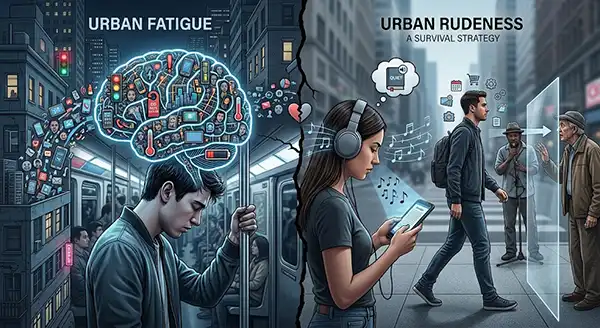
The short answer is nuanced: cities don’t inherently make people rude, but the overwhelming sensory and social load of urban life often triggers defensive behaviors that look like rudeness. Research shows that while city dwellers are frequently perceived as less friendly and more hurried than their small-town counterparts, this isn’t necessarily a character flaw—it’s often a psychological survival mechanism. However, a landmark 2020 study published in Proceedings of the Royal Society B found that urbanicity itself doesn’t predict a person’s willingness to help strangers; rather, neighborhood wealth and socio-economic deprivation are far stronger determinants of prosocial behavior.
The Day I Realized I Had Become the Person I Didn’t Want to Be
I remember the exact moment I caught myself being rude in a way that felt automatic, almost involuntary. I was rushing through Grand Central Terminal during evening rush hour, late for a train, when a tourist stopped in front of me to look at a map. Without thinking, I muttered something under my breath, sidestepped aggressively, and kept walking. It wasn’t until I was on the train that I felt a pang of shame. That wasn’t who I was. Or at least, it wasn’t who I wanted to be.
I grew up in a small town in Vermont where you waved at everyone you passed on the street. You held doors. You made eye contact. You asked strangers how their day was going—and you actually waited for the answer. Moving to New York City in my mid-twenties was a shock to that system. Within a year, I had learned to keep my head down, avoid eye contact, and treat the crowded sidewalks as obstacles rather than shared spaces.
I told myself I was just adapting. But I was also wondering: was the city making me colder? Or was I just finally seeing who I really was?
Why Does City Life Encourage Defensive Behavior?
Psychologists and sociologists have been studying this question for decades. One of the most influential frameworks comes from sociologist Georg Simmel, who argued as early as 1903 that the sheer density and sensory overload of city life forces people to develop a “protective organ” against the constant stimulation. In other words, urbanites aren’t naturally rude—they’re overwhelmed.
A 2026 study published in the journal Mobilities examined everyday social interactions on an inner-city bus route in Stockholm. Researchers observed 119 interactions and found that 83 were classified as acts of “diffuse incivility”—behaviors like playing music loudly or disrupting exits that weren’t directed at any one person but affected everyone on the bus. The study found that incivility was significantly more likely to occur on weekends and farther from the driver’s cabin, suggesting that the lack of social oversight in certain contexts encourages uncivil behavior.
The researchers noted that incivility is “highly context-dependent and shaped by socially constructed norms and subjective interpretations”. What feels rude in one setting might feel normal in another. And what looks like rudeness might actually be a form of self-protection in an environment where personal space is constantly under threat.
The Evolutionary Mismatch: Why Our Stone Age Brains Struggle in Cities
There’s a deeper, evolutionary explanation for why city life can bring out our less generous sides. A 2018 study from the University of Miami’s Evolution and Human Behavior Laboratory, published in Nature Human Behavior, found that humans can quickly “switch off” their automatic inclination to be generous when they learn there are no social consequences for their actions.
Lead author William McAuliffe and his team exposed 200 volunteers to an anonymous social environment with no incentives or punishments for how they treated others. On their first visit, participants shared about half their earnings fairly. On their second visit, about a month later, their generosity dropped by an average of 20 percent. As senior author Michael McCullough explained: “We are actually walking around with Stone Age minds… We have a natural karma built into us because our minds have evolved into thinking that what goes around really does come around”.
The problem is that this “natural karma” system evolved in small groups of about 150 people, where everyone knew everyone else. In a city of millions, you’re constantly surrounded by strangers you’ll never see again. Your brain doesn’t automatically register them as part of your social network. So the “cognitive shortcut” to be kind gets dialed down.
McCullough noted that this could explain why big-city dwellers have a reputation for being more hurried and less friendly to strangers than small-town folk. It’s not that urbanites are morally inferior. It’s that their brains are responding to an environment that doesn’t trigger the same cooperative instincts.
What the Latest Research Reveals About Urban Kindness
But here’s where the story gets more complicated—and more hopeful. A 2020 study from University College London, published in Proceedings of the Royal Society B, challenged the assumption that cities make people less prosocial. Researchers conducted three real-world experiments across 37 neighborhoods in 12 UK cities and 12 towns and villages. They measured whether people would post a lost letter, return a dropped item, or stop to let someone cross the road.
The researchers expected to find that people in more urban locations would be less willing to help strangers, driven by increased “diffusion of responsibility” and perceived anonymity. But their data didn’t support this hypothesis. There was no effect of either urbanicity or population density on people’s willingness to help a stranger.
Instead, the single strongest predictor of helping behavior was neighborhood deprivation. Help was offered less frequently in more deprived neighborhoods. As the authors concluded: “These findings highlight the importance of socio-economic factors, rather than urbanicity per se, in shaping variation in prosocial behaviour in humans”.
This is a crucial distinction. It’s not that cities make people rude. It’s that poverty, stress, and resource scarcity—which are often concentrated in urban areas—can make people less likely to extend kindness to strangers. When people are struggling to survive, they have less bandwidth for generosity.
The Traffic Connection: How Congestion Eats Away at Our Patience
Another recent study, published in 2025, explored the impact of urban traffic environments on prosocial behavior. Researchers found that drivers who experienced congested traffic were significantly less willing to engage in prosocial behavior compared to those in smooth traffic conditions.
The study identified a chain reaction: traffic congestion creates crowd pressure and time pressure, which leads to “experiential avoidance”—a psychological state where people try to escape or minimize uncomfortable experiences. In that state, they’re less likely to help others. The researchers also found that an orderly traffic environment could mitigate these negative effects.
This helps explain why urban rudeness often feels so situational. You’re not rude all the time. You’re rude when you’re stressed, rushed, and overwhelmed. The city doesn’t make you a bad person. It makes you a tired person.
Why Women in Cities Often Avoid Social Interaction
There’s another dimension to urban incivility that’s often overlooked: safety. Research on street harassment has found that many women modify their behavior in cities specifically to avoid unwanted attention. They avoid walking alone, consciously change their clothing choices, and sometimes even choose lower-ranked colleges if the commute is safer.
A study examining the psychological impact of street harassment found that “the final theme was the modification of behaviour after experiencing street harassment where women choose to avoid walking alone on the streets”. What looks like rudeness—avoiding eye contact, not smiling, hurrying past—can be a learned safety strategy.
This is a critical reminder that urban social behavior isn’t just about personality. It’s about perceived risk. When you’re constantly scanning your environment for threats, you don’t have the mental energy to be warm and open. You’re in survival mode.
How to Be Kinder in the City Without Losing Your Mind
If cities don’t have to make us rude, what can we actually do about it?
Start small. A 2025 study found that the mere presence of a man dressed as Batman on the subway increased acts of kindness by two-thirds. You don’t need a cape. But small, visible acts of courtesy—holding a door, offering a seat, saying “thank you”—can create a ripple effect. Kindness is contagious.
Reduce your cognitive load. If traffic congestion makes people less prosocial, avoid driving during peak hours when possible. If crowded subways drain you, travel at off-peak times. The less overwhelmed you are, the more bandwidth you have for generosity.
Choose your battles. You don’t have to be friendly to everyone. But you can be civil. A nod, a brief smile, a simple “excuse me”—these small gestures acknowledge other people’s humanity without requiring a full conversation.
Remember the research. Urbanicity itself doesn’t make people unkind. Poverty and deprivation do. If you have the resources to be generous, that generosity matters even more in a city where many people are struggling.
Reframe your “rudeness.” When you catch yourself being short with someone, ask: Am I actually being rude, or am I just overwhelmed? Sometimes the answer is both. But naming the overwhelm can help you separate your behavior from your character.
A Note on Mental Health
If city life is making you feel constantly anxious, irritable, or overwhelmed, you’re not alone. Urban lifestyles have been associated with increased risk for mental disorders, greater stress responses, and lower trust. These aren’t personal failures—they’re responses to a challenging environment.
If you’re experiencing persistent anxiety, depression, or thoughts of harming yourself, please reach out to a licensed mental health professional. A therapist can help you develop coping strategies for urban stress. If you’re in crisis, call or text the 988 Suicide & Crisis Lifeline. Help is available.
Questions people often ask
Is it true that people in small towns are genuinely nicer?
It’s more complicated than that. Studies show that people in rural areas often have more opportunities for repeated social interactions, which encourages cooperation. But when researchers controlled for neighborhood wealth, the urban-rural difference in helping behavior disappeared. It’s not about the city—it’s about the resources and stress levels of the people in it.
Why do I feel more tired and irritable in the city?
Because cities demand more from your brain. Constant noise, visual stimulation, and the need to navigate crowded spaces all consume cognitive resources. Your brain is working harder just to get through the day. That fatigue often shows up as irritability or withdrawal.
Can I change how I respond to urban stress?
Yes. Small changes—like leaving earlier to reduce time pressure, taking alternate routes to avoid congestion, or building in quiet moments during your day—can reduce your stress load. The less overwhelmed you are, the more room you have for kindness.
I still catch myself being short with strangers sometimes. The old habits—the averted gaze, the hurried step, the muttered complaint—they don’t disappear overnight. But I’ve started noticing them more. And when I do, I try to remember what the research shows: it’s not the city that makes us rude. It’s the stress. The overload. The exhaustion.
And those things, unlike the city itself, are things we can actually change.
Not all at once. Not perfectly. But one small, conscious choice at a time. A held door. A genuine “thank you.” A moment of eye contact that says: I see you. You’re human. So am I.
That’s not just kindness. That’s resistance. Against the overwhelm. Against the numbness. Against the lie that cities have to make us cold.
And in a world that often feels designed to wear us down, that resistance might be the most important thing we do.