The Acoustic Neural Anchor: Mantras, Attentional Entrainment, and the Neurobiology of Auditory Repetition
When individuals first attempt meditation, they frequently encounter an immediate, unsettling physical resistance. The instruction seems simple enough: sit still, close your eyes, and focus on nothing or quietly observe the breath. Yet within moments, the physical body responds with phantom itches, sudden restlessness, and a rapid surge of physiological discomfort. The mind, unaccustomed to singular focus, leaps frantically from unresolved past conversations to upcoming obligations—a state cognitive scientists refer to as the “monkey mind.”
For many, this initial friction leads to a hasty conclusion: “I am simply not built for meditation.”
Popular culture often frames meditation as a state of immediate, peaceful emptiness. When that emptiness fails to materialize, practitioners assume they have failed. However, this struggle is not a personal deficit; it is the predictable reaction of a modern nervous system subjected to chronic overstimulation. Expecting a mind conditioned by continuous task-switching to instantly settle into passive silence is like asking a speeding vehicle to stop without applying the brakes.
To stabilize an overactive mind, we do not need forced suppression; we need an anchor. This is where Mantra Meditation—the deliberate, rhythmic repetition of specific acoustic sounds, words, or phrases—shifts from a traditional contemplative exercise into a precise tool for cognitive neural entrainment.
1. The Neurobiology of the Wandering Mind
To understand why sitting in silence feels so demanding, we must look at how the brain behaves when deprived of external tasks.
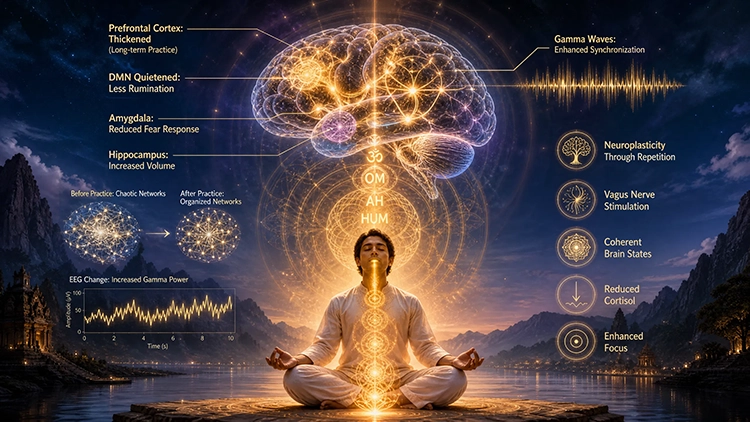
When you cease goal-directed activity, your brain does not shut down. Instead, it activates the Default Mode Network (DMN)—a complex neural circuit involving the medial prefrontal cortex and the posterior cingulate cortex. The DMN is responsible for self-referential thought, autobiographical memory, temporal projection (worrying about the future or replaying the past), and social evaluation.
[ Unstructured Stillness ] ──► DMN Hyperactivation ──► Self-Referential Rumination
│
▼
Physiological Restlessness
(Cortisol Spike / Itching)
In an untrained mind, the activation of the DMN often registers as continuous internal noise. When you force yourself to sit still without an operational focus, the DMN operates at full capacity, manufacturing narrative drama to keep the brain engaged. The physical restlessness—the sweating, the sudden need to move, the friction—is simply the physiological footprint of an unanchored Default Mode Network attempting to generate stimulation.
Traditional breath-awareness practices attempt to quiet the DMN by directing attention to the subtle sensation of airflow. While effective, the breath can sometimes prove too subtle for a highly agitated nervous system. The attention easily slips away, sliding back into narrative thought.
2. The Acoustic Anchor: How Mantras Entrain the Brain
A mantra functions as a high-density sensory anchor. Unlike abstract silence or subtle breath movements, an acoustic mantra engages multiple neurological systems simultaneously: auditory processing, motor control (speech apparatus), and somatosensory feedback (vibrational resonance and tactile touch).
                  ┌────────────────────────────────────────┐
│          Mantra Recitation             │
└───────────────────┬────────────────────┘
│
┌─────────────────────────────┼─────────────────────────────┐
▼                             ▼                             ▼
[ Auditory Cortex ]       [ Somatosensory System ]       [ Motor Cortex ]
Processing Sound & Frequency   Tactile Vibration & Mudras   Phonetic Production
│                             │                             │
└─────────────────────────────┼─────────────────────────────┘
▼
[ Central Executive Network ]
│
▼
[ Default Mode Network Suppression ]
When you recite a mantra—whether aloud, in a whisper, or mentally—you occupy the vocalization channels of the motor cortex and the processing loops of the auditory cortex. This creates a systematic occupational lock on the brain’s language centers.
Phonological Interference: The cognitive mechanism wherein active phonemes (spoken or internally vocalized sounds) prevent the formation of unstructured internal verbal thoughts by monopolizing the phonological loop in working memory.
Put simply: your internal critic cannot easily construct anxious verbal narratives about tomorrow’s schedule while your motor and auditory systems are actively occupied in producing a rhythmic, continuous acoustic pattern.
3. The Structural Chemistry of Repetition and Neuroplasticity
Why do ancient traditions emphasize the endless repetition of seemingly simple syllables, such as the seed (Bija) sounds found in classical Sanskrit practices?
The human brain relies on pattern recognition and neurochemical efficiency. When an acoustic phrase is repeated continuously, it triggers a shift in sensory processing known as Neural Habituation and Entrainment:
Random Stimuli Input  ──► High Prefrontal Energy Cost ──► Cognitive Fatigue
Rhythmic Mantra Loop   ──► Neural Entrainment          ──► Synchronized Alpha/Theta Waves
- Cortical Synchronization: Rhythmic auditory inputs encourage brainwave synchronization, shifting baseline activity away from high-frequency Beta waves (associated with active stress and logical analysis) toward slower Alpha and Theta waves (associated with deep relaxed alertness and neuroplastic consolidation).
- Proprioceptive Grounding via Mudras: Many mantra practices combine vocalization with physical finger movements (mudras). Pressing the fingertips in rhythm with the syllables activates the densely packed mechanoreceptors at the nerve endings of the hands. This sends continuous tactile signals to the somatosensory cortex, grounding abstract mental focus into a tangible physical sensation.
The Lifecycle Blueprint: The Deconstructive Power of ‘Sa Ta Na Ma’
Consider one of the most widely studied acoustic patterns in contemplative science: the Sa Ta Na Ma sequence (derived from Sat Nam, meaning “true identity” or “essential essence”).
| Syllable | Structural Meaning | Archetypal Phase | Cognitive / Biological Parallel |
| Sa | Beginning / Infinite | Birth / Emergence | The inception of form, thought, or sensory input |
| Ta | Growth / Manifestation | Life / Creation | The operational processing and sustained existence of form |
| Na | Dissolution / Transformation | Death / Release | The breakdown, entropy, or release of structure |
| Ma | Regeneration / Continuity | Rebirth / Renewal | The synthesis and emergence of new potential |
SA (Birth) ──► TA (Life) ──► NA (Dissolution) ──► MA (Rebirth) ──► [ Loop Resets ]
When practiced sequentially across three modalities—Loud (Voice of the World), Whisper (Voice of the Longing Mind), and Silent (Voice of the Inner Essence)—the practitioner systematically trains the brain to maintain continuous attentional continuity across varying levels of sensory feedback.
By cycling through these phases, the practitioner confronts the fundamental law of information and life: nothing remains static. The mind learns to observe the emergence, duration, and passing away of thoughts without clutching at them or panicking during the phase of dissolution.
4. Re-orienting the Voice: From External Echo to Internal Sovereignty
Beyond the neurobiology of attention, mantra meditation addresses a subtle psychological wound common in modern culture: Alienation from One’s Own Voice.
From childhood, your auditory system is exposed primarily to the voices of others—parents, teachers, media, algorithms, and authority figures. Over time, your internal monologue adopts these external tones, often transforming into a harsh, evaluative inner critic.
  External Voices (Conditioning) ──► Internalized Evaluative Monologue ──► Self-Alienation
│
[ Interrupted By ]
│
▼
Sovereign Acoustic Recitation  ──► Somatosensory Self-Audition     ──► Neural Re-alignment
When you chant or recite a mantra, you do something radical: you fill your personal acoustic space with your own intentional sound.
Hearing your own vocal chords vibrate through your thoracic cavity, throat, and skull activates the vagus nerve, stimulating the parasympathetic nervous system. You cease to be a passive consumer of ambient noise and become the active generator of your immediate sensory reality. The voice is no longer an instrument used exclusively to defend, explain, or persuade; it becomes a direct tool for physiological self-regulation.
5. Integrating the Practice: Beyond the Meditation Cushion
A common misconception is that meditation is an isolated exercise designed to generate an artificial bubble of peace separate from daily life.
In reality, the cushion or mat is simply a controlled laboratory. The ultimate purpose of using a mantra is not to become an expert at chanting in a quiet room, but to build an Operational Circuit of Attention that holds firm when stepping into high-friction, real-world environments.
Controlled Laboratory (Mat/Cushion) ──► Build Attentional Circuit
│
▼
Real-World High-Friction Environment ──► Deploy Acoustic/Mental Anchor
Protocols for Practical Entrainment
- Normalize the Reset: Drop the expectation of an uninterrupted, “perfect” session. The moment you realize your mind has wandered away from the mantra is not a failure; it is the exact moment of neuroplastic strengthening. The act of recognizing the lapse and returning to the sound is the mental equivalent of a strength-training repetition.
- Utilize Micro-Anchors: You do not need an uninterrupted hour to benefit from acoustic entrainment. A single, intentional breath paired with an internal repetition of a chosen focus word during a stressful work transition acts as an immediate pattern interrupt for the nervous system.
- Prioritize Rhythm over Meaning: While understanding the philosophical roots of a mantra adds intellectual depth, the primary neuro-cognitive mechanism lies in its rhythm, phonetic structure, and consistent cadence. Treat the sound as a physical tool rather than a complex puzzle to be solved.
The Sovereign Sound
The difficulty experienced during early meditation is not evidence of an incapable mind; it is simply proof of a nervous system looking for a reliable anchor.
Silence can sometimes act as a mirror that reflects too much internal chaos at once. A mantra offers a structured bridge—a rhythmic, acoustic path that guides the scattered energy of the brain back into a unified center.
You do not need to silence your thoughts through force of will. You simply need to give your mind a higher-frequency pattern to follow—until the ambient noise quietens, and the sound you generate becomes the ground upon which you stand.
The Audit of Attentional Continuity
To evaluate how your mind handles focus and acoustic anchoring, ask yourself these three structural questions:
- When I sit in complete silence, does my mind settle, or does it immediately begin manufacturing phantom physical distractions to evade stillness?
- How much of my daily internal monologue consists of authentic self-generated thought, versus internalized external noise from media and social environment?
- If I treated focal repetition not as a spiritual requirement, but as a deliberate neuro-cognitive anchor, how would my daily stress response shift?