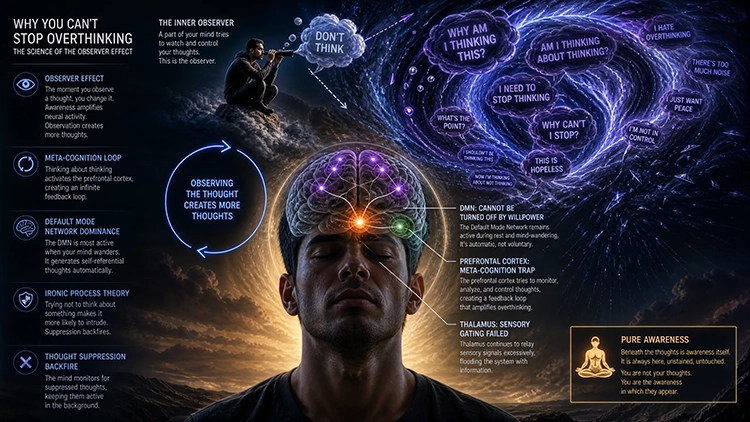
The Observer’s Dilemma: Why Attempting to Fix Your Mind Keeps You Trapped Inside It
Every day, millions of people lie awake at 3:00 AM attempting to solve the equation of their own internal distress. They dissect their anxiety, analyze their grief, or trace the root of a lingering panic attack back to its origin. They operate under a fundamental assumption inherited from three centuries of Western thought: if I can observe my mind clearly enough, I can fix it.
Yet, the harder they look, the worse the condition becomes. A sudden spike in heart rate during an afternoon meeting transforms, through intense scrutiny, into a week-long hyper-vigilance about cardiac health. A passing thought about failure, when inspected, metastasizes into an existential crisis.
The issue is not that your self-observation is flawed or that your coping mechanisms are weak. The issue is that you are attempting an impossibility: observing a system without altering it.
In quantum mechanics, physics uncovered a disturbing truth in the early 20th century—the act of measurement inevitably alters the state of the particle being measured. What few realize is that human psychology suffers from an identical, far more intimate constraint. In the human mind, the observer and the observed are not separate entities. They are the exact same system.
When you observe your internal state with the intention to evaluate, control, or repair it, you do not remain a neutral bystander. You become an active participant that alters the very reality you are trying to understand.
The Illusive Neutrality of Perception
We naturally treat our awareness as a clear glass window overlooking an internal landscape. When anxiety, sorrow, or rage appears, we assume we are simply noticing an objective event that has already occurred within us.
This is the central illusion of human cognition.
[Raw Physiological Event] ──► [Linguistic Conceptualization] ──► [Compounded Psychological Suffering]
(Heart Rate Spike)              ("Anxiety is dangerous")                (Hyper-vigilance & Avoidance)
In physical reality, an event occurs in isolation. A car horn blares; a dog darts onto the asphalt; brakes screech. The immediate biological response—an adrenaline surge, dilated pupils, a sharp contraction in the chest—is a temporary physiological state. It rises, peaks, and naturally dissipates within minutes as the sympathetic nervous system recalibrates.
However, human beings do not inhabit physical reality alone; we inhabit a symbolic world constructed by language.
Consider a woman sitting in the quiet safety of her home weeks after a near-miss traffic accident. No car is present. No immediate physical danger exists. Yet, her heart races, her chest tightens, and a sudden wave of panic floods her system. A single arbitrary trigger—a passing sound, a subtle thought, or even the act of recounting the event to a friend—re-engages the entire threat-response apparatus.
This occurs because language possesses a unique psychological property: arbitrary stimulus relation. Through language, a word, a memory, or an abstract concept can acquire the exact same psychological force as a physical threat.
Cognitive Prediction Debt
The psychological tax paid when the mind utilizes symbolic language to treat internal representations of past or potential threats as present physical realities, forcing the nervous system to react to concepts rather than environment.
When you label an internal state as “anxious,” “unacceptable,” or “broken,” you are not merely describing a pre-existing condition. You are altering its structure. You transform a fluid, temporary physiological sensation into a static, conceptual object—an enemy within your own skin.
The Heisenberg Effect of the Mind
In 1927, physicist Werner Heisenberg formulated his Uncertainty Principle, demonstrating that one cannot simultaneously measure both the exact position and momentum of a subatomic particle. To measure where a particle is, you must hit it with a photon, which inevitably changes how fast it is moving. The observer cannot be extracted from the experiment.
+---------------------------------------------------------------------------------------+
|                               THE OBSERVER'S DILEMMA                                 |
+---------------------------------------------------------------------------------------+
|  PHYSICAL WORLD (Heisenberg)          |  PSYCHOLOGICAL WORLD (Relational Frame)       |
|                                       |                                               |
|  [Photon] ──► Hits Particle           |  [Judgment] ──► Categorizes Emotion           |
|  Result: Alters Velocity/Momentum     |  Result: Transforms Pain into Suffering       |
|                                       |                                               |
|  "The observer alters the particle."  |  "The evaluation alters the state."          |
+---------------------------------------------------------------------------------------+
When applied to human psychology, this principle reveals why standard self-help strategies consistently backfire.
When you notice a sensation of tightness in your chest, your mind does not leave it alone. It fires its own “photons” of evaluation and judgment:
- “Why am I feeling this way again?”
- “I shouldn’t be anxious right now.”
- “I need to calm down immediately.”
The moment you evaluate an emotion as something to be eliminated, your brain’s survival network interprets that evaluation as a new threat. The amygdala does not distinguish between a physical threat in your external environment and a conceptual threat inside your thoughts.
If you decide that anxiety is dangerous, your brain responds logically: it generates more anxiety to fight the perceived danger.
                               ┌──────────────────────────┐
▼                          │
[Initial Sensation] ──► [Negative Evaluation] ──► [Threat Alarm Triggered]
(Tightness in Chest)   ("This state is bad")     (Adrenaline Released)
This creates a self-reinforcing feedback loop. The method you employ to escape psychological pain becomes the primary engine that reproduces it. In the external world, if you fall into a pit, you can climb out. In the internal world, the act of “climbing”—striving, analyzing, resisting—is the very action that digs the pit deeper.
Why External Solutions Fail Internal Problems
The human mind evolved to solve external problems. If our ancestors faced cold weather, they built fires. If they faced predators, they constructed weapons or fled. In the physical world, control works. If you do not like something outside of yourself, you can usually alter, avoid, or destroy it.
Because control is so effective externally, we automatically apply it to our internal world.
| Domain | Mechanism | Strategy | Result |
|---|---|---|---|
| External Reality | Physical Manipulation | Avoid, Remove, Destroy | Problem Solved |
| Internal Reality | Experiential Avoidance | Suppression, Analysis, Distraction | Problem Amplified |
When an unwanted thought or emotion appears, our immediate instinct is to suppress it, argue with it, or run from it. But psychological systems operate under entirely different laws than physical environments:
- Learning is Addition-Only: You cannot “unlearn” a thought or memory. The neural pathways formed by an experience remain. Attempting not to think of a traumatic memory requires your brain to activate the network associated with that memory to verify that you aren’t thinking about it.
- Resistance Creates Prominence: The brain prioritizes information that carries emotional importance. When you tag an internal state as “do not feel this,” you signal to your brain that this state is critically important to survival, ensuring it returns with greater frequency and intensity.
This strategy is known in clinical psychology as Experiential Avoidance. It is the hidden driver behind chronic anxiety, depressive cycles, and behavioral addictions. The goal of avoiding discomfort gradually shrinks a person’s life, until their entire existence revolves around managing internal symptoms rather than engaging with reality.
The Architecture of the Self: Conceptualized vs. Observing
To transcend this paradox, we must make a vital structural distinction within human consciousness: the difference between the Self-as-Content (the Conceptualized Self) and the Self-as-Context (the Observing Self).
+-----------------------------------------------------------------------------------+
|                            THE ARCHITECTURE OF MIND                               |
+-----------------------------------------------------------------------------------+
|  THE CONCEPTUALIZED SELF (Self-as-Content)                                       |
|  • "I am anxious."                                                                |
|  • "I am broken."                                                                 |
|  • Fused with thoughts, history, and evaluations.                                 |
|                                                                                   |
|  ───────────────────────────────────────────────────────────────────────────────  |
|                                                                                   |
|  THE OBSERVING SELF (Self-as-Context)                                             |
|  • "I am observing a sensation of anxiety rising and falling."                    |
|  • The stable arena in which thoughts, feelings, and sensations appear.           |
+-----------------------------------------------------------------------------------+
The Conceptualized Self (Self-as-Content)
This is the story you tell yourself about who you are. It is constructed from memories, beliefs, diagnoses, and judgments: “I am an anxious person,” “I am bad at relationships,” “I am traumatized.”
When you operate entirely from the Conceptualized Self, every thought and emotion is experienced as an absolute truth that requires immediate action. If the thought “I am failing” appears, you don’t experience it as a transient neurological event; you experience it as a literal, terrifying reality.
The Observing Self (Self-as-Context)
This is the locus of awareness itself—the quiet, unchanging space in which thoughts, feelings, and physical sensations appear and disappear.
Think of your consciousness as the sky, and your thoughts, emotions, and sensations as the weather. The Conceptualized Self gets caught up in the storm, trying to push away the rain or alter the direction of the wind. The Observing Self is the sky itself. A violent thunderstorm does not damage the sky; it simply occurs within it. The sky accommodates the storm, knowing it will pass.
Non-Interventionist Awareness
A state of cognitive perspective wherein the individual observes internal events (thoughts, sensations, emotions) without attempting to modify, judge, or escape them, thereby preventing the secondary emotional escalation that transforms pain into suffering.
When you step back into the Observing Self, your relationship to your mind changes fundamentally. You no longer try to fix the observation; you simply change the stance from which you observe.
Cultivating the Unaltering Observer
Transitioning from a reactive controller to a non-interventionist observer is not a passive surrender; it is a profound cognitive shift. It requires practicing radical psychological presence—allowing experience to exist as it is, without demands, conditions, or interference.
1. Differentiate Between Pain and Suffering
Pain is the baseline biological and emotional reality of human existence. You will experience loss, disappointment, fatigue, and fear. It is built into the human hardware.
Suffering, however, is the secondary compound interest you pay when you fight that baseline pain.
Suffering=Pain×Resistance
When resistance drops to zero, pain remains just pain—a finite, tolerable physiological event that moves through the body and exits.
2. Recognize the Symbolic Nature of Thought
A thought is not a fact; it is a linguistic event. It is a rapid firing of neurons producing an internal sentence. When the mind generates the thought, “I can’t handle this,” practice adding psychological distance:
- Fused: “I can’t handle this.”
- Defused: “I am having the thought that I can’t handle this.”
This simple adjustment breaks the automatic link between the internal symbol and your nervous system’s threat response. It prevents the observer from compounding the observed.
3. Shift from “Why?” to “What Is?”
The question “Why am I feeling this way?” is often an invitation to analytical rumination. It sends the mind searching through past memories, failures, and anxieties for explanations, adding fuel to the fire.
Replace it with the non-judgmental stance of “What is here right now?”
Observe the raw physical data without applying linguistic labels:
- “There is a tight sensation in the center of my chest.”
- “There is an elevated pulse.”
- “There is an urge to move or run.”
By holding space for the raw physical experience without labeling it as “bad” or “dangerous,” you allow the physiological cycle to complete itself naturally.
The Quiet Resolution
The ultimate paradox of self-transformation is that genuine change occurs only when you abandon the attempt to force it.
As long as you watch your mind with a hidden agenda—hoping that by observing your anxiety it will finally vanish—you are still operating as an interventionist observer. Your observation is still loaded with judgment, and the mind will continue to react to that judgment.
True peace begins when you drop the tools of control entirely. You step back from the battle, sit on the hillside of your awareness, and watch the weather move through your mind. You do not try to speed up the wind, nor do you try to hold back the rain.
You realize, with quiet clarity, that you are not the storm. You are the space in which the storm has permission to exist.