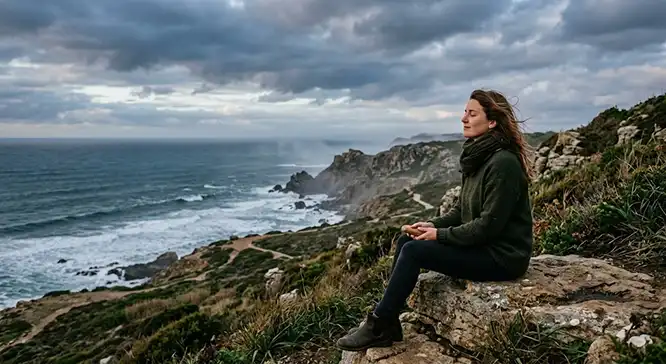
Healing Climate Change’s Wounds with Self-Compassion
Do you worry when temperatures spike above normal? Does the thought of floods and storms make your chest tighten? Do you feel a pang of guilt when you reach for plastic, knowing there might be a better choice? Do you lie awake sometimes, wondering if we’ve already passed the point of no return? Do you find yourself questioning whether it’s responsible to bring children into a world that feels increasingly unstable?
If any of this sounds familiar, you’re not alone. And you’re not broken. You’re having a normal response to an abnormal situation. Your nervous system is doing exactly what it evolved to do: sounding the alarm when it perceives a threat.
The short answer to whether eco-anxiety is real is yes—it’s a documented psychological response to the climate crisis. And the most effective way to manage it isn’t to suppress it, but to face it with compassion. For yourself first, then for the world. Because you can’t pour from an empty cup, and you can’t save a planet you’re too anxious to engage with.
The Weight We’re All Carrying
Every day, we’re bombarded with evidence that things are changing. Not gradually. Rapidly. The fires. The floods. The heat waves. The storms that arrive with force we’ve never seen before. The 200 species that go extinct every single day. The 75 percent of Arctic ice that has melted in just three decades. Half the world’s coral reefs, already gone. Temperature records broken every year, and then broken again.
And somewhere beneath that weight, we’re trying to live normal lives. We’re trying to work. To raise children. To plan for the future. To feel hopeful. To not be consumed by the anxiety that sits just below the surface. To maintain relationships and careers and routines while the ground beneath us feels increasingly unstable.
It’s not easy. It’s not supposed to be easy. And pretending it is doesn’t help anyone. Pretending we’re fine when we’re not just adds another layer of exhaustion.
What Eco-Anxiety Actually Is
The term “eco-anxiety” has gained traction in recent years. In 2018, the United Nations climate panel issued a warning that has shaped how many of us think about the future: without significant changes by 2030, life on earth would become increasingly precarious. That warning landed differently for different people. Some were galvanized. Some were terrified. Some were numb. Some were a mix of all three.
All of those responses are normal. All of them are understandable. All of them make sense given what we’re facing.
Caroline Hickman, from the Climate Psychology Alliance, points out that the reactions we have to the climate crisis are actually the same as clinical anxiety. The feeling of dread. The sense of impending doom. The inability to stop thinking about worst-case scenarios. The physical symptoms—racing heart, shallow breathing, difficulty sleeping, loss of appetite, irritability.
But here’s the distinction that matters: climate anxiety isn’t a disorder. It’s a healthy response to a real threat. It’s your brain recognizing danger and trying to get you to act. The problem isn’t the anxiety itself. It’s what you do with it—or what you don’t do.
A Question to Sit With
What if the anxiety you’re feeling isn’t a sign that you’re broken, but a sign that you’re paying attention? What if it’s your conscience, speaking clearly, telling you that something needs to change? What if the discomfort is actually a gift, showing you where your values lie?
The Three Emotional Responses
The climate crisis triggers a cluster of related emotions. It’s not just one thing. It’s a constellation of feelings that overlap and intensify each other.
Eco-anxiety is the fear. The sense that things are going wrong and might not get better. Eco-guilt is the sense that you could be doing more. That you’re not living up to your own values. That you’re part of the problem. Eco-grief is the mourning for what’s already been lost. The species that are gone forever. The places that will never be the same. The future that our children may not have.
All three are valid. All three are painful. All three are uncomfortable. And all three are pointing toward something useful. They’re not obstacles to action. They’re the fuel for it.
The anxiety says: pay attention. Something important is happening.
The guilt says: you have agency. You can make different choices.
The grief says: you care. This matters to you.
Without these emotions, we wouldn’t act. We wouldn’t change. We wouldn’t try to do better. The discomfort is the engine of transformation. The pain is the signal that something needs to shift.
The Danger of Avoidance
It’s natural to want to avoid pain. When something hurts, we push it away. We distract ourselves. We scroll through social media. We binge-watch shows. We find reasons not to think about it. We tell ourselves it’s not that bad, or that someone else will handle it, or that there’s nothing we can do anyway.
But avoidance doesn’t solve the problem. It just postpones it. And while we’re postponing, the problem gets worse. The anxiety doesn’t disappear. It just goes underground, where it festers and grows. It shows up in other ways—irritability, fatigue, trouble sleeping, difficulty concentrating.
If we want to address climate change, we have to be willing to feel the weight of it. We have to stop looking away. We have to sit with the discomfort long enough to let it move us. We have to let the pain become purpose.
That doesn’t mean drowning in despair. It means allowing the emotions to be present. It means letting them inform our choices. It means using the energy of the anxiety to fuel action instead of using it to fuel paralysis.
What Research Shows About Self-Compassion
There’s a study I keep returning to. It looked at veterans returning from Iraq and Afghanistan. The ones who showed themselves compassion—who were gentle with their own struggles—were less likely to develop PTSD. They adapted more easily. They found their way back into life more smoothly. They were more resilient.
The same principle applies to eco-anxiety.
When you criticize yourself for not doing enough, you add a layer of suffering on top of the original anxiety. You make it worse. You drain the energy you could be using to make a difference. You turn the anxiety into shame, and shame is paralyzing.
When you treat yourself with compassion, something different happens. You create space. You reduce the internal resistance. You free up energy to act. You acknowledge the weight without being crushed by it.
Three Steps to Self-Compassion in Difficult Times
The research on self-compassion points to a simple framework. Three steps that can help when the weight feels unbearable. They’re not complicated. They just take practice.
First, notice what you’re feeling. Not from a distance—actually notice it. The tightness in your chest. The racing thoughts. The sense of dread. The grief. The guilt. Don’t push it away. Don’t minimize it. Don’t judge yourself for feeling it. Just acknowledge it. Just name it. That’s the first step.
Second, remember that you’re not alone. Other people are feeling this too. Other people are carrying the same weight. The anxiety you feel isn’t yours alone. It’s a shared human response to a shared human crisis. That recognition can be a relief. It can take the isolation out of the experience.
Third, be kind to yourself. Talk to yourself the way you would talk to a friend who was struggling. Not with criticism. With warmth. With understanding. With the recognition that you’re doing the best you can. With the acknowledgment that it’s okay to feel overwhelmed. With the reassurance that you’re not failing.
A Few Things I’ve Noticed
I’ve noticed that the people who are most committed to climate action aren’t the ones who are most anxious. They’re the ones who have learned to channel their anxiety into something productive. They’re the ones who have found a way to stay engaged without being consumed. They’re the ones who have learned to hold the weight without being crushed by it.
I’ve also noticed that self-compassion isn’t the same as complacency. You can be kind to yourself and still be committed to change. The kindness makes the commitment sustainable. It’s not either/or. It’s both. The compassion fuels the action instead of draining it.
One Thing Before You Go
The next time you feel the weight of the climate crisis pressing down, pause. Take a breath. Notice what you’re feeling. And then ask yourself: what is one small thing I can do today? Not everything. Not the solution. Just one small, meaningful action.
It might be contacting a representative. It might be choosing a different product. It might be having a conversation with someone. It might be just allowing yourself to feel the grief and not pushing it away. It might be taking care of yourself so you can show up tomorrow.
That’s enough. Not as a solution to the crisis. As a way of staying present. As a way of staying engaged. As a way of keeping the anxiety from turning into paralysis. As a way of honoring your values without being consumed by them.
Let Me Be Honest About Something
I don’t always handle this well. Sometimes the news is too heavy. Sometimes I want to look away. Sometimes I feel so small in the face of such a big problem that I wonder why I even try. Sometimes I just want to stop thinking about it and pretend it’s not happening.
But I’ve learned that the feeling of being small doesn’t mean I’m powerless. It just means I’m part of something larger than myself. And that’s not a reason to give up. It’s a reason to find my role.
What I Keep Coming Back To
If humans caused this problem, then humans can also solve it. That’s not naive optimism. That’s recognizing that the same capacity that created the problem also contains the potential for the solution. We are both the source of the damage and the source of the healing.
The solution won’t come from despair. It won’t come from denial. It won’t come from pretending we’re not afraid. It will come from a different place. From compassion. From connection. From the willingness to feel what we’re feeling and let that feeling move us toward action.
Where This Leaves Me
I don’t know what the future holds. None of us do. The climate crisis is real. The losses are real. The uncertainty is real. The grief is real. The fear is real.
But so is the possibility.
The possibility that we can change. That we can act. That we can find ways to live that don’t destroy the world we depend on. That we can face the truth without being crushed by it. That we can hold the weight together instead of alone.
That possibility starts with how we hold the weight. Not by pushing it away. Not by being consumed by it. But by carrying it with compassion. For ourselves. For each other. For the world we’re trying to protect.
And that’s enough. Not as a guarantee. As a beginning. As a commitment. As a way forward.