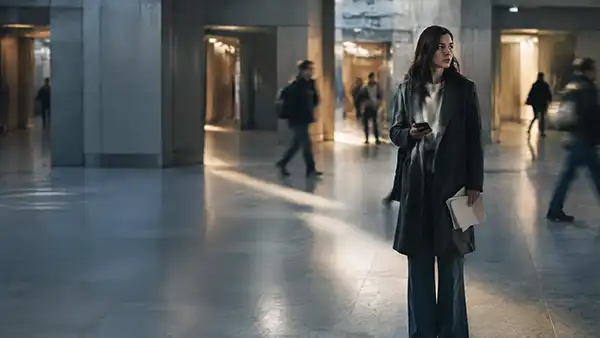
The Choice You Never Made
She voted in every election. She donated to causes. She shared articles and signed petitions. By every measure, she was an engaged citizen. But when her therapist asked her a simple question—”What do you actually want for your life?”—she could not answer. She had opinions about everything except her own existence. She had been so busy choosing between options that others presented that she had never learned to choose for herself.
This is not an unusual story. It is the story of millions of people who have confused compliance with agency. They make decisions all day long—what to wear, what to eat, what to watch—but these are not the decisions that shape a life. The decisions that matter are the ones about who you want to become, what you are willing to sacrifice, what you will no longer tolerate. And most people avoid these decisions entirely.
They avoid them because choosing is frightening. Choosing means committing. Committing means risking failure. And failure, in a culture that worships success, feels like death.
Before we continue, an important note: this article explores choice, agency, and personal growth from a general, educational perspective. It is not a substitute for professional mental health care. If you are experiencing persistent anxiety, depression, or difficulty functioning due to an inability to make decisions or take action, please consult a qualified mental health professional. Only a trained specialist can provide the individualized care you may need.
Why We Pretend We Are Choosing
Most people believe they are making choices. They point to their jobs, their relationships, their daily routines as evidence of agency. But when you look closer, you often find something else. You find habits inherited from parents. You find decisions made by default. You find a life shaped by external expectations rather than internal desire.
Psychologist Barry Schwartz, in his research on the paradox of choice, found that having too many options can lead to paralysis. When people are presented with dozens of alternatives, they often freeze. They do not choose. They wait for someone else to choose for them. And then they complain about the outcome.
This is what I call choice atrophy—the gradual weakening of your decision-making capacity through disuse. Like a muscle that never gets exercised, the ability to make authentic choices diminishes over time. You become dependent on others to set the agenda. You become reactive rather than proactive. You become a passenger in your own life.
The first step to reversing this process is recognizing it. You have to see that you have been avoiding choices, not making them. You have to acknowledge that you have been hiding behind excuses, not exercising agency. And you have to accept that the only person who can change this is you.
The Three Fears That Keep You Stuck
Why do people avoid choosing? The answer is fear. But not the generic fear that people talk about. There are three specific fears that keep people trapped in indecision.
The first is the fear of failure. If you choose something and it does not work out, you have no one to blame but yourself. That is a heavy weight. Many people would rather not choose at all than risk the possibility of being wrong.
The second is the fear of judgment. When you choose something unconventional—a career that does not fit the mold, a relationship that surprises people, a life that does not look like everyone else’s—you open yourself to criticism. You become a target. And for many people, social approval matters more than personal fulfillment.
The third is the fear of the unknown. The future is uncertain. If you choose a path, you cannot know where it will lead. The familiar, even if painful, has the comfort of predictability. The unfamiliar, even if promising, has the terror of uncertainty.
Psychiatrist Viktor Frankl, who survived the concentration camps, observed that “between stimulus and response there is a space. In that space is our power to choose our response.” That space is where freedom lives. But it is also where fear lives. And fear often wins.
When ‘Maybe’ Becomes a Way of Life
There is a particular kind of person who never chooses. They do not say yes, and they do not say no. They say maybe. Maybe is safe. Maybe keeps all options open. Maybe avoids commitment. But maybe is also a choice—it is the choice to let someone else decide. It is the choice to remain in limbo. It is the choice to let life happen to you rather than to happen for you.
This pattern often begins in childhood. Children who grow up in environments where their choices are ignored or punished learn that choosing is dangerous. They learn to wait for instructions. They learn to defer to authority. They learn that their preferences do not matter.
Developmental psychologist Jean Piaget observed that children form their sense of agency through play and exploration. When they are allowed to make choices—even small ones—they develop confidence in their ability to navigate the world. When they are not, they develop what psychologist Martin Seligman called “learned helplessness”—the belief that their actions have no effect on outcomes.
This belief can persist into adulthood. It becomes a lens through which all decisions are viewed. “It doesn’t matter what I want.” “Nothing will change anyway.” “Why bother trying?” These thoughts are not facts. They are the residue of early experiences. But they feel like facts. And they keep people stuck.
The Freedom You Are Afraid Of
There is a strange paradox at the heart of human psychology. We say we want freedom, but when we have it, we often flee from it. We choose constraints. We choose routines. We choose the familiar. Because freedom is terrifying.
Philosopher Jean-Paul Sartre wrote that “man is condemned to be free.” He meant that we cannot escape the responsibility of choice. Even when we do not choose, we are choosing. Even when we say “I have no choice,” we are lying to ourselves. There is always a choice. We simply do not like the alternatives.
This is why awareness is so important. Awareness is the capacity to see the choices you are making—especially the ones you are making without realizing it. It is the ability to notice when you are avoiding a decision. It is the willingness to look at your life and ask, “Is this what I chose, or is this what I settled for?”
Psychologist Rollo May, who wrote extensively about the human struggle for meaning, argued that courage is not the absence of fear but the willingness to act in the face of fear. The same is true of choice. You do not need to feel confident to choose. You only need to be willing to take responsibility for the outcome.
Choosing the Chooser
There is a deeper question that most people never ask. It is not just “What do I want?” It is “Who is the one doing the wanting?” Who is the self that is making the choice?
For most people, the self is a collection of borrowed identities. They are their job title, their relationship status, their social media profile. They are the sum of what others expect them to be. They have never stopped to ask, “Who am I beneath all of this?”
Psychologist Erik Erikson described identity formation as the central task of adolescence. But identity is not formed once and then finished. It is an ongoing process. Every choice you make reinforces or revises your sense of self. Every decision is an opportunity to become more authentically yourself.
When you choose from a place of authenticity, the choice feels different. It feels grounded. It feels right. It may not be popular or safe or conventional. But it is yours. And that is what matters.
A Practice of Small Decisions
If you have been avoiding choices for years, you cannot reverse the pattern overnight. You cannot suddenly become a decisive person. But you can start small. You can practice.
Start with low-stakes decisions. What will you have for breakfast? Not what should you have, but what do you actually want? How will you spend your evening? Not what should you do, but what would feel meaningful? These small decisions build the muscle of choice. They remind you that you have preferences, that you have agency, that you have the capacity to shape your life.
Then move to medium decisions. What will you say yes to? What will you say no to? What boundaries will you set? These are harder because they involve other people. But they are essential.
And eventually, you will be ready for the big decisions. The ones that change the trajectory of your life. The ones that require courage and faith. The ones that define who you are.
If you find yourself unable to make decisions, if you feel paralyzed by even small choices, or if you are experiencing persistent anxiety or depression that interferes with your ability to function, that is a signal. Please reach out to a licensed therapist or counselor. They can help you explore what is holding you back and develop strategies for moving forward. You do not have to figure this out alone.
The Door You Have Not Opened
There is a door in every life that remains closed. It is the door to the life you could have if you were willing to choose it. Most people walk past this door every day. They know it is there. They feel its presence. But they do not open it. They are afraid of what is on the other side.
What is on the other side is not guaranteed happiness. It is not a perfect life. It is simply a different life—one that you chose, rather than one that happened to you. It is a life where you are the author, not the character. It is a life where the decisions are yours, and so are the consequences.
Choice is not just a right. It is a responsibility. You are responsible for the life you are living. Not entirely—circumstances matter, privilege matters, luck matters—but more than you probably believe. You have more agency than you think. You have more power than you feel.
The alternative to choosing is not safety. It is stagnation. It is the slow erosion of self that comes from letting others decide who you will be. It is the quiet desperation of a life unlived.
But the choice is yours. It always has been. And it is never too late to start.