What Fifteen Years of Tutoring Taught Me About Learning
I have been tutoring students for fifteen years. In that time, I have watched hundreds of them sit at my table, open their books, and begin to study. And I have noticed something that took me years to understand: the students who struggle most are almost always the ones working hardest. Not the ones who don’t care. Not the ones who are distracted. The ones who are trying the most, and getting the least in return.
This is not a paradox. It is a pattern. And once you see it, you cannot unsee it.
The student who rereads the same chapter three times, highlighting every line, copying passages into a notebook—that student is not lazy. They are diligent. They are committed. They are doing exactly what they were taught to do. And they are learning almost nothing. The familiarity of the text creates a feeling of understanding. But recognition is not recall. Knowing you have seen something before is not the same as being able to reproduce it.
The research on this is not new. Psychologists have been documenting the difference between passive review and active retrieval for over a century. But the findings have not made it into most classrooms. They have not made it into most study guides. They have not made it into the advice that parents give their children.
So let me tell you what I have seen.
The Highlighting Delusion
There is a student I worked with—a sophomore at a large state university—who came to me after failing her first biology exam. She was devastated. She had studied for two weeks. She had read every chapter. She had highlighted the textbook so thoroughly that almost every page was yellow. She had made flashcards and reviewed them. She had done everything she was supposed to do.
When I asked her to explain the process of cellular respiration, she could not. She could describe the chapter. She could tell me where the information was located. She could recall the diagrams. But she could not reconstruct the concept. The knowledge was there in fragments. It had never been assembled.
This is what I call the familiarity fallacy—the mistaken belief that recognizing information is the same as knowing it. The brain is very good at recognizing things it has seen before. It is much less good at retrieving things it has not actively recalled. Highlighting strengthens recognition. It does almost nothing for retrieval.
The fix is uncomfortable. You have to close the book. You have to try to remember without looking. You have to fail, and then check, and then try again. The discomfort is the point. The struggle to retrieve is what builds the memory.
What I Learned Watching Students Sleep
There is a student I will never forget. He was brilliant—genuinely brilliant—and he was failing. He would come to sessions exhausted. He would tell me he had been up until three in the morning studying. He would tell me he had been up until three every night for weeks. He was proud of it. He thought it was evidence of dedication.
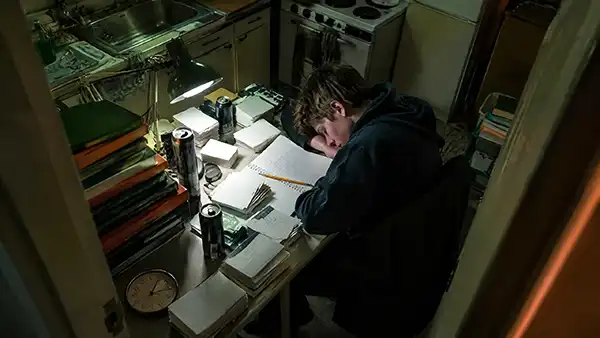
His grades did not improve. They got worse. And then he fell asleep in one of our sessions. I let him sleep. When he woke up, he was embarrassed. I asked him a simple question: what did he remember from the material he had studied the night before? He could not remember anything.
The research on sleep and memory has been clear for decades. Matthew Walker at the University of California, Berkeley, has documented how deep sleep consolidates learning. The brain replays the day’s experiences, transferring information from short-term to long-term storage. Without sleep, the transfer does not happen. The information stays in the hippocampus, fragile and temporary, and eventually fades.
The student was not studying more. He was studying less effectively. He was trading consolidation for exposure. He was pouring water into a cup with a hole in the bottom and then wondering why the cup was empty.
The message is not complicated. Sleep is not the enemy of study. It is part of it. The student who stays up all night to study is not gaining time. They are losing the very mechanism that makes learning permanent.
The Room That Shapes What You Remember
I have worked with students in coffee shops, in libraries, in their dorm rooms, in my office. And I have noticed that the environment matters more than most people think. Not just for focus—for memory itself.
The brain forms associations between places and behaviors. If you study in the same place every time, that place becomes a cue for concentration. If you study in different places—the couch, the bed, the kitchen table, the coffee shop—the brain never fully enters study mode. It is always waiting for something else to happen.
The research on environmental psychology, including the work of Rachel and Stephen Kaplan on attention restoration, has shown that the physical environment affects cognitive performance. Clutter increases cognitive load. Noise disrupts concentration. Poor lighting causes fatigue. Temperature extremes impair focus.
The ideal study environment is not luxurious. It is specific. A dedicated space. Good lighting. Minimal distractions. A comfortable chair and a desk. A temperature between sixty-eight and seventy-five degrees. These are not preferences. They are conditions that support the brain’s ability to concentrate.
I once worked with a student who studied on her bed, lying down, with the television on. She wondered why she could not remember anything. She was not stupid. She was studying in a context that told her brain to relax, to sleep, to do anything but learn. The context was the problem.
Why Test-Taking Is a Study Strategy
There is a moment in every tutoring session when I ask a student to close their book and tell me what they just read. Almost every student resists. They want to keep the book open. They want to check. They want to be sure before they speak.
This resistance is the problem. It is the belief that learning happens by looking, not by retrieving. It is the belief that if you read something enough times, you will remember it. The research says otherwise.
Henry Roediger and Jeffrey Karpicke at Washington University in St. Louis conducted a series of experiments that demonstrated what they called the “testing effect.” Students who read a passage and then took a test on it remembered significantly more a week later than students who read the passage and then reread it. The testing group had less exposure to the material. They had more retention.
The mechanism is not fully understood, but the leading theory is that retrieval strengthens the memory trace. Each time you recall something, you reinforce the neural pathway that stores it. Each time you reread something, you reinforce the feeling of familiarity without reinforcing the memory itself.
The practical application is simple. After reading a chapter, close the book and write down everything you remember. Check your notes against the chapter. Identify what you missed. Repeat the process until you can recall the material accurately. This takes less time than rereading. It produces more learning.
The Compound Effect of Short Sessions
There is a myth that studying requires long, uninterrupted blocks of time. The myth is perpetuated by the image of the dedicated student who spends hours at the library. The reality is different. The brain learns better in short, spaced sessions.
The spacing effect, first documented by Hermann Ebbinghaus in the 1880s and replicated hundreds of times since, shows that information is retained better when study sessions are distributed over time rather than massed together. Cramming may work for a single exam. It does not work for long-term retention.
A study published in Psychological Bulletin by researchers at the University of California, San Diego, analyzed more than three hundred experiments on spacing. The findings were unambiguous. Spaced practice consistently outperformed massed practice, across all ages, all subjects, and all retention intervals.
I have seen this in my own practice. The students who study for thirty minutes a day, six days a week, outperform the students who study for three hours on Sunday. The daily students are not working more. They are working with the grain of their brain instead of against it.
Learning Is Not a Solo Sport
There is a final principle that is often overlooked. Learning is social. The brain is wired for interaction. The most effective learning often happens in conversation, not in isolation.
The research on collaborative learning, including work by John Hattie at the University of Melbourne, has shown that students who discuss material with peers, who explain concepts to others, and who engage in structured group study perform better than those who study alone. The mechanism is not just motivation. It is cognitive. Explaining something to someone else forces you to organize your understanding, to identify gaps, and to articulate connections you might otherwise miss.
I have seen this in my sessions. When I ask a student to teach me a concept, they often discover that they do not understand it as well as they thought. The act of teaching reveals the gaps. The act of explaining forces clarity. The student who can teach something is the student who has truly learned it.
This does not mean that every study session should be a group session. Solitude is necessary for deep reading and reflection. But the balance matters. The student who only studies alone misses the benefits of explanation, debate, and feedback.
The Architecture of Learning
The research on learning has produced a set of principles that are consistent across decades and disciplines. Retrieval beats review. Spacing beats cramming. Sleep consolidates what effort produces. Environment shapes focus. Testing reveals what reading conceals. Social interaction deepens understanding.
None of these principles is intuitive. The strategies that feel effective—rereading, highlighting, cramming—are the strategies that produce the least retention. The strategies that feel difficult—self-testing, spacing, explaining—are the strategies that produce the most.
This is the paradox of learning. The feeling of ease is not the sign of understanding. The feeling of difficulty is not the sign of failure. The student who struggles to retrieve information is learning more than the student who reads smoothly and remembers nothing.
I have been teaching long enough to know that this message is not always welcome. Students want a shortcut. They want a technique that makes learning effortless. The research says that no such technique exists. The brain is not designed for effortless learning. It is designed for effortful learning. The effort is the mechanism.
The student who failed that biology exam is now a doctor. She graduated from medical school two years ago. She told me recently that she still uses the strategies we worked on. She still closes the book. She still tests herself. She still spaces her sessions. She still sleeps.
She also told me something else. She said the biggest change was not the techniques. It was the realization that she was not bad at learning. She was just using the wrong strategies. Once she changed the strategies, the learning took care of itself.
That is what I have learned in fifteen years. The problem is almost never the student. It is the method. And methods, unlike intelligence, can be changed.